

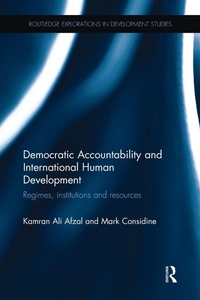
Democratic Accountability and International Human Development
Regimes, institutions and resources
1st Edition
Published on 10. April 2017
Book
Paperback/Softback
278 pages
978-1-138-05721-0 (ISBN)
Description
Scholars and policymakers have long known that there is a strong link between human development and spending on key areas such as education and health. However, many states still neglect these considerations in favour of competing priorities, such as expanding their armies. This book examines how states arrive at these decisions, analysing how democratic accountability influences public spending and impacts on human development.
The book shows how the broader paradigm of democratic accountability - extending beyond political democracy to also include bureaucratic and judicial institutions as well as taxation and other modes of resource mobilisation - can best explain how states allocate public resources for human development. Combining cross-country regression analysis with exemplary case studies from Pakistan, India, Botswana and Argentina, the book demonstrates that enhancing human capabilities requires not only effective party competition and fair elections, but also a particular nesting of public organisational structures that are tied to taxpaying citizens in an undisturbed chain of accountability. It draws out vital lessons for institutional design and our approach to the question of human development, particularly in the less developed states.
This book will be of great interest to postgraduate students and researchers in the fields of political economy, public policy, governance, and development. It also provides valuable insights for those working in the international relations field, including inside major aid and investment organisations.
The book shows how the broader paradigm of democratic accountability - extending beyond political democracy to also include bureaucratic and judicial institutions as well as taxation and other modes of resource mobilisation - can best explain how states allocate public resources for human development. Combining cross-country regression analysis with exemplary case studies from Pakistan, India, Botswana and Argentina, the book demonstrates that enhancing human capabilities requires not only effective party competition and fair elections, but also a particular nesting of public organisational structures that are tied to taxpaying citizens in an undisturbed chain of accountability. It draws out vital lessons for institutional design and our approach to the question of human development, particularly in the less developed states.
This book will be of great interest to postgraduate students and researchers in the fields of political economy, public policy, governance, and development. It also provides valuable insights for those working in the international relations field, including inside major aid and investment organisations.
More details
Series
Language
English
Place of publication
London
United Kingdom
Publishing group
Taylor & Francis Ltd
Target group
College/higher education
Dimensions
Height: 234 mm
Width: 156 mm
Thickness: 15 mm
Weight
430 gr
ISBN-13
978-1-138-05721-0 (9781138057210)
Copyright in bibliographic data and cover images is held by Nielsen Book Services Limited or by the publishers or by their respective licensors: all rights reserved.
Schweitzer Classification
Other editions
Additional editions
Kamran Afzal | Mark Considine
Democratic Accountability and International Human Development
Regimes, institutions and resources
Book
12/2014
1st Edition
Routledge
€246.10
Shipment within 10-20 days
Kamran Afzal | Mark Considine
Democratic Accountability and International Human Development
Regimes, institutions and resources
E-Book
11/2014
1st Edition
Routledge
€61.99
Available for download
Kamran Afzal | Mark Considine
Democratic Accountability and International Human Development
Regimes, institutions and resources
E-Book
11/2014
1st Edition
Routledge
€61.99
Available for download
Persons
Kamran Ali Afzal is a career civil servant in Pakistan and has served on a range of administrative and policymaking positions over the past twenty years. He earned his PhD in political economy from the University of Melbourne, Australia, and his areas of interest include public policy, governance, public finance, and social development.
Mark Considine is Professor of Political Science and Dean of Arts, University of Melbourne, Australia. His research interests include public governance studies, comparative social policy, reform of higher education and public service reform.?
Mark Considine is Professor of Political Science and Dean of Arts, University of Melbourne, Australia. His research interests include public governance studies, comparative social policy, reform of higher education and public service reform.?
Content
1. The Centrality of the Human Development Approach 2. Traversing the Known: Potential Determinants of Public Spending and Performance 3. Democratic Accountability and Public Spending on Human Development: A Theoretical Construction 4. What Really Drives Human Development Spending and Outcomes? 5. Why Governments Differ in Spending on Human Development 6. From Increased Democratic Accountability to Better Human Development Outcomes 7. Pakistan and India: Of Military Ballads and Popular Ballots 8. Botswana: A Miracle of Institutions 9. Argentina: A Tale Told by Taxation 10. Conclusion: Ending a Story to Begin Another