

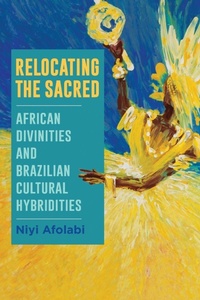
Relocating the Sacred
African Divinities and Brazilian Cultural Hybridities
Published on 2. May 2023
Book
Paperback/Softback
366 pages
978-1-4384-9072-4 (ISBN)
Description
Maps manifestations of the sacred and religious syncretism in Afro-Brazilian cultural forms.
Although Brazil is home to the largest African diaspora, the religions of its African descendants have often been syncretized and submerged, first under the force of colonialism and enslavement and later under the spurious banner of a harmonious national Brazilian character. Relocating the Sacred argues that these religions nevertheless have been preserved and manifested in a strategic corpus of shifting masks and masquerades of Afro-Brazilian identity. Following the re-Africanization process and black consciousness movement of the 1970s to 1990s, Afro-Brazilians have questioned racial democracy, seeing how its claim to harmony actually dispossesses them of political power. By embracing African deities as a source of creative inspiration and resistance, Afro-Brazilians have appropriated syncretism as a means of not only popularizing African culture but also decolonizing themselves from the past shame of slavery. This book maps the role of African heritage in-and relocation of the sacred to-three sites of Brazilian cultural production: ritual altars, literature, and carnival culture.
Although Brazil is home to the largest African diaspora, the religions of its African descendants have often been syncretized and submerged, first under the force of colonialism and enslavement and later under the spurious banner of a harmonious national Brazilian character. Relocating the Sacred argues that these religions nevertheless have been preserved and manifested in a strategic corpus of shifting masks and masquerades of Afro-Brazilian identity. Following the re-Africanization process and black consciousness movement of the 1970s to 1990s, Afro-Brazilians have questioned racial democracy, seeing how its claim to harmony actually dispossesses them of political power. By embracing African deities as a source of creative inspiration and resistance, Afro-Brazilians have appropriated syncretism as a means of not only popularizing African culture but also decolonizing themselves from the past shame of slavery. This book maps the role of African heritage in-and relocation of the sacred to-three sites of Brazilian cultural production: ritual altars, literature, and carnival culture.
Reviews / Votes
"...Relocating the Sacred serves not only those concerned with cultural criticism but also anyone seeking to do transnational religious scholarship across all our political and social disparities." - H-Net Reviews (H-Africa)"Relocating the Sacred is an important contribution to the study of Atlantic spiritualities and religiosities ... Afolabi's book is a terrific study of African divinities in Brazil, but his study also sheds light on the enduring questions of the coloniality and politics of knowledge production about Africa and the looting and repatriation of African cultural objects (especially chapter 2). This book will be useful for students and scholars interested in the religion, history, material culture, literature, and anthropology of Africa and its diaspora." - Research in African Literatures
"...the book provides a thorough scholarly analysis, particularly in terms of literature. It is extensively researched, documented, and annotated ... an excellent work of analytic scholarship." - Hispania
"Afolabi provides a subtle and exciting reading of the cosmology of African traditions in Brazilian cultural productions, showing the complicated ways race and racism operate on an aesthetic level." - Tshombe Miles, author of Race and Afro-Brazilian Agency in Brazil
"Relocating the Sacred makes a valuable contribution to our understanding of the Yoruba diaspora and the transnational vivacity of African traditions. Afolabi brings to English-speaking audiences Afro-lusophone texts and contexts with remarkable translational capacity." - Felipe Fanuel Xavier Rodrigues, Federal University of Roraima, Brazil
More details
Series
Language
English
Place of publication
Albany, NY
United States
Target group
Professional and scholarly
US School Grade: College Graduate Student and over
Product notice
Paperback (trade)
Illustrations
1 Tables, black and white
Dimensions
Height: 229 mm
Width: 152 mm
Thickness: 21 mm
Weight
540 gr
ISBN-13
978-1-4384-9072-4 (9781438490724)
Copyright in bibliographic data and cover images is held by Nielsen Book Services Limited or by the publishers or by their respective licensors: all rights reserved.
Schweitzer Classification
Other editions
Additional editions
E-Book
11/2022
1st Edition
De Gruyter
from
€88.99
Available for download
Person
Niyi Afolabi is Professor of African and African Diaspora Studies at the University of Texas at Austin. He is the author of Identities in Flux: Race, Migration, and Citizenship in Brazil, also published by SUNY Press; Afro-Brazilians: Cultural Production in a Racial Democracy; and Ile Aiye in Brazil and the Reinvention of Africa.
Content
Preface
Introduction
Part I: Mapping the Sacred
1. Bahia: Yoruba Diasporic Domain of Activating the Sacred
2. Pierre Verger and Yoruba Ritual Altars in Brazil
3. Matriarchs of Candomble: Mae Stella de Oxossi, Mae Beata de Yemonja, and Mae Valnizia Bianch
Part II: The Sacred in Literary Manifestations
4. Jorge Amado and Vasconcelos Maia: The Sea/River as Iemoja/Oxum's Domain
5. Abdias Nascimento and Nelson Rodrigues: The Fallen Angel as Betrayal of Blackness
6. Zora Seljan and Alfredo Dias Gomes: Sacred Feminine Solidarities and Sango's Revenge
7. Raul Longo and Robson Pinheiro: Afro-Brazilian Deities in Literary Rituals
8. Cleo Martins and Chynae: Oia and Oxossi in Invocations and Encounters
Part III: Hybridities in Afro-Brazilian Culture
9. Filhos de Gandhi and Cortejo Afro: Candomble in the Carnivalesque Frame
10. Give Us This Day Our Daily Acaraje
Conclusion
Notes
Bibliography
Index
Introduction
Part I: Mapping the Sacred
1. Bahia: Yoruba Diasporic Domain of Activating the Sacred
2. Pierre Verger and Yoruba Ritual Altars in Brazil
3. Matriarchs of Candomble: Mae Stella de Oxossi, Mae Beata de Yemonja, and Mae Valnizia Bianch
Part II: The Sacred in Literary Manifestations
4. Jorge Amado and Vasconcelos Maia: The Sea/River as Iemoja/Oxum's Domain
5. Abdias Nascimento and Nelson Rodrigues: The Fallen Angel as Betrayal of Blackness
6. Zora Seljan and Alfredo Dias Gomes: Sacred Feminine Solidarities and Sango's Revenge
7. Raul Longo and Robson Pinheiro: Afro-Brazilian Deities in Literary Rituals
8. Cleo Martins and Chynae: Oia and Oxossi in Invocations and Encounters
Part III: Hybridities in Afro-Brazilian Culture
9. Filhos de Gandhi and Cortejo Afro: Candomble in the Carnivalesque Frame
10. Give Us This Day Our Daily Acaraje
Conclusion
Notes
Bibliography
Index