

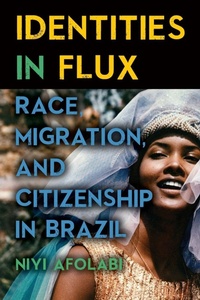
Identities in Flux
Race, Migration, and Citizenship in Brazil
Published on 2. July 2021
Book
Paperback/Softback
296 pages
978-1-4384-8250-7 (ISBN)
Description
Reevaluates the significance of iconic Afro-Brazilian figures, from slavery to post-abolition.
Drawing on historical and cultural approaches to race relations, Identities in Flux examines iconic Afro-Brazilian figures and theorizes how they have been appropriated to either support or contest a utopian vision of multiculturalism. Zumbi dos Palmares, the leader of a runaway slave community in the seventeenth century, is shown not as an anti-Brazilian rebel but as a symbol of Black consciousness and anti-colonial resistance. Xica da Silva, an eighteenth-century mixed-race enslaved woman who "married" her master and has been seen as a licentious mulatta, questions gendered stereotypes of so-called racial democracy. Manuel Querino, whose ethnographic studies have been ignored and virtually unknown for much of the twentieth century, is put on par with more widely known African American trailblazers such as W. E. B. Du Bois. Niyi Afolabi draws out the intermingling influences of Yoruba and Classical Greek mythologies in Brazilian representations of the carnivalesque Black Orpheus, while his analysis of City of God focuses on the growing centrality of the ghetto, or favela, as a theme and producer of culture in the early twenty-first-century Brazilian urban scene. Ultimately, Afolabi argues, the identities of these figures are not fixed, but rather inhabit a fluid terrain of ideological and political struggle, challenging the idealistic notion that racial hybridity has eliminated racial discrimination in Brazil.
Drawing on historical and cultural approaches to race relations, Identities in Flux examines iconic Afro-Brazilian figures and theorizes how they have been appropriated to either support or contest a utopian vision of multiculturalism. Zumbi dos Palmares, the leader of a runaway slave community in the seventeenth century, is shown not as an anti-Brazilian rebel but as a symbol of Black consciousness and anti-colonial resistance. Xica da Silva, an eighteenth-century mixed-race enslaved woman who "married" her master and has been seen as a licentious mulatta, questions gendered stereotypes of so-called racial democracy. Manuel Querino, whose ethnographic studies have been ignored and virtually unknown for much of the twentieth century, is put on par with more widely known African American trailblazers such as W. E. B. Du Bois. Niyi Afolabi draws out the intermingling influences of Yoruba and Classical Greek mythologies in Brazilian representations of the carnivalesque Black Orpheus, while his analysis of City of God focuses on the growing centrality of the ghetto, or favela, as a theme and producer of culture in the early twenty-first-century Brazilian urban scene. Ultimately, Afolabi argues, the identities of these figures are not fixed, but rather inhabit a fluid terrain of ideological and political struggle, challenging the idealistic notion that racial hybridity has eliminated racial discrimination in Brazil.
More details
Series
Language
English
Place of publication
Albany, NY
United States
Target group
Professional and scholarly
US School Grade: College Graduate Student and over
Product notice
Paperback (trade)
Dimensions
Height: 229 mm
Width: 152 mm
Thickness: 18 mm
Weight
487 gr
ISBN-13
978-1-4384-8250-7 (9781438482507)
Copyright in bibliographic data and cover images is held by Nielsen Book Services Limited or by the publishers or by their respective licensors: all rights reserved.
Schweitzer Classification
Other editions
Additional editions
E-Book
02/2021
1st Edition
De Gruyter
from
€84.99
Available for download
Person
Niyi Afolabi is Professor of African and African Diaspora Studies at the University of Texas at Austin. He is the author and editor of many books, including Ile Aiye in Brazil and the Reinvention of Africa and Afro-Brazilians: Cultural Production in a Racial Democracy.
Content
Preface
Acknowledgments
Introduction
1. The Afro-Brazilian Diaspora: From Slavery to Migrating Identities
2. Zumbi dos Palmares: Relocating History, Film, and Print
3. Xica da Silva: Sexualized and Miscegenated Body Politics
4. Manuel Querino: African Contributions to Brazil
5. Jorge Amado's Poetic License: Fictionalizing History
6. Black Orpheus: Regeneration of Greco-Yoruba Mythologies
7. City of God: The Ghettoization of Violence
Conclusion
Notes
Bibliography
Index
Acknowledgments
Introduction
1. The Afro-Brazilian Diaspora: From Slavery to Migrating Identities
2. Zumbi dos Palmares: Relocating History, Film, and Print
3. Xica da Silva: Sexualized and Miscegenated Body Politics
4. Manuel Querino: African Contributions to Brazil
5. Jorge Amado's Poetic License: Fictionalizing History
6. Black Orpheus: Regeneration of Greco-Yoruba Mythologies
7. City of God: The Ghettoization of Violence
Conclusion
Notes
Bibliography
Index