

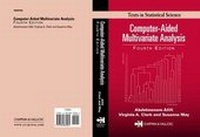
Computer-Aided Multivariate Analysis, Fourth Edition
4th Edition
Published on 29. December 2003
Book
Hardback
512 pages
978-1-58488-308-1 (ISBN)
Description
Computer-Aided Multivariate Analysis, Fourth Edition enables researchers and students with limited mathematical backgrounds to understand the concepts underlying multivariate statistical analysis, perform analysis using statistical packages, and understand the output. New topics include Loess and Poisson regression, nominal and ordinal logistic regression, interpretation of interactions in logistic and survival analysis, and imputation for missing values. This book includes new exercises and references, and updated options in the latest versions of the statistical packages. All data sets and codebooks are available for download.
The authors explain the assumptions made in performing each analysis and test, how to determine if your data meets those assumptions, and what to do if they do not. What to Watch out for sections in each chapter warn of common difficulties. By reading this text, you will know what method to use with your data set, how to get the results, and how to interpret them and explain them to others.
New in the Fourth Edition:
Expanded explanation of checking for goodness of fit in logistic regression and survival analysis
Kaplan-Meier estimates of survival curves, formal tests for comparing survival between groups, interactions and the use of time-dependent covariates in survival analysis
Expanded discussion of how to handle missing values
Latest features of the S-PLUS package in addition to SAS, SPSS, STATA, and STATISTICA for multivariate analysis
Data sets for the problems are available at the CRC web site: http://www.crcpress.com/product/isbn/9781584883081
Commands and output for examples used in the text for each statistical package are available at the UCLA web site: http://www.ats.ucla.edu/stat/examples/cama4/
The authors explain the assumptions made in performing each analysis and test, how to determine if your data meets those assumptions, and what to do if they do not. What to Watch out for sections in each chapter warn of common difficulties. By reading this text, you will know what method to use with your data set, how to get the results, and how to interpret them and explain them to others.
New in the Fourth Edition:
Expanded explanation of checking for goodness of fit in logistic regression and survival analysis
Kaplan-Meier estimates of survival curves, formal tests for comparing survival between groups, interactions and the use of time-dependent covariates in survival analysis
Expanded discussion of how to handle missing values
Latest features of the S-PLUS package in addition to SAS, SPSS, STATA, and STATISTICA for multivariate analysis
Data sets for the problems are available at the CRC web site: http://www.crcpress.com/product/isbn/9781584883081
Commands and output for examples used in the text for each statistical package are available at the UCLA web site: http://www.ats.ucla.edu/stat/examples/cama4/
More details
Series
Edition
4th New edition
Language
English
Place of publication
United States
Publishing group
Taylor & Francis Inc
Target group
College/higher education
Senior undergraduate and graduate level students taking an applied multivariate analysis course, primarily those from biomedical, social science, business, and the physical sciences; researchers and investigators in those fields; statisticians, particularly those working as consultants
Edition type
New edition
Illustrations
70 s/w Tabellen, 75 s/w Abbildungen
342 equations; 70 Tables, black and white; 75 Illustrations, black and white
Dimensions
Height: 235 mm
Width: 156 mm
Weight
839 gr
ISBN-13
978-1-58488-308-1 (9781584883081)
Copyright in bibliographic data and cover images is held by Nielsen Book Services Limited or by the publishers or by their respective licensors: all rights reserved.
Schweitzer Classification
Other editions
New editions
Abdelmonem Afifi | Susanne May | Virginia A. Clark
Practical Multivariate Analysis
Book
07/2011
5th Edition
Chapman & Hall/CRC
€77.98
Article exhausted; check for reprint
Previous edition
A. A. Afifi
Computer-Aided Multivariate Analysis
Book
06/1996
Chapman & Hall/CRC
€85.59
Article exhausted; check for reprint
Persons
Content
Section 1: Preparation for Analysis
WHAT IS MULTIVARIATE ANALYSIS?
Defining multivariate analysis
Examples of multivariate analyses
Multivariate analyses discussed in this book
Organization and content of the book
CHARACTERIZING DATA FOR ANALYSES
Variables: their definition, classification, and use
Defining statistical variables
Stevens's classification of variables
How variables are used in data analysis
Examples of classifying variables
Other characteristics of data
PREPARING FOR DATA ANALYSIS
Processing data so they can be analyzed
Choice of a statistical package
Techniques for data entry
Organizing the data
Example: depression study
DATA SCREENING AND TRANSFORMATIONS
Transformations, assessing normality and independence
Common transformations
Selecting appropriate transformations
Assessing independence
SELECTING APPROPRIATE ANALYSES
Which analyses to perform?
Why selection is often difficult
Appropriate statistical measures
Selecting appropriate multivariate analyses
Section 2: Applied Regression Analysis
SIMPLE REGRESSION AND CORRELATION
Chapter outline
When are regression and correlation used?
Data example
Regression methods: fixed-X case
Regression and correlation: variable-X case
Interpretation: fixed-X case
Interpretation: variable-X case
Other available computer output
Robustness and transformations for regression
Other types of regression
Special applications of regression
Discussion of computer programs
What to watch out for
MULTIPLE REGRESSION AND CORRELATION
Chapter outline
When are regression and correlation used?
Data example
Regression methods: fixed-X case techniques
Regression and correlation: variable-X case techniques
Interpretation: fixed-X case
Interpretation: variable-X case
Regression diagnostics and transformations
Other options in computer programs
Discussion of computer programs
What to watch out for
VARIABLE SELECTION IN REGRESSION 163
Chapter outline
When are variable selection methods used?
Data example
Criteria for variable selection
A general F test
Stepwise regression
Subset regression
Discussion of computer programs
Discussion of strategies
What to watch out for
SPECIAL REGRESSION TOPICS
Chapter outline
Missing values in regression analysis
Dummy variables
Constraints on parameters
Regression analysis with multicollinearity
Ridge regression
Section 3: Multivariate Analysis
CANONICAL CORRELATION ANALYSIS
Chapter outline
When is canonical correlation analysis used?
Data example
Basic concepts of canonical correlation
Other topics in canonical correlation
Discussion of computer program
What to watch out for.
DISCRIMINANT ANALYSIS
Chapter outline
When is discriminant analysis used?
Data example
Basic concepts of classification
Theoretical background
Interpretation
Adjusting the dividing point
How good is the discriminant?
Testing variable contributions
Variable selection
Discussion of computer programs
What to watch out for
LOGISTIC REGRESSION
Chapter outline
When is logistic regression used?
Data example
Basic concepts of logistic regression
Interpretation: Categorical variables
Interpretation: Continuous variables
Interpretation: Interactions
Refining and evaluating logistic regression
Nominal and ordinal logistic regression
Applications of logistic regression
Poisson Regression
Discussion of computer programs
What to watch out for
REGRESSION ANALYSIS WITH SURVIVAL DATA
Chapter outline
When is survival analysis used?
Data examples
Survival functions
Common survival distributions
Comparing survival among groups
The log-linear regression model
Cox regression model
Comparing regression models
Discussion of computer programs
What to watch out for
PRINCIPAL COMPONENTS ANALYSIS
Chapter outline
When is principal components analysis used?
Data example
Basic concepts
Interpretation
Other uses
Discussion of computer programs
What to watch out for
FACTOR ANALYSIS
Chapter outline
When is factor analysis used?
Data example
Basic concepts
Initial extraction: principal components
Initial extraction: iterated components
Factor rotations
Assigning factor scores
Application of factor analysis
Discussion of computer programs
What to watch out for
CLUSTER ANALYSIS
Chapter outline
When is cluster analysis used?
Data example
Basic concepts: initial analysis
Analytical clustering techniques
Cluster analysis for financial data set
Discussion of computer programs
What to watch out for
LOG-LINEAR ANALYSIS
Chapter outline
When is log-linear analysis used?
Data example
Notation and sample considerations
Tests and models for two-way tables
Example of a two-way table
Models for multiway tables
Exploratory model building
Assessing specific models
Sample size issues
The logit model
Discussion of computer programs
What to watch out for
APPENDIX
INDEX
Each chapter also includes Summary, References, and Problems sections.
WHAT IS MULTIVARIATE ANALYSIS?
Defining multivariate analysis
Examples of multivariate analyses
Multivariate analyses discussed in this book
Organization and content of the book
CHARACTERIZING DATA FOR ANALYSES
Variables: their definition, classification, and use
Defining statistical variables
Stevens's classification of variables
How variables are used in data analysis
Examples of classifying variables
Other characteristics of data
PREPARING FOR DATA ANALYSIS
Processing data so they can be analyzed
Choice of a statistical package
Techniques for data entry
Organizing the data
Example: depression study
DATA SCREENING AND TRANSFORMATIONS
Transformations, assessing normality and independence
Common transformations
Selecting appropriate transformations
Assessing independence
SELECTING APPROPRIATE ANALYSES
Which analyses to perform?
Why selection is often difficult
Appropriate statistical measures
Selecting appropriate multivariate analyses
Section 2: Applied Regression Analysis
SIMPLE REGRESSION AND CORRELATION
Chapter outline
When are regression and correlation used?
Data example
Regression methods: fixed-X case
Regression and correlation: variable-X case
Interpretation: fixed-X case
Interpretation: variable-X case
Other available computer output
Robustness and transformations for regression
Other types of regression
Special applications of regression
Discussion of computer programs
What to watch out for
MULTIPLE REGRESSION AND CORRELATION
Chapter outline
When are regression and correlation used?
Data example
Regression methods: fixed-X case techniques
Regression and correlation: variable-X case techniques
Interpretation: fixed-X case
Interpretation: variable-X case
Regression diagnostics and transformations
Other options in computer programs
Discussion of computer programs
What to watch out for
VARIABLE SELECTION IN REGRESSION 163
Chapter outline
When are variable selection methods used?
Data example
Criteria for variable selection
A general F test
Stepwise regression
Subset regression
Discussion of computer programs
Discussion of strategies
What to watch out for
SPECIAL REGRESSION TOPICS
Chapter outline
Missing values in regression analysis
Dummy variables
Constraints on parameters
Regression analysis with multicollinearity
Ridge regression
Section 3: Multivariate Analysis
CANONICAL CORRELATION ANALYSIS
Chapter outline
When is canonical correlation analysis used?
Data example
Basic concepts of canonical correlation
Other topics in canonical correlation
Discussion of computer program
What to watch out for.
DISCRIMINANT ANALYSIS
Chapter outline
When is discriminant analysis used?
Data example
Basic concepts of classification
Theoretical background
Interpretation
Adjusting the dividing point
How good is the discriminant?
Testing variable contributions
Variable selection
Discussion of computer programs
What to watch out for
LOGISTIC REGRESSION
Chapter outline
When is logistic regression used?
Data example
Basic concepts of logistic regression
Interpretation: Categorical variables
Interpretation: Continuous variables
Interpretation: Interactions
Refining and evaluating logistic regression
Nominal and ordinal logistic regression
Applications of logistic regression
Poisson Regression
Discussion of computer programs
What to watch out for
REGRESSION ANALYSIS WITH SURVIVAL DATA
Chapter outline
When is survival analysis used?
Data examples
Survival functions
Common survival distributions
Comparing survival among groups
The log-linear regression model
Cox regression model
Comparing regression models
Discussion of computer programs
What to watch out for
PRINCIPAL COMPONENTS ANALYSIS
Chapter outline
When is principal components analysis used?
Data example
Basic concepts
Interpretation
Other uses
Discussion of computer programs
What to watch out for
FACTOR ANALYSIS
Chapter outline
When is factor analysis used?
Data example
Basic concepts
Initial extraction: principal components
Initial extraction: iterated components
Factor rotations
Assigning factor scores
Application of factor analysis
Discussion of computer programs
What to watch out for
CLUSTER ANALYSIS
Chapter outline
When is cluster analysis used?
Data example
Basic concepts: initial analysis
Analytical clustering techniques
Cluster analysis for financial data set
Discussion of computer programs
What to watch out for
LOG-LINEAR ANALYSIS
Chapter outline
When is log-linear analysis used?
Data example
Notation and sample considerations
Tests and models for two-way tables
Example of a two-way table
Models for multiway tables
Exploratory model building
Assessing specific models
Sample size issues
The logit model
Discussion of computer programs
What to watch out for
APPENDIX
INDEX
Each chapter also includes Summary, References, and Problems sections.