

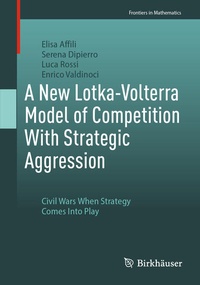
A New Lotka-Volterra Model of Competition With Strategic Aggression
Description
This monograph introduces a new mathematical model in population dynamics that describes two species sharing the same environmental resources in a situation of open hostility. Its main feature is the expansion of the family of Lotka-Volterra systems by introducing a new term that defines aggression. Because the model is flexible, it can be applied to various scenarios in the context of human populations, such as strategy games, competition in the marketplace, and civil wars.
Drawing from a variety of methodologies within dynamical systems, ODEs, and mathematical biology, the authors' approach focuses on the dynamical properties of the system. This is accomplished by detecting and describing all possible equilibria, and analyzing the strategies that may lead to the victory of the aggressive population. Techniques typical of two-dimensional dynamical systems are used, such as asymptotic behaviors regulated by the Poincaré-Bendixson Theorem.
A New Lotka-Volterra Model of Competition With Strategic Aggression will appeal to researchers and students studying population dynamics and dynamical systems, particularly those interested in the cross section between mathematics and ecology.
Reviews / Votes
"A New Lotka--Volterra Model of Competition with Strategic Aggression delivers compelling theoretical advancements in modeling competitive interactions. The book excels in clarity, writing quality, and mathematical depth, making it a valuable resource for students and researchers in applied mathematics, mathematical biology, control theory, and mathematical economics. Its greatest strength lies in the expert authorship, ensuring up-to-date reviews that synthesize techniques from dynamical systems, differential equations, optimization, and control theory." (Rikha Rahim, Ahmad F. Sihombing, Ika W. Palupi and Nona T. Sapulette, SIAM Review, Vol. 67 (4), December, 2025)
"This monograph provides with a self-contained description on a new Lotka-Volterra model, for readers who are interested in the applications of dynamical systems and control theory to biology and social science." (Takashi Suzuki, zbMATH 1562.92002, 2025)
More details
Other editions
Additional editions
Persons
Elisa Affili has been an Associate Professor (Maître de Conférences) at the Laboratoire de Mathématique Raphaël Salem, University of Rouen Normandie, France, since 2023. She earned her PhD through a joint program between Sorbonne Université and the University of Milan in 2021. Following this, she held postdoctoral positions in Bilbao, Spain, and Bologna, Italy. She is also an alumna of the Galilean School of Higher Education in Padua, Italy.
Serena Dipierro is Professor of Mathematics, Australian Research Council Future Fellow, and Fellow of the Australian Mathematical Society. She carried out her academic career in Santiago de Chile, Edinburgh, Magdeburg, Berlin, Melbourne, Milan, and Perth.
She has been the recipient of the Australian Mathematical Society Medal, the Mahony-Neumann-Room Prize, the Bartolozzi Prize, the Christopher Heyde Medal, and the Book Prize of the Unione Matematica Italiana.
Luca Rossi is an Associate Professor at the Department of Mathematics of Sapienza University of Rome. He has been a 1st class CNRS researcher at the Centre d'Analyse et de Mathématique Sociales (CAMS) of the Ecole des Hautes Etudes en Sciences Sociales (EHESS) - Paris, France. In 2016 he was awarded the Prime d'Encadrement Doctoral et de Recherche by the CNRS.
Enrico Valdinoci is Professor of Mathematics and Australian Laureate Fellow.
He carried out his academic career in Pisa, Rome, Milan, Berlin, Melbourne, and Perth.
He is a highly cited researcher and has been awarded the James S. W. Wong Prize, the Mahony-Neumann-Room Prize, the Orazio Arena Prize, the Book Prize of the Unione Matematica Italiana, and the Amerio Gold Medal Prize.
Content
Introduction.- Description of the model.- Description of the main results.- Toolbox.- Basins of attraction.- Parameters dependence.- Strategies of the first population.