

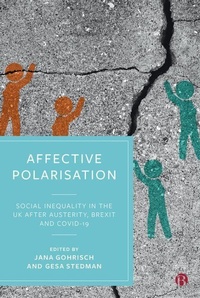
Affective Polarisation
Social Inequality in the UK after Austerity, Brexit and COVID-19
Bristol University Press
1st Edition
Published on 25. September 2023
Book
Hardback
192 pages
978-1-5292-2226-5 (ISBN)
Description
Inequality is an ever-present danger in our society. This important book addresses the crucial nexus between the lived experience of inequality and how it shapes political responses.
With contributors from the UK and Continental Europe, the book compiles case studies with theoretically informed discussions of the relationship between affective polarisation, social inequality and the fall-out from Brexit and COVID-19. Using a broad concept of social inequality, the book incorporates aspects of economy and society, language, and emotion culture, as well as interviews and film in historical and transnational perspectives.
The contributors offer a powerful examination of the ways in which the politics of the UK and the lived experiences of its residents have been reframed in the first decades of the 21st century.
With contributors from the UK and Continental Europe, the book compiles case studies with theoretically informed discussions of the relationship between affective polarisation, social inequality and the fall-out from Brexit and COVID-19. Using a broad concept of social inequality, the book incorporates aspects of economy and society, language, and emotion culture, as well as interviews and film in historical and transnational perspectives.
The contributors offer a powerful examination of the ways in which the politics of the UK and the lived experiences of its residents have been reframed in the first decades of the 21st century.
Reviews / Votes
"This edited book is essential for anyone interested in social, ethnic and gender inequalities in contemporary Britain. It approaches the topic from different disciplines, painting a critical and nuanced picture." Isabelle Hertner, King's College LondonMore details
Edition
First Edition
Language
English
Place of publication
Bristol
United Kingdom
Target group
Professional and scholarly
Product notice
Unsewn / adhesive bound
Cloth over boards
Illustrations
Not illustrated
Dimensions
Height: 234 mm
Width: 156 mm
Thickness: 16 mm
Weight
540 gr
ISBN-13
978-1-5292-2226-5 (9781529222265)
Copyright in bibliographic data and cover images is held by Nielsen Book Services Limited or by the publishers or by their respective licensors: all rights reserved.
Schweitzer Classification
Other editions
Additional editions
Affective Polarisation
Social Inequality in the UK after Austerity, Brexit and COVID-19
E-Book
09/2023
1st Edition
Bristol University Press
€51.99
Available for download
Persons
Jana Gohrisch is Professor of British and Postcolonial Studies at Leibniz University Hannover.
Gesa Stedman is Professor of British Culture and Literature at the Centre for British Studies, Humboldt-Universitaet zu Berlin.
Gesa Stedman is Professor of British Culture and Literature at the Centre for British Studies, Humboldt-Universitaet zu Berlin.
Contributions
Student at the University of York
Humboldt-Universitaet zu Berlin
Birmingham City University
National Poet of Wales (2016-22)
Bielefeld University
Humboldt-Universitaet zu Berlin; Grossbritannien-Zentrum Centre for British Studie
Chair of British Cultures, School of Humanities and Social Sciences, University of Sankt Gallen Visiting Proffesor London School of Economics and Political Science
Middlesex University
The Open University (Scotland)
University of Dundee Business School
Content
Introduction - Gesa Stedman and Jana Gohrisch
1. The Divided Left in the UK: Partisanship, Ideology, and Class After Brexit - Paolo Chiocchetti
2. Populism and the People: Elitism, Authoritarianism and Libertarianism - Kirsten Forkert and Marius Guderjan
3. "Coloring the Utterance With Some Kind of Perceivable Affect." Constructing 'Country' and 'People' in Speeches by Theresa May and Boris Johnson: A Linguistic Perspective - Rainer Schulze
4. The Challenges of Polarisation: Lessons for (Re)politicising Inequality Across Four English Towns - Insa Koch, Mark Fransham, Sarah Cant, Jill Ebrey, Luna Glucksberg, Mike Savage
5. 'Go Away, but Don't Leave Us.' Affective Polarisation and the Precarisation of Romanian Essential Workers in the UK - Anisia Petcu
6. Racialised Affective Polarisation in the UK - Jana Gohrisch
7. "Now You Have To Listen": A Historical Analysis of Britain's Left-Behind Communities - Harvey Butterfield
8. Britain in a State of Emergency - Studying Ken Loach's Films I, Daniel Blake (2016) and Sorry We Missed You (2019) - Ellen Gruenkemeier
9. Cloaking Class - Making the Working Class Visible - Lisa McKenzie
10. Class, Poverty and Inequality in Scotland: Independence and the Creation of Affective Polarisations - Carlo Morelli and Gerry Mooney
11. Language and Identity - the Taliesin Tradition - Ifor Ap Glyn
Conclusion - Gesa Stedman and Jana Gohrisch
1. The Divided Left in the UK: Partisanship, Ideology, and Class After Brexit - Paolo Chiocchetti
2. Populism and the People: Elitism, Authoritarianism and Libertarianism - Kirsten Forkert and Marius Guderjan
3. "Coloring the Utterance With Some Kind of Perceivable Affect." Constructing 'Country' and 'People' in Speeches by Theresa May and Boris Johnson: A Linguistic Perspective - Rainer Schulze
4. The Challenges of Polarisation: Lessons for (Re)politicising Inequality Across Four English Towns - Insa Koch, Mark Fransham, Sarah Cant, Jill Ebrey, Luna Glucksberg, Mike Savage
5. 'Go Away, but Don't Leave Us.' Affective Polarisation and the Precarisation of Romanian Essential Workers in the UK - Anisia Petcu
6. Racialised Affective Polarisation in the UK - Jana Gohrisch
7. "Now You Have To Listen": A Historical Analysis of Britain's Left-Behind Communities - Harvey Butterfield
8. Britain in a State of Emergency - Studying Ken Loach's Films I, Daniel Blake (2016) and Sorry We Missed You (2019) - Ellen Gruenkemeier
9. Cloaking Class - Making the Working Class Visible - Lisa McKenzie
10. Class, Poverty and Inequality in Scotland: Independence and the Creation of Affective Polarisations - Carlo Morelli and Gerry Mooney
11. Language and Identity - the Taliesin Tradition - Ifor Ap Glyn
Conclusion - Gesa Stedman and Jana Gohrisch