

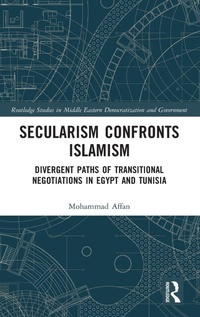
Secularism Confronts Islamism
Divergent Paths of Transitional Negotiations in Egypt and Tunisia
1st Edition
Published on 31. January 2022
Book
Hardback
240 pages
978-1-032-13373-7 (ISBN)
Description
This book provides in-depth examination of the recent confrontation between Islamists and secularists in Egypt and Tunisia. Presenting a new approach to understand Islamism and secularism, the research addresses the variables that could affect the outcome of transitional negotiations.
The secularist-Islamist conflict proved to be a major hindrance for democratisation and a main source of political instability in the Middle East. During the Arab Spring, disputes between both political trends sparked shortly after getting rid of their common enemy: the autocratic rulers. First, they disagreed on how to lead the transitional period. Then, polarisation grew deeper with the political competition in the parliamentary and presidential elections and the ideological disagreements during the drafting of the constitution. Eventually, this conflict put Tunisia at a verge of civil strife in the summer of 2013 and led to collapse of the transitional process in Egypt after the military coup.
Examining the causes of the conflict between the secularists and the Islamists during the transitional period, the work provides new insights from the Arab Spring experience. Updating the transition literature, the book is a key resource to academics and students interested in democratization theory and Middle East politics.
The secularist-Islamist conflict proved to be a major hindrance for democratisation and a main source of political instability in the Middle East. During the Arab Spring, disputes between both political trends sparked shortly after getting rid of their common enemy: the autocratic rulers. First, they disagreed on how to lead the transitional period. Then, polarisation grew deeper with the political competition in the parliamentary and presidential elections and the ideological disagreements during the drafting of the constitution. Eventually, this conflict put Tunisia at a verge of civil strife in the summer of 2013 and led to collapse of the transitional process in Egypt after the military coup.
Examining the causes of the conflict between the secularists and the Islamists during the transitional period, the work provides new insights from the Arab Spring experience. Updating the transition literature, the book is a key resource to academics and students interested in democratization theory and Middle East politics.
More details
Series
Language
English
Place of publication
London
United Kingdom
Publishing group
Taylor & Francis Ltd
Target group
College/higher education
Illustrations
6 s/w Abbildungen, 6 s/w Zeichnungen, 11 s/w Tabellen
11 Tables, black and white; 6 Line drawings, black and white; 6 Illustrations, black and white
Dimensions
Height: 240 mm
Width: 161 mm
Thickness: 18 mm
Weight
549 gr
ISBN-13
978-1-032-13373-7 (9781032133737)
Copyright in bibliographic data and cover images is held by Nielsen Book Services Limited or by the publishers or by their respective licensors: all rights reserved.
Schweitzer Classification
Other editions
Additional editions
Mohammad Affan
Secularism Confronts Islamism
Divergent Paths of Transitional Negotiations in Egypt and Tunisia
Book
09/2023
1st Edition
Routledge
€65.40
Shipment within 10-20 days
Mohammad Affan
Secularism Confronts Islamism
Divergent Paths of Transitional Negotiations in Egypt and Tunisia
E-Book
01/2022
1st Edition
Routledge
€59.49
Available for download
Mohammad Affan
Secularism Confronts Islamism
Divergent Paths of Transitional Negotiations in Egypt and Tunisia
E-Book
01/2022
1st Edition
Routledge
€59.49
Available for download
Person
Mohammad Affan is the director of Al Sharq Strategic Research, an Istanbul-based think tank. A medical doctor by training, he holds a Ph.D. from the Institute of Arab and Islamic Studies, University of Exeter in 2020. He obtained his MA degree in Comparative Politics at the American University of Cairo in 2015. In addition, he holds a post-graduate diploma in Civil Society and Human Rights from Cairo University, a diploma in Political Research and Studies from the Institute of Arab Research and Studies in Cairo, and a diploma in Islamic Studies from The Higher Institute for Islamic Studies, Cairo. His research interests include Islamism and democratisation in MENA region.
Content
Introduction 1. Transitional Negotiations: What Do We Know So far? 2. Secularism and Islamism: A Search for Definitions 3. Contested Transitions 4. Negotiating Shari?ah in Transitional Periods 5. The Challenges of the Established Order 6. The Defining Organisational Settings 7. The Limits of Elites' Abilities 8. Transitional Negotiations: What Can Be learnt From the Arab Spring Experience?