

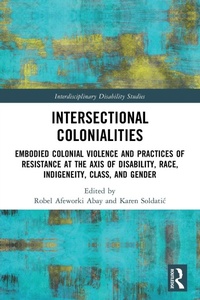
Intersectional Colonialities
Embodied Colonial Violence and Practices of Resistance at the Axis of Disability, Race, Indigeneity, Class, and Gender
1st Edition
Published on 29. August 2025
Book
Paperback/Softback
292 pages
978-1-032-24856-1 (ISBN)
Description
This book provides a rich synthesis of empirical research and theoretical engagements with questions of disability across different practices of colonialism as historically defined - post/de/anti/settler colonialism.
It synthesises, critiques, and expands the boundaries of existing disability research which has been undertaken within different colonial contexts through the rich examination of recent empirical work mapping across disability and its intersectional colonialities. Filling an existing gap within the international literature through embedding the importance of grounding these within scholarly debates of colonialism, it empirically demonstrates the significance of disability for the broader scholarly fields of postcolonial, decolonial, and intersectional theories.
It will be of interest to all scholars and students of disability studies, sociology, critical studies, sociology of race and ethic relations, intersectionality, postcolonial and decolonial studies, and human geography.
It synthesises, critiques, and expands the boundaries of existing disability research which has been undertaken within different colonial contexts through the rich examination of recent empirical work mapping across disability and its intersectional colonialities. Filling an existing gap within the international literature through embedding the importance of grounding these within scholarly debates of colonialism, it empirically demonstrates the significance of disability for the broader scholarly fields of postcolonial, decolonial, and intersectional theories.
It will be of interest to all scholars and students of disability studies, sociology, critical studies, sociology of race and ethic relations, intersectionality, postcolonial and decolonial studies, and human geography.
More details
Series
Language
English
Place of publication
London
United Kingdom
Publishing group
Taylor & Francis Ltd
Target group
College/higher education
Postgraduate
Illustrations
7 s/w Photographien bzw. Rasterbilder, 7 s/w Abbildungen
7 Halftones, black and white; 7 Illustrations, black and white
Dimensions
Height: 234 mm
Width: 156 mm
Thickness: 17 mm
Weight
477 gr
ISBN-13
978-1-032-24856-1 (9781032248561)
Copyright in bibliographic data and cover images is held by Nielsen Book Services Limited or by the publishers or by their respective licensors: all rights reserved.
Schweitzer Classification
Other editions
Additional editions
Robel Afeworki Abay | Karen Soldatic
Intersectional Colonialities
Embodied Colonial Violence and Practices of Resistance at the Axis of Disability, Race, Indigeneity, Class, and Gender
Book
05/2024
1st Edition
Routledge
€189.50
Shipment within 10-20 days
Robel Afeworki Abay | Karen Soldatic
Intersectional Colonialities
Embodied Colonial Violence and Practices of Resistance at the Axis of Disability, Race, Indigeneity, Class, and Gender
E-Book
05/2024
1st Edition
Routledge
€60.49
Available for download
Robel Afeworki Abay | Karen Soldatic
Intersectional Colonialities
Embodied Colonial Violence and Practices of Resistance at the Axis of Disability, Race, Indigeneity, Class, and Gender
E-Book
05/2024
1st Edition
Routledge
€60.49
Available for download
Persons
Robel Afeworki Abay is a sociologist and a guest professor of participatory approaches in social and health sciences at Alice Salomon University of Applied Sciences Berlin.
Karen Soldatic is a Canadian excellence research chair, Health Equity and Community Wellbeing, Toronto Metropolitan University and Whitlam Fellow at Western Sydney University.
Karen Soldatic is a Canadian excellence research chair, Health Equity and Community Wellbeing, Toronto Metropolitan University and Whitlam Fellow at Western Sydney University.
Content
0.The relevance of analysing embodied violence and practices of resistance, contestation, and mobilisation at the axis of disability, race, indigeneity, class, and gender. 1.Decolonising disability studies: Conceptualising disability justice from an African community ideal. 2.Racialized and Gendered Ableism: The Epistemic Erasure and Epistemic Labour of Disability in Transnational Contexts. 3.Trans-Latinidades, disability and decoloniality: Diasporic and Global South LatDisCrit lessons from Central America. 4.Degeneracy & Replacement: Reproducing white settler anxieties in the 21st century. 5.Disabled Romani people in Germany: Learning from the notion of indigeneity in disability studies outside of Settler-Colonial states. 6.Africa and the epistemic normativity of disability. 7.Impossible working lives and disabled bodies during racialised capitalism: Perspectives from Germany and the UK. 8.Stigma as a structure of disablement: Towards collective postcolonial justice. 9.Coloniality, disability, and the family in Kurdistan-Iraq. 10.Raising children with autism in a patriarchal society of a new liberal state: Experiences of mothers of autistic children in Bangladesh. 11.Disability discourse and Muslim student organisations in Malang, Indonesia. 12.Migration studies and disability studies: Colonial engagements past, present and future. 13.Colonial and ableist constructions of 'vulnerability' shaping the lives of disabled asylum seekers and refugees in the UK and Germany. 14.Towards a decolonial approach to disability as knowledge and praxis: Unsettling the 'colonial' and re-imagining research as spaces of struggles. 15.Reflecting on the How Questions: Using intersectional methods for policy changes. 16.Cultural humility in participatory research: Debunking the myth of 'hard-to-reach' groups.