

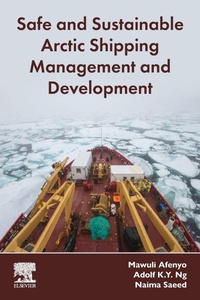
Safe and Sustainable Arctic Shipping Management and Development
Published on 18. April 2024
Book
Paperback/Softback
205 pages
978-0-443-18849-7 (ISBN)
Description
Safe and Sustainable Arctic Shipping Management and Development presents insight into the Arctic and shipping and natural resource exploration in the region. The book discusses the challenges in harnessing the Arctic's potential, and making it sustainable and productive. It enables both researchers and practitioners to apply the theoretical knowledge obtained in the field to solve challenging issues. The book focuses on the management and development of Arctic shipping, including the use of shipping for natural resource exploration and the socio-economic implications of shipping activities. Sections cover the geography, planning, environmental, economics, management, policy, regulations, and governance.
The book also closely integrates the implications of Arctic activities with indigenous ways of life. It is divided into four major sections, namely Theoretical Settings, Economic Opportunities and Risks, Operational Challenges, and Environmental and Social Implications. This book is a quality companion to any researchers, policymakers, and industrial practitioners involved in transport and environmental planning and management as a solid platform for further research, planning, and development of appropriate policies and practices.
The book also closely integrates the implications of Arctic activities with indigenous ways of life. It is divided into four major sections, namely Theoretical Settings, Economic Opportunities and Risks, Operational Challenges, and Environmental and Social Implications. This book is a quality companion to any researchers, policymakers, and industrial practitioners involved in transport and environmental planning and management as a solid platform for further research, planning, and development of appropriate policies and practices.
More details
Language
English
Place of publication
Philadelphia
United States
Target group
Professional and scholarly
Dimensions
Height: 152 mm
Width: 228 mm
Thickness: 12 mm
Weight
338 gr
ISBN-13
978-0-443-18849-7 (9780443188497)
Copyright in bibliographic data and cover images is held by Nielsen Book Services Limited or by the publishers or by their respective licensors: all rights reserved.
Schweitzer Classification
Other editions
Additional editions
Mawuli Afenyo | Adolf K. Y. Ng | Naima Saeed
Safe and Sustainable Arctic Shipping Management and Development
E-Book
04/2024
Elsevier
€109.00
Available for download
Persons
Mawuli Afenyo is currently Assistant Professor at Texas A&M University, US. He previously worked at the Memorial University of Newfoundland and the Asper School of Business of the University of Manitoba and Transport Institute, Canada, as well as in Italy and Ghana. He obtained his PhD from the Memorial University of Newfoundland, Canada and focused on developing tools for improving the safety of shipping in Arctic regions for which he won the outstanding award for graduate research. Further, he co-founded CCAPPTIA, a non-profit consulting and research organization with more than 60 researchers, policymakers, and practitioners. He won the KLU- young researcher award for his work on "A method for assessing the socio-economic impact of oil spills generated by Arctic shipping.? Dr. Afenyo is also co-editor of the Maritime Economist. He has also organized conferences, e.g. 1st and 2nd Climate Change Adaptation for Transportation Infrastructure for Ports and the Arctic Conference. Adolf K.Y. Ng is a Professor at the Division of Business and Management of the Beijing Normal University-Hong Kong Baptist University United International College (UIC), China. He obtained his Ph.D. from University of Oxford, UK. His research interests include maritime transport and logistics, climate change adaptation and resilience, Arctic shipping and development, and logistics education. He is the associate editor of Maritime Policy & Management and the Asian Journal of Shipping and Logistics and is highly successful in securing competitive research grants, with nearly 30 funded projects. He frequently serves in major grant panels, such as the Social Science and Humanities Research Council of Canada (SSHRC) and Research Manitoba. He co-founded of CCAPPTIA, a non-profit consulting and research organization with more than 60 researchers, policymakers, and practitioners. Naima Saeed is a Professor in Supply Chain Management at the School of Business and Law at the University of Agder, Norway. Saeed was an honorary visiting fellow at La Trobe Business School, Melbourne, Australia, and a visiting scholar at the School of Business IT and Logistics, RMIT, Melbourne, Australia; University of California, Berkeley, United States; Tokyo University of Science, Tokyo, Japan; and Nelson Mandela University Business School, South Africa. She has a PhD in Logistics from Molde University College, Norway. Saeed has published in journals such as the European Journal of Operational Research, Computers in Industry, Transportation Science, Maritime Economics & Logistics, and Maritime Policy & Management. Before joining the University of Agder, Saeed worked as an Associate Professor in Logistics at Molde University College. She has also worked as a consultant in a project financed by the VRI program of The Research Council of Norway.
Content
SECTION A: THEORETICAL SETTINGS
1. Setting the Scene
2. Arctic shipping development and management: A holistic view
3. Arctic policies, governance, and cooperation: A catalyst for the development and management of the Arctic
SECTION B: ECONOMIC OPPORTUNITIES AND RISKS
4. Potential consequences of Arctic shipping and resource exploitation
5. Operational risks of Arctic shipping
PART C: OPERATIONAL CHALLENGES OF ARCTIC SHIPPING
6. Arctic oil spills: Should we be worried?
7. Arctic shipping insurance
8. Evaluation of Arctic resources exploration, management, and supply chains
PART D: ENVIRONMENTAL AND SOCIAL IMPACTS OF ARCTIC SHIPPING
9. Environmental and Socio-economic implications of Arctic development
10. Indigenous knowledge and culture: How important are it for Arctic development and management?
11. The stories of frontline workers in the Northwest Passage
1. Setting the Scene
2. Arctic shipping development and management: A holistic view
3. Arctic policies, governance, and cooperation: A catalyst for the development and management of the Arctic
SECTION B: ECONOMIC OPPORTUNITIES AND RISKS
4. Potential consequences of Arctic shipping and resource exploitation
5. Operational risks of Arctic shipping
PART C: OPERATIONAL CHALLENGES OF ARCTIC SHIPPING
6. Arctic oil spills: Should we be worried?
7. Arctic shipping insurance
8. Evaluation of Arctic resources exploration, management, and supply chains
PART D: ENVIRONMENTAL AND SOCIAL IMPACTS OF ARCTIC SHIPPING
9. Environmental and Socio-economic implications of Arctic development
10. Indigenous knowledge and culture: How important are it for Arctic development and management?
11. The stories of frontline workers in the Northwest Passage