

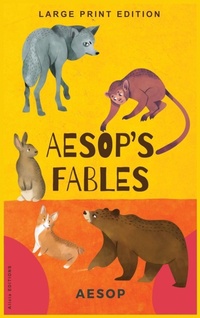
Aesop's Fables
Classic Moral Stories and Timeless Life Lessons for All Ages-Large Print Edition
Published on 4. June 2020
Book
Hardback
350 pages
978-2-35728-475-3 (ISBN)
Description
"Slow but steady wins the race."
For at least 2500 years, Aesop's fables have been teaching people of all ages and every social status lessons how to choose correct actions and the likely consequences of choosing incorrect actions.
Most of the characters in his stories are animals, some of which take on human characteristic and are personified in ways of speech and emotions. Each fable has an accompanying moral to be learned from the tale like Self-help is the best help, Persuasion is better than Force, Misfortune tests the sincerity of friends...
This collection presents nearly 310 of Aesop's most entertaining and short stories, from 'The Hare and the Tortoise' and 'The Ass and the Grasshopper' to 'The Crow and the Fox' and 'The Eagle and the Fox'.
Large print edition.
More details
Edition
Large type / large print edition
Language
English
Place of publication
France
Target group
Children/juvenile
US School Grade: Preschool, Interest Age: From 6 to 8 years
Edition type
Large type / large print edition
Product notice
sewn/stitched
Cloth over boards
Dimensions
Height: 235 mm
Width: 157 mm
Thickness: 25 mm
Weight
719 gr
ISBN-13
978-2-35728-475-3 (9782357284753)
Copyright in bibliographic data and cover images is held by Nielsen Book Services Limited or by the publishers or by their respective licensors: all rights reserved.
Schweitzer Classification
Persons
Aesop, or Æsop (from the Greek ¿¿¿¿¿¿¿ Aisopos), known only for his fables, was by tradition a slave of African descent who lived from about 620 to 560 bc in Ancient Greece. Aesop's Fables are still taught as moral lessons and used as subjects for various entertainments, especially children's plays and cartoons. Aesop wrote thousands of fables, his most famous fable is "The Lion and the Mouse."
Nothing was known about Aesop from credible records. The tradition was that he was at one point freed from slavery and that he eventually died at the hands of Delphians. In fact, the obscurity shrouding his life has led some scholars to deny his existence altogether.
His most famous fable in America is a parable of "The Tortoise and the Hare." In this story, a rabbit challenges a tortoise to a race. The rabbit is sure of its victory and as a result, depending on the version of the story, in some way completes the race slower than the turtle. Often, the hare takes a nap or takes too many breaks. The persistent tortoise, despite being slower, wins because it persevered.