

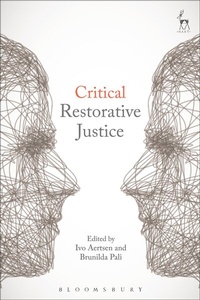
Critical Restorative Justice
Published on 16. November 2017
Book
Hardback
352 pages
978-1-5099-0664-2 (ISBN)
Description
Theories and practices of justice do not meet the socio-political challenges of our times. For those theorists attempting to develop an alternative to the criminal justice system, restorative justice has provided an alternative horizon. The restorative justice approach involves meeting people, understanding and recognising their vulnerability through participatory and deliberative forums and practices. The aim of this collection is to bridge the distance between restorative justice and the critical theory tradition. It, on the one hand, takes into account the limits of restorative justice as they have been articulated, or can be articulated through critical social theory, and on the other hand emphasises the ground-breaking potential that restorative justice can bring to this tradition as a way to address crimes, conflicts and injustices, and to pursue justice.
More details
Language
English
Place of publication
Oxford
United Kingdom
Publishing group
Bloomsbury Publishing PLC
Target group
College/higher education
Professional and scholarly
Product notice
Hardback (stationery)
Dimensions
Height: 234 mm
Width: 156 mm
Weight
671 gr
ISBN-13
978-1-5099-0664-2 (9781509906642)
Copyright in bibliographic data and cover images is held by Nielsen Book Services Limited or by the publishers or by their respective licensors: all rights reserved.
Schweitzer Classification
Other editions
Additional editions
Ivo Aertsen | Brunilda Pali
Critical Restorative Justice
E-Book
11/2017
1st Edition
Hart Publishing
€46.49
Available for download
Persons
Ivo Aertsen is Professor of Criminology at the University of Leuven.
Brunilda Pali is Researcher at the Leuven Institute of Criminology at the University of Leuven.
Brunilda Pali is Researcher at the Leuven Institute of Criminology at the University of Leuven.
Content
Introduction: Restorative Justice and Critical Social Theory
Brunilda Pali and Ivo Aertsen
Part I: Bridging the Theoretical Gap and Sharpening the Critical Edge
1. Is a Critical Model of Restorative Justice Possible? A Penal Abolitionist Approach
Daniel Achutti
2. Deconstructing Empowerment in Restorative Justice
Daniela Bolivar
3. Restorative Justice and the Decision-making Process: Beyond Deliberative Democracy?
Raffaella da Porciuncula Pallamolla
4. Doing Restorative Justice 'Otherwise': Decolonising Practices in the Global South
Harry Blagg
5. Outlining a Historical and Critical Ontology of Restorative Justice
Giuseppe Maglione
6. Restorative Justice is Not a Panacea Against All Social Evils
Lode Walgrave
7. Restorative Justice, Procedural Justice and Care
Josep Tamarit Sumalla
Part II: Applying Analytical Tools and Frameworks to Research and Practice
8. Restorative Justice and Democratic Citizenship: A New Social Pedagogy or Back to 'Social Defence'?
Leo Van Garsse
9. Old Goffman as a New Research Strategy in Restorative Justice
Ida Helene Asmussen
10. Lifeworld, Law and Justice
Katrin Kremmel and Christa Pelikan
11. 'Cultural' Problematisations in the Restorative Justice Discourse
Brunilda Pali
12. To Talk or Not to Talk? The Limits and Potential of Restorative Justice in Addressing Social Inequalities
Borbala Fellegi, Gabor Hera and Gabriella Benedek
13. Digital Stories and Restorative Justice in Brussels
Erik Claes, Iman Lechkar, Minne Huysmans and Nele Gulinck
Part III: Philosophical Explorations for Restorative Justice
14. Restorative Justice and the Potential of 'Exemplarity': In Search of a 'Persuasive' Coherence Within Criminal Justice
Claudia Mazzucato
15. The Broken Tablets of Moses and the Exodus from (Post-) Modernity: On Rethinking the Role and the
Rule of Law in a Dialogical Way
Federico Reggio
16. Control Society, Sovereign Victim Culture and Restorative Justice
Ronnie Lippens
17. Promised Communities and Unrestored Justice
George Pavlich
18. A Radical in Disguise: Judith Shklar's Victimology and Restorative Justice
Antony Pemberton and Pauline GM Aarten
Brunilda Pali and Ivo Aertsen
Part I: Bridging the Theoretical Gap and Sharpening the Critical Edge
1. Is a Critical Model of Restorative Justice Possible? A Penal Abolitionist Approach
Daniel Achutti
2. Deconstructing Empowerment in Restorative Justice
Daniela Bolivar
3. Restorative Justice and the Decision-making Process: Beyond Deliberative Democracy?
Raffaella da Porciuncula Pallamolla
4. Doing Restorative Justice 'Otherwise': Decolonising Practices in the Global South
Harry Blagg
5. Outlining a Historical and Critical Ontology of Restorative Justice
Giuseppe Maglione
6. Restorative Justice is Not a Panacea Against All Social Evils
Lode Walgrave
7. Restorative Justice, Procedural Justice and Care
Josep Tamarit Sumalla
Part II: Applying Analytical Tools and Frameworks to Research and Practice
8. Restorative Justice and Democratic Citizenship: A New Social Pedagogy or Back to 'Social Defence'?
Leo Van Garsse
9. Old Goffman as a New Research Strategy in Restorative Justice
Ida Helene Asmussen
10. Lifeworld, Law and Justice
Katrin Kremmel and Christa Pelikan
11. 'Cultural' Problematisations in the Restorative Justice Discourse
Brunilda Pali
12. To Talk or Not to Talk? The Limits and Potential of Restorative Justice in Addressing Social Inequalities
Borbala Fellegi, Gabor Hera and Gabriella Benedek
13. Digital Stories and Restorative Justice in Brussels
Erik Claes, Iman Lechkar, Minne Huysmans and Nele Gulinck
Part III: Philosophical Explorations for Restorative Justice
14. Restorative Justice and the Potential of 'Exemplarity': In Search of a 'Persuasive' Coherence Within Criminal Justice
Claudia Mazzucato
15. The Broken Tablets of Moses and the Exodus from (Post-) Modernity: On Rethinking the Role and the
Rule of Law in a Dialogical Way
Federico Reggio
16. Control Society, Sovereign Victim Culture and Restorative Justice
Ronnie Lippens
17. Promised Communities and Unrestored Justice
George Pavlich
18. A Radical in Disguise: Judith Shklar's Victimology and Restorative Justice
Antony Pemberton and Pauline GM Aarten