

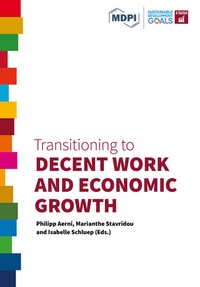
Transitioning to Decent Work and Economic Growth
1st Edition
Published on 6. August 2021
Book
Hardback
254 pages
978-3-03897-778-0 (ISBN)
Description
According to the United Nations Development Program (UNDP) and the United Nations Conference on Trade and Development (UNCTAD), the private sector plays a key role in achieving the UN Sustainable Development Goals (SDGs). After all, sustainable and inclusive economic growth is essential to enable more people to participate in global prosperity. Encouraging entrepreneurship and job creation are key to SDG 8, as are effective measures to eradicate forced labour, slavery, and human trafficking. Since more than 90 percent of jobs are created by the private sector, more attention must be paid to entrepreneurs that help create dynamic and responsible enterprises that often generate positive externalities for society and the environment through investments in scalable innovations and a commitment to local embeddedness. As such, they help lift people out of poverty through new and relatively well-paid jobs and enable local economies to become more sustainable through global value chain integration.
Transitioning to Decent Work and Economic Growth explores the prospects for SDG 8 in the Global South as well as the Global North. It especially considers the positive role the private sector may play as an enabler of human rights, creator of decent work, and engine for inclusive development in different contexts. Further, it examines how the institutional environment can facilitate economic change, which may lead to social empowerment and enhanced economic opportunities. A key question the volume explores is how-in an entrepreneurial context-innovation and scientific knowledge contribute to the creation of scalable innovation that help to de-couple economic growth from the use of natural resources.
Transitioning to Decent Work and Economic Growth is part of MDPI's Open Access book series, Transitioning to Sustainability, which aims to add to the conversation about regional and global sustainable development according to the 17 SDGs.
More details
Language
English
Place of publication
Basel
Switzerland
Target group
College/higher education
Professional and scholarly
Professional/Scholar
Edition type
New edition
Product notice
sewn/stitched
Cloth over boards
Illustrations
26
Dimensions
Height: 250 mm
Width: 175 mm
Thickness: 21 mm
Weight
830 gr
ISBN-13
978-3-03897-778-0 (9783038977780)
DOI
10.3390/books978-3-03897-779-7
Schweitzer Classification
Persons
Editor
Philipp Aerni is Director of the Center for Corporate Responsibility and Sustainability (CCRS) at the University of Zurich. He is an interdisciplinary social scientist with a Master's Degree in Geography and a PhD in Agricultural Economics. During his postdoctoral research in public policy, he focused on the role of science, technology, and innovation for sustainable development, with a particular interest in the institutional framework conditions that enable effective public-private partnerships to become drivers of sustainable change. Prior to his position at CCRS, Dr. Aerni worked at Harvard University, ETH Zurich, and the University of Berne, as well as the Food and Agriculture Organisation of the United Nations (FAO). He currently teaches at ETH Zurich, the University of Zurich and the University of Basel. His team at CCRS closely works with partners in academia, government, civil society and business in Switzerland and abroad on practice-oriented and interdisciplinary research projects related to sustainable change in business and society.
Marianthe Stavridou is Head of Business Ethics at CCRS. She studied Linguistics and History at the University of Bern (Switzerland), Sociology and Law in Milan and Rome (Italy) and Corporate Communications and Sustainable Finance at the University of Zurich (Switzerland). Prior to CCRS, she worked in different institutes, think tanks and the private sector. Her research interests include social resilience, migration, entrepreneurship, inclusive growth, SMEs, the SDGs, and business ethics.
Isabelle Schluep is head of the sustainable impact research group at the Center for Corporate Responsibility and Sustainability (CCRS) at the University of Zurich. Her areas of expertise include international trade, public policy, development, food and agriculture. Isabelle conducts interdisciplinary research and develops tools together with industry partners to measure the sustainability performance of companies.