

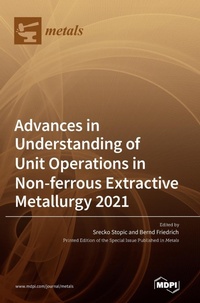
Advances in Understanding of Unit Operations in Non-ferrous Extractive Metallurgy 2021
MDPI AG (Publisher)
Published on 6. July 2022
Book
Hardback
266 pages
978-3-0365-4573-8 (ISBN)
Description
Unit metallurgical operations processes are usually separated into three categories: 1) hydrometallurgy (leaching, mixing, neutralization, precipitation, cementation, and crystallization); 2) pyrometallurgy (roasting and smelting); and 3) electrometallurgy (aqueous electrolysis and molten salt electrolysis). In hydrometallurgy, the aimed metal is first transferred from ores and concentrates to a solution using a selective dissolution (leaching or dry digestion) under an atmospheric pressure below 100 °C and under a high pressure (40-50 bar) and high temperature (below 270°C) in an autoclave. The purification of the obtained solution was performed using neutralization agents such as sodium hydroxide and calcium carbonate or more selective precipitation agents such as sodium carbonate and oxalic acid. The separation of metals is possible using a liquid/liquid process (solvent extraction in mixer-settler) and solid-liquid (filtration in filter-press under high pressure). Crystallization is the process by which a metallic compound is converted from a liquid into a solid crystalline state via a supersaturated solution. The final step is metal production using electrochemical methods (aqueous electrolysis for basic metals such as copper, zinc, silver, and molten salt electrolysis for rare earth elements and aluminum). Advanced processes, such as ultrasonic spray pyrolysis and microwave-assisted leaching, can be combined with reduction processes in order to produce metallic powders.
More details
Language
English
Product notice
sewn/stitched
Cloth over boards
Dimensions
Height: 250 mm
Width: 175 mm
Thickness: 22 mm
Weight
865 gr
ISBN-13
978-3-0365-4573-8 (9783036545738)
Copyright in bibliographic data and cover images is held by Nielsen Book Services Limited or by the publishers or by their respective licensors: all rights reserved.
Schweitzer Classification