

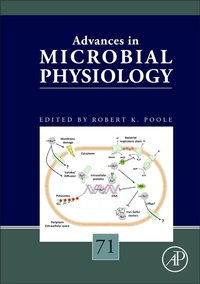
Advances in Microbial Physiology: Volume 71
Academic Press
Published on 29. July 2017
Book
Hardback
266 pages
978-0-12-812385-0 (ISBN)
Description
Advances in Microbial Physiology, Volume 71, continues the long tradition of topical, important, cutting-edge reviews in microbiology. The book contains updates in the field, with comprehensive chapters covering The Microbiology of Ruthenium Complexes, The role of plant growth-promoting bacteria in metal phytoremediation, the Mechanism and Role of Globin Coupled Sensor Signaling, Cytochrome bd and gaseous ligands in bacterial physiology, and Haem-Based Sensors of O2: Lessons and Perspectives.
More details
Series
Language
English
Place of publication
San Diego
United States
Publishing group
Elsevier Science Publishing Co Inc
Target group
Professional and scholarly
Microbiologists, biochemists, biotechnologists, and those interested in physiology, microbial biochemistry and its applications.
Dimensions
Height: 229 mm
Width: 152 mm
Weight
550 gr
ISBN-13
978-0-12-812385-0 (9780128123850)
Copyright in bibliographic data and cover images is held by Nielsen Book Services Limited or by the publishers or by their respective licensors: all rights reserved.
Schweitzer Classification
Other editions
Additional editions
Person
Professor Robert K Poole is Emeritus Professor of Microbiology at the University of Sheffield, UK. He was previously West Riding Professor of Microbiology at Sheffield and until 1996 held a Personal Chair in Microbiology at King's College London. During his long career, he has been awarded several research Fellowships, and taken sabbatical leave at the Australian National University, Kyoto University and Cornell University. His career-long interests have been in the areas of bacterial respiratory metabolism, metal-microbe interactions and bioactive small gas molecules. In particular, he has made notable contributions to bacterial terminal oxidases and resistance to nitric oxide with implications for bacterial pathogenesis. He co-discovered the flavohaemoglobin Hmp, now recognised as the preeminent mechanism of nitric oxide resistance in bacteria. He has served as Chairman of numerous research council grant committees, held research grants for over 40 years and published extensively (h-index, 2024 = 70). He served on several Institute review panels in the UK and overseas. He is a Fellow of the Royal Society of Chemistry and the Royal Society of Biology.
Content
1. The Microbiology of Ruthenium Complexes
Hannah M. Southam, Jonathan A. Butler, Jonathan A. Chapman and Robert K. Poole
2. The Role of Plant Growth-Promoting Bacteria in Metal Phytoremediation
Zhaoyu Kong and Bernard R. Glick
3. Mechanism and Role of Globin-Coupled Sensor Signalling
Johnnie A. Walker, Shannon Rivera and Emily E. Weinert
4. Cytochrome bd and Gaseous Ligands in Bacterial Physiology
Elena Forte, Vitaliy B. Borisov, Joao B. Vicente and Alessandro Giuffre
5. Haem-Based Sensors of O2: Lessons and Perspectives
Eduardo H.S. Sousa and Marie-Alda Gilles-Gonzalez
Hannah M. Southam, Jonathan A. Butler, Jonathan A. Chapman and Robert K. Poole
2. The Role of Plant Growth-Promoting Bacteria in Metal Phytoremediation
Zhaoyu Kong and Bernard R. Glick
3. Mechanism and Role of Globin-Coupled Sensor Signalling
Johnnie A. Walker, Shannon Rivera and Emily E. Weinert
4. Cytochrome bd and Gaseous Ligands in Bacterial Physiology
Elena Forte, Vitaliy B. Borisov, Joao B. Vicente and Alessandro Giuffre
5. Haem-Based Sensors of O2: Lessons and Perspectives
Eduardo H.S. Sousa and Marie-Alda Gilles-Gonzalez