

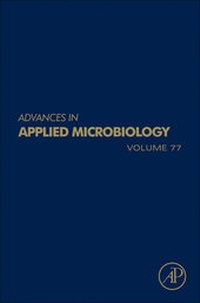
Advances in Applied Microbiology: Volume 77
Academic Press
Published on 5. December 2011
Book
Hardback
168 pages
978-0-12-387044-5 (ISBN)
Description
Published since 1959, Advances in Applied Microbiology continues to be one of the most widely read and authoritative review sources in microbiology. The series contains comprehensive reviews of the most current research in applied microbiology. Recent areas covered include bacterial diversity in the human gut, protozoan grazing of freshwater biofilms, metals in yeast fermentation processes and the interpretation of host-pathogen dialogue through microarrays. Eclectic volumes are supplemented by thematic volumes on various topics, including Archaea and sick building syndrome. Impact factor for 2009: 1.860.
Reviews / Votes
Praise for the series:"No laboratory scientist, field worker or technical administrator can afford to pass it up." --ASM News
"The topics are well supported by an extensive bibliography and provide a rich source of current information." --Biopharm
More details
Series
Language
English
Place of publication
San Diego
United States
Publishing group
Elsevier Science Publishing Co Inc
Target group
Professional and scholarly
Researchers in applied microbiology, molecular biology, mycology, biotechnology and biochemistry
Dimensions
Height: 229 mm
Width: 152 mm
Weight
370 gr
ISBN-13
978-0-12-387044-5 (9780123870445)
Copyright in bibliographic data and cover images is held by Nielsen Book Services Limited or by the publishers or by their respective licensors: all rights reserved.
Schweitzer Classification
Other editions
Additional editions
Persons
Geoffrey Gadd is a Professor at the University of Dundee, Scotland, UK Sima Sariaslani - PhD in microbial Biochemistry - UK. Professor of microbiology/biochemistry - IranResearch at Univ. of Calif, Riverside - US. Research at Univ. of Iowa - US. Research at DuPont Central Research and Development - USIntellectual property - DuPont - US
Content
Contributors
Chapter 1: Phage Therapy Pharmacology
I. Introduction
II. Standard Antibacterial In Vitro Metrics
III. Killing Titer and MBC Calculation
IV. Reduction Times and Dosing
V. Bacterial Density and Phage Population Growth
VI. Effective Dose Revisited
VII. Conclusion
Chapter 2: From Rio Tinto to Mars
I. Introduction
II. Extremophiles
III. Acidophiles
IV. Geomicrobiology of Rio Tinto
V. Subsurface Geomicrobiology of the Iberian Pyrite Belt
VI. Methanogenesis in Nonmethanogenic Conditions
VII. Rio Tinto as a Geochemical Analogue of Mars
VIII. Future Trends
Chapter 3: Fungal Adaptation to Extremely High Salt Concentrations
I. Halotolerant and Halophilic Fungi: An Introduction
II. Hortaea werneckii-A Model for Extreme Halotolerance
III. Wallemia ichthyophaga-Alternative Halophilic Solutions
IV. The Next Step: Genomics, Transcriptomics, and Beyond
V. Conclusions: An Integrated Model of Extreme Halotolerance
Chapter 4: Resistance of Yeasts to Weak Organic Acid Food Preservatives
I. The Monocarboxylate Preservatives
II. The Physiological Action of Weak Organic Carboxylic Acids on Yeast
III. Resistance Mechanisms
IV. Conclusions
Chapter 5: Silver Nanoparticles
I. Introduction
II. NP Types
III. Microbial-related Applications of NPs
IV. Mechanism of Antimicrobial Action of AgNP
V. Environmental Implications of AgNP-Microbial Considerations
VI. Conclusions
Subject Index
Contents of previous volumes
Chapter 1: Phage Therapy Pharmacology
I. Introduction
II. Standard Antibacterial In Vitro Metrics
III. Killing Titer and MBC Calculation
IV. Reduction Times and Dosing
V. Bacterial Density and Phage Population Growth
VI. Effective Dose Revisited
VII. Conclusion
Chapter 2: From Rio Tinto to Mars
I. Introduction
II. Extremophiles
III. Acidophiles
IV. Geomicrobiology of Rio Tinto
V. Subsurface Geomicrobiology of the Iberian Pyrite Belt
VI. Methanogenesis in Nonmethanogenic Conditions
VII. Rio Tinto as a Geochemical Analogue of Mars
VIII. Future Trends
Chapter 3: Fungal Adaptation to Extremely High Salt Concentrations
I. Halotolerant and Halophilic Fungi: An Introduction
II. Hortaea werneckii-A Model for Extreme Halotolerance
III. Wallemia ichthyophaga-Alternative Halophilic Solutions
IV. The Next Step: Genomics, Transcriptomics, and Beyond
V. Conclusions: An Integrated Model of Extreme Halotolerance
Chapter 4: Resistance of Yeasts to Weak Organic Acid Food Preservatives
I. The Monocarboxylate Preservatives
II. The Physiological Action of Weak Organic Carboxylic Acids on Yeast
III. Resistance Mechanisms
IV. Conclusions
Chapter 5: Silver Nanoparticles
I. Introduction
II. NP Types
III. Microbial-related Applications of NPs
IV. Mechanism of Antimicrobial Action of AgNP
V. Environmental Implications of AgNP-Microbial Considerations
VI. Conclusions
Subject Index
Contents of previous volumes