

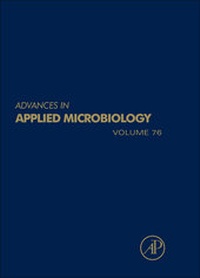
Advances in Applied Microbiology: Volume 75
Academic Press
Published on 7. October 2011
Book
Hardback
172 pages
978-0-12-387046-9 (ISBN)
Description
Published since 1959, Advances in Applied Microbiology continues to be one of the most widely read and authoritative review sources in microbiology. The series contains comprehensive reviews of the most current research in applied microbiology. Recent areas covered include bacterial diversity in the human gut, protozoan grazing of freshwater biofilms, metals in yeast fermentation processes and the interpretation of host-pathogen dialogue through microarrays. Eclectic volumes are supplemented by thematic volumes on various topics, including Archaea and sick building syndrome. Impact factor for 2009: 1.860.
Reviews / Votes
Praise for the series:"No laboratory scientist, field worker or technical administrator can afford to pass it up." --ASM News
"The topics are well supported by an extensive bibliography and provide a rich source of current information." --Biopharm
More details
Series
Language
English
Place of publication
San Diego
United States
Publishing group
Elsevier Science Publishing Co Inc
Target group
Professional and scholarly
Researchers in applied microbiology, molecular biology, mycology, biotechnology and biochemistry
Dimensions
Height: 229 mm
Width: 152 mm
Weight
400 gr
ISBN-13
978-0-12-387046-9 (9780123870469)
Copyright in bibliographic data and cover images is held by Nielsen Book Services Limited or by the publishers or by their respective licensors: all rights reserved.
Schweitzer Classification
Other editions
Additional editions
Persons
Geoffrey Gadd is a Professor at the University of Dundee, Scotland, UK Sima Sariaslani - PhD in microbial Biochemistry - UK. Professor of microbiology/biochemistry - IranResearch at Univ. of Calif, Riverside - US. Research at Univ. of Iowa - US. Research at DuPont Central Research and Development - USIntellectual property - DuPont - US
Content
Myxobacterial Vesicles
I. Introduction
II. Outer Membrane Vesicles
III. Myxobacteria
IV. Myxobacterial Vesicles
V. Concluding Remarks
Acknowledgments
Diversity, Structure, and Size of N2O-Producing Microbial Communities in Soils-What Matters for Their Functioning?
I. Introduction
II. Global Importance of N2O Emissions
III. Processes Leading to N2O Production
IV. Exploring Ammonia Oxidizer and Denitrifier Communities in Soil
V. Importance of Diversity, Structure, and Size of Nitrifier and Denitrifier Communities for N2O Production in Soil
VI. Conclusion
Acknowledgments
Solar-Driven Hydrogen Production in Green Algae
I. Introduction
II. Biophotolytic H2 Production
III. H2 Production in Green Algae
IV. Improving H2 Production in C. reinhardtii
V. Engineering Challenges: Photobioreactors
VI. Conclusions and Future Prospects
Mucosal Biofilm Communities in the Human Intestinal Tract
I. Introduction
II. Colonization of the Upper Gastrointestinal Tract
III. Mucosal-Associated Populations in the Large Bowel
IV. Alterations in Intestinal Mucosal Communities in IBD
V. Therapeutic Manipulation of Mucosal Biofilm Communities
VI. Modeling Studies
VII. Conclusions
I. Introduction
II. Outer Membrane Vesicles
III. Myxobacteria
IV. Myxobacterial Vesicles
V. Concluding Remarks
Acknowledgments
Diversity, Structure, and Size of N2O-Producing Microbial Communities in Soils-What Matters for Their Functioning?
I. Introduction
II. Global Importance of N2O Emissions
III. Processes Leading to N2O Production
IV. Exploring Ammonia Oxidizer and Denitrifier Communities in Soil
V. Importance of Diversity, Structure, and Size of Nitrifier and Denitrifier Communities for N2O Production in Soil
VI. Conclusion
Acknowledgments
Solar-Driven Hydrogen Production in Green Algae
I. Introduction
II. Biophotolytic H2 Production
III. H2 Production in Green Algae
IV. Improving H2 Production in C. reinhardtii
V. Engineering Challenges: Photobioreactors
VI. Conclusions and Future Prospects
Mucosal Biofilm Communities in the Human Intestinal Tract
I. Introduction
II. Colonization of the Upper Gastrointestinal Tract
III. Mucosal-Associated Populations in the Large Bowel
IV. Alterations in Intestinal Mucosal Communities in IBD
V. Therapeutic Manipulation of Mucosal Biofilm Communities
VI. Modeling Studies
VII. Conclusions