

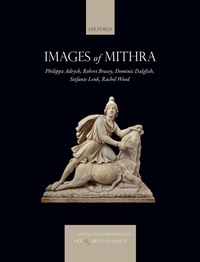
Images of Mithra
Published on 16. March 2017
Book
Hardback
232 pages
978-0-19-879253-6 (ISBN)
Description
With a history of use extending back to Vedic texts of the second millennium BC, derivations of the name Mithra appear in the Roman Empire, across Sasanian Persia, and in the Kushan Empire of southern Afghanistan and northern India during the first millennium AD. Even today, this name has a place in Yazidi and Zoroastrian religion. But what connection have Mihr in Persia, Miiro in Kushan Bactria, and Mithras in the Roman Empire to one another?
Over the course of the volume, specialists in the material culture of these diverse regions explore appearances of the name Mithra from six distinct locations in antiquity. In a subversion of the usual historical process, the authors begin not from an assessment of texts, but by placing images of Mithra at the heart of their analysis. Careful consideration of each example's own context, situating it in the broader scheme of religious traditions and on-going cultural interactions, is key to this discussion. Such an approach opens up a host of potential comparisons and interpretations that are often side-lined in historical accounts.
What Images of Mithra offers is a fresh approach to the ways in which gods were labelled and depicted in the ancient world. Through an emphasis on material culture, a more nuanced understanding of the processes of religious formation is proposed in what is but the first part of the Visual Conversations series.
Over the course of the volume, specialists in the material culture of these diverse regions explore appearances of the name Mithra from six distinct locations in antiquity. In a subversion of the usual historical process, the authors begin not from an assessment of texts, but by placing images of Mithra at the heart of their analysis. Careful consideration of each example's own context, situating it in the broader scheme of religious traditions and on-going cultural interactions, is key to this discussion. Such an approach opens up a host of potential comparisons and interpretations that are often side-lined in historical accounts.
What Images of Mithra offers is a fresh approach to the ways in which gods were labelled and depicted in the ancient world. Through an emphasis on material culture, a more nuanced understanding of the processes of religious formation is proposed in what is but the first part of the Visual Conversations series.
Reviews / Votes
the best account for those who want to understand the complex relationship of the Vedic Mitra, the Hellenistic Mithra and the Roman Mithras ... represents the aurea mediocritas between the dry positivism and abundance of sources and the abstractions of contemporary social theories. * Csaba Szabo, Antigueedad: Religiones y Sociedades * a successful, highly innovative collaborative contribution to a much-studied field which will surely influence similar volumes in the future. It shows the riches of Mithraic visual culture in a new light with some fresh observations, which are largely concordant with recent scholarship, and its focus on (iconographic) diversity places it well within emergent trends in both Mithraic research and ancient religions more generally. Images of Mithra is a valuable read for scholars interested in religious and art history, the movement of ideas, and the multifarious types of relationships between iconography and religion. * Kevin Stoba, Bryn Mawr Classical Review * the focus on the few selected images and the context of each gives the authors a new perspective on this tantalising feature of Roman and Eastern religious life. * Alan Beale, Classics for All *More details
Series
Language
English
Place of publication
Oxford
United Kingdom
Target group
College/higher education
Dimensions
Height: 260 mm
Width: 208 mm
Thickness: 17 mm
Weight
729 gr
ISBN-13
978-0-19-879253-6 (9780198792536)
Copyright in bibliographic data and cover images is held by Nielsen Book Services Limited or by the publishers or by their respective licensors: all rights reserved.
Schweitzer Classification
Other editions
Additional editions
Philippa Adrych | Robert Bracey | Dominic Dalglish
Images of Mithra
E-Book
03/2017
1st Edition
OUP eBook
€48.99
Available for download
Philippa Adrych | Robert Bracey | Dominic Dalglish
Images of Mithra
E-Book
03/2017
1st Edition
OUP eBook
€48.99
Available for download
Persons
Philippa Adrych read Classics as an undergraduate at Magdalen College, Oxford. She then proceeded to an MPhil in Roman History, and is now a DPhil candidate on the Empires of Faith project. She works on the historiographic problems of the study of Mithras in the Roman world from an object-based perspective.
Robert Bracey joined the British Museum in 2008 where he conducts research on the South and Central Asian coins collection. His research focuses particularly on the Kushan Empire (north India and Central Asia from the first to fourth centuries AD). He worked on the Empires of Faith research project from 2013 to 2015, and is currently working with the ERC-funded project Beyond Boundaries.
Dominic Dalglish studied for a BA in Ancient History and MA in Classics at the University of Durham before moving to Oxford to do a Masters in Classical Archaeology in 2010. He is now a DPhil candidate at Wolfson College, Oxford, working on the movement of religious ideas in the Roman Empire, particularly through material culture, as part of the British Museum's Empires of Faith project.
Stefanie Lenk is a DPhil candidate researching classical imagery in late antique baptismal spaces in the western Mediterranean at Wolfson College, Oxford, as part of the British Museum's Empires of Faith research project. She previously studied history of art, history, and curating at the Humboldt-Universitaet zu Berlin, Universita degli Studi di Firenze, Courtauld Institute of Art, and Oxford University.
Rachel Wood is a postdoctoral researcher on the British Museum's Empires of Faith project and a Junior Research Fellow at Wolfson College, Oxford. Her current research focuses on religious iconography in the Sasanian period, in particular on questions surrounding cultural interaction and local reinterpretations of images. Her DPhil, from Lincoln College, Oxford, explored interactions, continuity, and change in the art of the Hellenistic East (c.330-100 BC).
Robert Bracey joined the British Museum in 2008 where he conducts research on the South and Central Asian coins collection. His research focuses particularly on the Kushan Empire (north India and Central Asia from the first to fourth centuries AD). He worked on the Empires of Faith research project from 2013 to 2015, and is currently working with the ERC-funded project Beyond Boundaries.
Dominic Dalglish studied for a BA in Ancient History and MA in Classics at the University of Durham before moving to Oxford to do a Masters in Classical Archaeology in 2010. He is now a DPhil candidate at Wolfson College, Oxford, working on the movement of religious ideas in the Roman Empire, particularly through material culture, as part of the British Museum's Empires of Faith project.
Stefanie Lenk is a DPhil candidate researching classical imagery in late antique baptismal spaces in the western Mediterranean at Wolfson College, Oxford, as part of the British Museum's Empires of Faith research project. She previously studied history of art, history, and curating at the Humboldt-Universitaet zu Berlin, Universita degli Studi di Firenze, Courtauld Institute of Art, and Oxford University.
Rachel Wood is a postdoctoral researcher on the British Museum's Empires of Faith project and a Junior Research Fellow at Wolfson College, Oxford. Her current research focuses on religious iconography in the Sasanian period, in particular on questions surrounding cultural interaction and local reinterpretations of images. Her DPhil, from Lincoln College, Oxford, explored interactions, continuity, and change in the art of the Hellenistic East (c.330-100 BC).
Author
DPhil candidate, Empires of Faith projectDPhil candidate, Empires of Faith project, The British Museum and Oxford University
Project CuratorProject Curator, The British Museum
DPhil candidateDPhil candidate, Wolfson College, Oxford University
DPhil candidateDPhil candidate, Wolfson College, Oxford University
Postdoctoral Researcher, Empires of Faith projectPostdoctoral Researcher, Empires of Faith project, The British Museum
Editor
Humfrey Payne Senior Research Fellow in Classical Archaeology and ArtHumfrey Payne Senior Research Fellow in Classical Archaeology and Art, Oxford University
Content
Introduction
1: Reconstructions: Mithras in Rome
2: Patrons and Viewers: Dura-Europos
3: Settings: Bourg-Saint-Andeol
4: Identifications: Mihr in Sasanian Iran
5: Interpretations: Miiro in Kushan Bactria
6: Syncretisms: Apollo-Mithras in Commagene
Conclusions
Epilogue - Quetzalcoatl and Mithra
1: Reconstructions: Mithras in Rome
2: Patrons and Viewers: Dura-Europos
3: Settings: Bourg-Saint-Andeol
4: Identifications: Mihr in Sasanian Iran
5: Interpretations: Miiro in Kushan Bactria
6: Syncretisms: Apollo-Mithras in Commagene
Conclusions
Epilogue - Quetzalcoatl and Mithra