

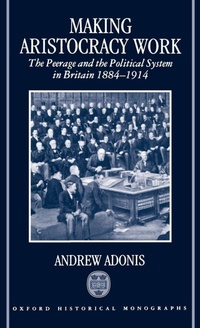
Making Aristocracy Work
The Peerage and the Political System in Britain, 1884-1914
Published on 27. May 1993
Book
Hardback
324 pages
978-0-19-820389-6 (ISBN)
Description
Making Aristocracy Work explores the political role of the British peerage in the thirty years before the First World War. It charts its transition from ruling class to embattled faction, analysing the response of the peers to the challenge of democracy and their impact on the constitutional order which emerged from the turbulent politics of the late Victorian and Edwardian era.
Andrew Adonis opens with a study of the House of Lords, assessing its strengths and weaknesses as a political institution and offering new interpretations of the constitutional crises of 1884-5 and 1909-11. He goes on to show how, at a time when the anachronism of a hereditary peerage was increasingly recognized, its members were able to justify themselves by their works.
A readable book, thoroughly grounded in the aristocracy's rich archives, Making Aristocracy Work is an important contribution to our understanding of the development of Britain's modern political system.
Andrew Adonis opens with a study of the House of Lords, assessing its strengths and weaknesses as a political institution and offering new interpretations of the constitutional crises of 1884-5 and 1909-11. He goes on to show how, at a time when the anachronism of a hereditary peerage was increasingly recognized, its members were able to justify themselves by their works.
A readable book, thoroughly grounded in the aristocracy's rich archives, Making Aristocracy Work is an important contribution to our understanding of the development of Britain's modern political system.
Reviews / Votes
a welcome addition ... scholarly and thorough studyTimes Literary Supplement `formidably researched and constantly fascinating book ... He is neither excessively deferential nor uncomprehendingly hostile ... as an account of the late nineteenth and early twentieth-century peerage at work, this book will not be bettered. And it should be read by anyone with an interest in second chambers: past, present - or future.'
David Cannadine, The Observer 'scholarly, but quite fascinating, new book The Daily Mail 'This is a very important and salutary book ... it is written with elegance and clarity.'
J.H. Plumb, Financial Times 'extraordinary lumber-room of a book ... My first visit to the Other Place, some thirty years ago, remains a vivid memory because the conditions were so similar to those described by Adonis.'
London Review of Books 'a welcome addition ... scholarly and thorough study'
Contemporary Review 'accomplished book'
Times Literary Supplement This book is more than the history of an institution. It is a study of the career patterns and aspirations of a political class. * Parliamentary History * Lucidly written and based on a wealth of archives, Andrew Adonis's Making Aristocracy Work ... fires efficiently on three cylinders, as an analysis of a power elite in operation, as a contribution to the still neglected study of how Parliament performed its functions, and as a commentary on the adjustment of pre-1914 British politics to what contemporaries chose to call 'democracy'. * Paul Smith, University of Southampton, EHR Apr.96 *
More details
Series
Language
English
Place of publication
Oxford
United Kingdom
Publishing group
Oxford University Press
Target group
Professional and scholarly
Illustrations
numerous tables, 4 graphs
Dimensions
Height: 222 mm
Width: 145 mm
Thickness: 23 mm
Weight
595 gr
ISBN-13
978-0-19-820389-6 (9780198203896)
Copyright in bibliographic data and cover images is held by Nielsen Book Services Limited or by the publishers or by their respective licensors: all rights reserved.
Schweitzer Classification
Person
Content
Introduction: Peers, power and the constitution. Part 1 The House of Lords: parties, organizations and leadership; the House of Lords as a Second Chamber; private bills and public interests. Part 2 Party politics and public policy: Salisbury's house; the Lords and Edwardian liberalism. Part 3 A governing elite: governing the realm; governing the empire; the will to rule; making aristocracy work. Appendix: The 4th Earl of Carnarvon and his dispositions in the 1880s.