

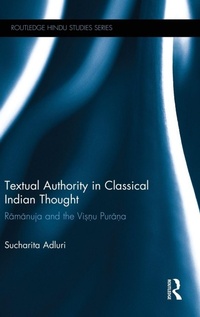
Textual Authority in Classical Indian Thought
Ramanuja and the Vishnu Purana
1st Edition
Published on 17. November 2014
Book
Hardback
170 pages
978-0-415-69575-6 (ISBN)
Description
Theistic Vedanta originated with Ramanuja (1077-1157), who was one of the foremost theologians of Visistadvaita Vedanta and also an initiate of the Srivaisnava sectarian tradition in South India. As devotees of the God Visnu and his consort Sri, the Srivaisnavas established themselves through various processes of legitimation as a powerful sectarian tradition. One of the processes by which the authority of the Srivaisnavas was consolidated was Ramanuja's synthesis of popular Hindu devotionalism with the philosophy of Vedanta.
This book demonstrates that by incorporating a text often thought to be of secondary importance - the Visnu Purana (1st-4th CE) - into his reading of the Upanisads, which were the standard of orthodoxy for Vedanta philosophy, Ramanuja was able to interpret Vedanta within the theistic context of Srivaisnavism. Ramanuja was the first Brahmin thinker to incorporate devotional puranas into Vedanta philosophy. His synthetic theology called Visistadvaita (unity-of-the-differenced) wielded tremendous influence over the expansion of Visnu devotionalism in South India and beyond. In this book, the exploration of the exegetical function of this purana in arguments salient to Ramanuja's Vedanta facilitates our understanding of the processes of textual accommodation and reformulation that allow the incorporation of divergent doctrinal claims.
Expanding on and reassessing current views on Ramanuja's theology, the book contributes new insights to broader issues in religious studies such as canon expansion, commentarial interpretation, tradition-building, and the comparative study of scripture. It will be of interest to students and scholars of Indian philosophy and Religious Studies.
This book demonstrates that by incorporating a text often thought to be of secondary importance - the Visnu Purana (1st-4th CE) - into his reading of the Upanisads, which were the standard of orthodoxy for Vedanta philosophy, Ramanuja was able to interpret Vedanta within the theistic context of Srivaisnavism. Ramanuja was the first Brahmin thinker to incorporate devotional puranas into Vedanta philosophy. His synthetic theology called Visistadvaita (unity-of-the-differenced) wielded tremendous influence over the expansion of Visnu devotionalism in South India and beyond. In this book, the exploration of the exegetical function of this purana in arguments salient to Ramanuja's Vedanta facilitates our understanding of the processes of textual accommodation and reformulation that allow the incorporation of divergent doctrinal claims.
Expanding on and reassessing current views on Ramanuja's theology, the book contributes new insights to broader issues in religious studies such as canon expansion, commentarial interpretation, tradition-building, and the comparative study of scripture. It will be of interest to students and scholars of Indian philosophy and Religious Studies.
More details
Series
Language
English
Place of publication
London
United Kingdom
Publishing group
Taylor & Francis Ltd
Target group
College/higher education
Illustrations
1 s/w Tabelle
1 Tables, black and white
Dimensions
Height: 240 mm
Width: 161 mm
Thickness: 14 mm
Weight
429 gr
ISBN-13
978-0-415-69575-6 (9780415695756)
Copyright in bibliographic data and cover images is held by Nielsen Book Services Limited or by the publishers or by their respective licensors: all rights reserved.
Schweitzer Classification
Other editions
Additional editions
Book
01/2018
1st Edition
Routledge
€50.60
Shipment within 10-20 days
E-Book
10/2014
1st Edition
Routledge
€44.99
Available for download
E-Book
10/2014
1st Edition
Routledge
€44.99
Available for download
Person
Sucharita Adluri is Assistant Professor in the Department of Philosophy and Comparative Religion at Cleveland State University. Her research interests include Sanskrit Commentary and Intellectual History and the History of Religions of South India.
Content
1. Introduction
2. The Individual Self, Cosmology, and the Divine Body in the Vedarthasa?graha
3. Brahman, Individual Self, and Ignorance in the Sribha?ya
4. Sa?khya-Yoga, K???a, and the Foremost Devotee in the Bhagavadgitabha?ya
2. The Individual Self, Cosmology, and the Divine Body in the Vedarthasa?graha
3. Brahman, Individual Self, and Ignorance in the Sribha?ya
4. Sa?khya-Yoga, K???a, and the Foremost Devotee in the Bhagavadgitabha?ya