

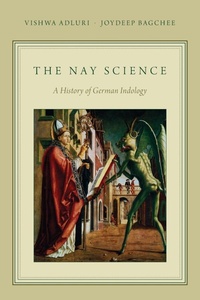
The Nay Science
A History of German Indology
Published on 24. July 2014
Book
Paperback/Softback
512 pages
978-0-19-993136-1 (ISBN)
Description
The Nay Science offers a new perspective on the problem of scientific method in the human sciences. Taking German Indological scholarship on the Mahabharata and the Bhagavadgita as their example, Adluri and Bagchee develop a critique of the modern valorization of method over truth in the humanities.
The authors show how, from its origins in eighteenth-century Neo-Protestantism onwards, the critical method was used as a way of making theological claims against rival philosophical and/or religious traditions. Via discussions of German Romanticism, the pantheism controversy, scientific positivism, and empiricism, they show how theological concerns dominated German scholarship on the Indian texts. Indology functions as a test case for wider concerns: the rise of historicism, the displacement of philosophical concerns from thinking, and the belief in the ability of a technical method to produce truth.
Based on the historical evidence of the first part of the book, Adluri and Bagchee make a case in the second part for going beyond both the critical pretensions of modern academic scholarship and and the objections of its post-structuralist or post-Orientalist critics. By contrasting German Indology with Plato's concern for virtue and Gandhi's focus on praxis, the authors argue for a conception of the humanities as a dialogue between the ancients and moderns and between eastern and western cultures.
The authors show how, from its origins in eighteenth-century Neo-Protestantism onwards, the critical method was used as a way of making theological claims against rival philosophical and/or religious traditions. Via discussions of German Romanticism, the pantheism controversy, scientific positivism, and empiricism, they show how theological concerns dominated German scholarship on the Indian texts. Indology functions as a test case for wider concerns: the rise of historicism, the displacement of philosophical concerns from thinking, and the belief in the ability of a technical method to produce truth.
Based on the historical evidence of the first part of the book, Adluri and Bagchee make a case in the second part for going beyond both the critical pretensions of modern academic scholarship and and the objections of its post-structuralist or post-Orientalist critics. By contrasting German Indology with Plato's concern for virtue and Gandhi's focus on praxis, the authors argue for a conception of the humanities as a dialogue between the ancients and moderns and between eastern and western cultures.
Reviews / Votes
[A]n important work of hermeneutic analysis * Bruce M. Sullivan, Religion Compass * The Nay Science is arguably one of most comprehensive historiographies of Indology, assessing the fields philosophical roots and the implications it has had on both academic and practical discourses about Hinduism and other Indian classical traditions The Nay Science (a clever play on nescience, or ignorance) speaks to the institutional antagonism of 19th and early 20th century German Indologists towards ancient Indian scriptures, subsequently shaping a paradigm from which many Indologists continue to draw. Their assertion, backed by correspondences between Indologists and their own published works, is not so much a critique of Orientalism as it is a surgical evisceration of the scholarly field that has developed over nearly two centuries. * Murali Balaji, OPEN Magazine * The Nay Science is more than a history of German Indology. Besides offering a highly nuanced critique of scientific positivism and historicism, it makes important interventions in broader debates on the development of the social and human sciences in nineteenth- and twentieth-century Germany, and has much to say regarding the role of race and religion in the formation of German national identity. Last but not least, The Nay Science contributes greatly to our understanding of the origins, nature, and consequences of German orientalism. While the non specialist reader might find this ambitious work daunting in its depth, breadth, and complexity, the authors have produced a remarkable work of scholarship. * Eric Kurlander, Central European History * The Nay Science concludes with some exciting and discomforting questions: How should we navigate and negotiate apparent antitheses: 'modern' and 'traditional,' 'reason' and 'faith'? What pragmatic concerns and consequences should inform our scholarship, such that the humanities can truly humanize us? These questions are key to a critical reorientation, toward thinking about India 'after Indology.' * American Historical Review * Adluri and Bagchee eschew the shooting-fish-in-a-barrel exercise of excoriating nineteenth-century European scholars for their sins and instead conclude by drawing some lessons from Gadamer and Gandhi on the benefits of an alternative philosophical philology. The points the authors make are relevant to historians of religion no matter what discipline they study. * Religious Studies Review * [The Nay Science] adds significantly to the many recent studies of Orientalism ... Highly recommended. * CHOICE * This book begins at a point where Edward Said left off. Rather than replicate the 'Orientalist' critique as so many have done, Adluri and Bagchee offer a diagnosis of German Indology as a form of 'Occidentalism': rather than accomplishing its stated goal of defining the other (which would be 'Orientalism'), it represents the other so as to define itself The Nay Science challenges scholars to recognize that the 'Brahmanic hypothesis' was not and probably no longer can be an innocuous thesis. The 'corrupting' impact of Brahmanical 'priestcraft' served German Indology as a cover by which to talk about Catholics, Jews, and other 'Semites. * Alf Hiltebeitel, Professor of Religion and Human Sciences, Washington University * If ever there is a fine specimen of how to do the in-depth history of ideas as it pertains to an academic discipline, this study by Vishwa Adluri and Joydeep Bagchee ranks very, very highly. * Garry W. Trompf, History of Religions *More details
Language
English
Place of publication
New York
United States
Target group
College/higher education
Professional and scholarly
Dimensions
Height: 234 mm
Width: 156 mm
Thickness: 30 mm
Weight
866 gr
ISBN-13
978-0-19-993136-1 (9780199931361)
Copyright in bibliographic data and cover images is held by Nielsen Book Services Limited or by the publishers or by their respective licensors: all rights reserved.
Schweitzer Classification
Other editions
Additional editions
Book
07/2014
Oxford University Press Inc
€227.30
Shipment within 15-20 days
E-Book
06/2014
1st Edition
OUP USA
€38.49
Available for download
Persons
Vishwa Adluri has a PhD in Philosophy from the New School and a PhD in Indology from Philipps-Universitaet Marburg. He is Adjunct Associate Professor of Religion at Hunter College.; Joydeep Bagchee has a PhD in Philosophy from the New School and is Wissenschaftlicher Mitarbeiter at Freie Universitaet Berlin.
Content
INTRODUCTION ; A HISTORY OF GERMAN INDOLOGY ; THE HISTORY OF GERMAN INDOLOGY AS A HISTORY OF METHOD ; THE ORIGINS OF THE HISTORICAL-CRITICAL METHOD IN NEO-PROTESTANTISM OF THE 18TH CENTURY ; THE ORIGINS OF PHILOLOGY IN THE ARGUMENT FOR THE IMMORTALITY OF THE SOUL ; DEFINING THE SCOPE OF INQUIRY ; PLAN OF STUDY ; CHAPTER 1: HISTORICAL IDENTITY AND NARRATIVE CONSTRUCTS IN AN INDO-GERMANIC SETTING ; THE BIRTH OF GERMAN MAHABHARATA STUDIES ; THE INDO-GERMANIC ORIGINAL EPIC: ; THE BUDDHIST POETIC COMPOSITION ; BUDDHISM AND PROTESTANTISM ; PROTESTANTISM, THE COUNTER-REFORMATION, AND THE PROSECUTION OF HERESY ; THE TWIN BRAHMANIC REDACTIONS ; BRAHMANISM AND CATHOLICISM ; RETURN TO THE PROBLEM OF TEXTUAL RECONSTRUCTION ; CHAPTER 2: TEXT-HISTORICAL RECONSTRUCTION AND THE STRUGGLE FOR AN OBJECTIVE CANON ; THE BHAGAVAD GITA IN GERMAN INDOLOGY ; THE THEISTIC GITA: RICHARD GARBE ; THE EPIC GITA: HERMANN JACOBI ; A PRACTICAL GITA: HERMANN OLDENBERG ; THE TRINITARIAN GITA: RUDOLF OTTO ; THE SOLDIER'S GITA: THEODOR SPRINGMANN ; THE ARYAN GITA: JAKOB WILHELM HAUER ; THE BRAHMANIC GITA: GEORG VON SIMSON ; WHAT IS THE GERMAN GITA?: A REVIEW ; CHAPTER 3: GERMAN INDOLOGY IN THE CONTEXT OF THE EUROPEAN GEISTESWISSENSCHAFTEN ; PROBLEMS WITH THE CRITICAL METHOD ; THE SCIENTIFICATION OF PROTESTANT THEOLOGY IN THE CRITICAL METHOD ; THE SECULARIZATION OF PROTESTANT THEOLOGY IN THE STUDY OF THE HISTORY OF RELIGIONS ; THE INSTITUTIONALIZATION OF PROTESTANT THEOLOGY IN INDOLOGY ; THREE NOTIONS OF SCIENCE: POSITIVISM, HISTORICISM, AND EMPIRICISM ; CRITICISMS OF THE POSITIVISTIC NOTION OF TRUTH ; FROM HISTORICISM TO HERMENEUTICS ; CONCLUSION ; WRITING UNDER ERASURE ; CREATING THE OBJECT OF SCIENTIFIC RESEARCH ; HONEST HERETICS OR NEO-BRAHMINS? ; AFTERWORD: GANDHI ON THE GITA PROBLEM ; NOTES ; BIBLIOGRAPHY ; INDEX