

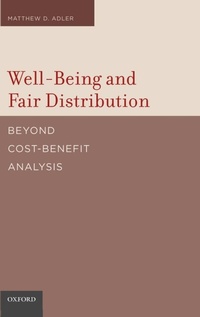
Well-Being and Fair Distribution
Beyond Cost-Benefit Analysis
Published on 15. December 2011
Book
Hardback
656 pages
978-0-19-538499-4 (ISBN)
Description
In Well-Being and Fair Distribution: Beyond Cost-Benefit Analysis, author Matthew D. Adler provides readers with a comprehensive philosophically grounded argument for the use of social welfare functions as a framework for governmental policy analysis.
Well-Being and Fair Distribution addresses a range of relevant theoretical issues, including the possibility of an interpersonally comparable measure of well-being, or "utility" metric; the moral value of equality, and how that bears on the form of the social welfare function; social choice under uncertainty; and the possibility of integrating considerations of individual choice and responsibility into the social-welfare-function framework. Adler's book also deals with issues of implementation, and explores how survey data and other sources of evidence might be used to calibrate both a utility metric and a social welfare function, and whether distributive goals are ever best pursued through regulation rather than the tax system. In working through this range of theoretical and practical issues, Well-Being and Fair Distribution draws from a wide variety of literatures, including philosophical scholarship on equality, responsibility, the nature of well-being, and personal identity over time; the social choice literature within economics; applied economic literatures concerning the measurement of inequality and poverty; legal and policy-analysis scholarship on cost-benefit analysis, environmental justice, and the choice between regulation and taxation; and the burgeoning field of "happiness studies."
Well-Being and Fair Distribution addresses a range of relevant theoretical issues, including the possibility of an interpersonally comparable measure of well-being, or "utility" metric; the moral value of equality, and how that bears on the form of the social welfare function; social choice under uncertainty; and the possibility of integrating considerations of individual choice and responsibility into the social-welfare-function framework. Adler's book also deals with issues of implementation, and explores how survey data and other sources of evidence might be used to calibrate both a utility metric and a social welfare function, and whether distributive goals are ever best pursued through regulation rather than the tax system. In working through this range of theoretical and practical issues, Well-Being and Fair Distribution draws from a wide variety of literatures, including philosophical scholarship on equality, responsibility, the nature of well-being, and personal identity over time; the social choice literature within economics; applied economic literatures concerning the measurement of inequality and poverty; legal and policy-analysis scholarship on cost-benefit analysis, environmental justice, and the choice between regulation and taxation; and the burgeoning field of "happiness studies."
Reviews / Votes
... a new and refreshing take on the subject of fair distribution... an invaluable contribution to an ongoing dialogue that is critically important to sustain and nourish. * Efthymios Athanasiou, New Economic School, Moscow * In an impressive feat of interdisciplinary scholarship, Professor Adler begins by situating his argument within moral philosophy, then lays out a generic welfarist decisionmaking architecture, specifies his preferred SWF formulation, argues that SWF should be preferred to all other welfarist analyses, and considers ways to extend SWF to account for intertemporality and personal responsibility. * Harvard Law Review *More details
Language
English
Place of publication
New York
United States
Target group
College/higher education
Dimensions
Height: 240 mm
Width: 161 mm
Thickness: 39 mm
Weight
1139 gr
ISBN-13
978-0-19-538499-4 (9780195384994)
Copyright in bibliographic data and cover images is held by Nielsen Book Services Limited or by the publishers or by their respective licensors: all rights reserved.
Schweitzer Classification
Person
Matthew D. Adler is the Leon Meltzer Professor of Law at the University of Pennsylvania. He is the author of many articles on cost-benefit analysis, risk regulation, and equity.
Content
Introduction ; Chapter 1. Preliminaries: Morality, Consequentialism, Welfarism ; Chapter 2. The SWF Approach and its Competitors ; Chapter 3. Well-Being and Interpersonal Comparisons ; Chapter 4. Estimating Utilities ; Chapter 5. The Case for a Continuous Prioritarian SWF ; Chapter 6. Lifetime Prioritarianism ; Chapter 7. Ranking Actions: Prioritarianism under Uncertainty ; Chapter 8. Next Steps