

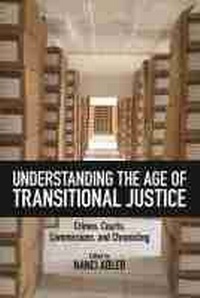
Understanding the Age of Transitional Justice
Crimes, Courts, Commissions, and Chronicling
Published on 22. June 2018
Book
Hardback
258 pages
978-0-8135-9777-5 (ISBN)
Description
Since the 1980s, an array of legal and non-legal practices-labeled Transitional Justice-has been developed to support post-repressive, post-authoritarian, and post-conflict societies in dealing with their traumatic past. In Understanding the Age of Transitional Justice, the contributors analyze the processes, products, and efficacy of a number of transitional justice mechanisms and look at how genocide, mass political violence, and historical injustices are being institutionally addressed. They invite readers to speculate on what (else) the transcripts produced by these institutions tell us about the past and the present, calling attention to the influence of implicit history conveyed in the narratives that have gained an audience through international criminal tribunals, trials, and truth commissions. Nanci Adler has gathered leading specialists to scrutinize the responses to and effects of violent pasts that provide new perspectives for understanding and applying transitional justice mechanisms in an effort to stop the recycling of old repressions into new ones.
Reviews / Votes
"Bringing together some of the most notable voices in the field, this volume moves away from the often narrow focus of other treatments of transitional justice-situating and evaluating the effect of accountability mechanisms within a larger social, cultural, and political context." - Ronald Slye (coauthor of International Criminal Law and Its Enforcement) "This rich and interesting volume goes beyond the legal understanding of Transitional Justice in order to address the challenge of post-conflict societies. A valuable and important contribution to the current literature." - Elazar Barkan (Columbia University) "Chronicle of Higher Education weekly book list," by Nina C. Ayoub (Chronicle of Higher Education) "With an extraordinary and impressively informative body of seminal scholarship by experts in the subject of transitional justice that is unreservedly recommended for both community and academic library collections, it should be noted for the personal reading lists of students, academia, social activists, and non-specialist general readers with an interest in the subject that Understanding the Age of Transitional Justice is also available in a paperback edition and in a digital book format." (Midwest Book Review)More details
Series
Language
English
Place of publication
New Brunswick NJ
United States
Target group
College/higher education
Professional and scholarly
Illustrations
10 figures, 4 tables
Dimensions
Height: 229 mm
Width: 152 mm
Thickness: 18 mm
Weight
513 gr
ISBN-13
978-0-8135-9777-5 (9780813597775)
Copyright in bibliographic data and cover images is held by Nielsen Book Services Limited or by the publishers or by their respective licensors: all rights reserved.
Schweitzer Classification
Other editions
Additional editions
Unknown | Nanci Adler
Understanding the Age of Transitional Justice
Crimes, Courts, Commissions, and Chronicling
E-Book
06/2018
1st Edition
Rutgers University Press
€117.99
Available for download
Persons
NANCI ADLER is professor of memory, history, and transitional justice at the University of Amsterdam and program director of genocide studies at the NIOD Institute for War, Holocaust, and Genocide Studies (Royal Netherlands Academy of Arts and Sciences). She is the author of numerous titles, including Keeping Faith with the Party: Communist Believers Return from the Gulag.
Content
Introduction: On History, Historians, and Transitional Justice
Nanci Adler
Part I: Truth and Justice
Chapter 1: Swinging the Pendulum: Fin de SiEcle Historians in the Courts
Vladimir Petrovic
Chapter 2: Time, Justice and Human Rights: Statutory Limitation on the Right to Truth?
William A. Schabas
Chapter 3: How Truth Recovery Can Benefit from a Conditional Amnesty
Jeremy Sarkin
Chapter 4: New Epistemologies for Confronting International Crimes: Developing the IDP Approach to Transitional Justice
Stephan Parmentier, Mina Rauschenbach, and Maarten van Craen
Part II: The Trial Record
Chapter 5: The Spark for Genocide? Propaganda and Historical Narratives at International Criminal Tribunals
Richard Ashby Wilson
Chapter 6: The International Criminal Trial Record as Historical Source
Thijs B. Bouwknegt
Part III: The Afterlife of Transitional Justice Processes
Chapter 7: Narrating (In)Justice in the Form of a Reparation Claim: Bottom-up Reflections on a Post-Colonial Setting - The Rawagede Case
Nicole L. Immler
Chapter 8: Collective and Competitive Victimhood as Identity in the Former Yugoslavia
Christian Axboe Nielsen
Chapter 9: Perpetrator-Victims: How Universal Victimhood in Cambodia Impacts Transitional Justice Measures
Timothy Williams
Chapter 10: Collective Crimes, Collective Memory, and Transitional Justice in Bangladesh
Kjell Anderson
Acknowledgments
Notes on Contributors
Index
Nanci Adler
Part I: Truth and Justice
Chapter 1: Swinging the Pendulum: Fin de SiEcle Historians in the Courts
Vladimir Petrovic
Chapter 2: Time, Justice and Human Rights: Statutory Limitation on the Right to Truth?
William A. Schabas
Chapter 3: How Truth Recovery Can Benefit from a Conditional Amnesty
Jeremy Sarkin
Chapter 4: New Epistemologies for Confronting International Crimes: Developing the IDP Approach to Transitional Justice
Stephan Parmentier, Mina Rauschenbach, and Maarten van Craen
Part II: The Trial Record
Chapter 5: The Spark for Genocide? Propaganda and Historical Narratives at International Criminal Tribunals
Richard Ashby Wilson
Chapter 6: The International Criminal Trial Record as Historical Source
Thijs B. Bouwknegt
Part III: The Afterlife of Transitional Justice Processes
Chapter 7: Narrating (In)Justice in the Form of a Reparation Claim: Bottom-up Reflections on a Post-Colonial Setting - The Rawagede Case
Nicole L. Immler
Chapter 8: Collective and Competitive Victimhood as Identity in the Former Yugoslavia
Christian Axboe Nielsen
Chapter 9: Perpetrator-Victims: How Universal Victimhood in Cambodia Impacts Transitional Justice Measures
Timothy Williams
Chapter 10: Collective Crimes, Collective Memory, and Transitional Justice in Bangladesh
Kjell Anderson
Acknowledgments
Notes on Contributors
Index