

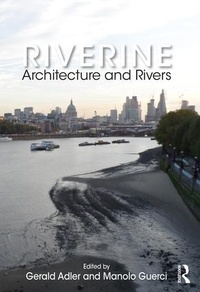
Riverine
Architecture and Rivers
1st Edition
Published on 30. October 2018
Book
Hardback
236 pages
978-1-138-68175-0 (ISBN)
Description
Riverscapes are the main arteries of the world's largest cities, and have, for millennia, been the lifeblood of the urban communities that have developed around them. These human settlements - given life through the space of the local waterscape - soon developed into ritualised spaces that sought to harness the dynamism of the watercourse and create the local architectural landscape. Theorised via a sophisticated understanding of history, space, culture, and ecology, this collection of wonderful and deliberately wide-ranging case studies, from Early Modern Italy to the contemporary Bengal Delta, investigates the culture of human interaction with rivers and the nature of urban topography. Riverine explores the ways in which architecture and urban planning have imbued cultural landscapes with ritual and structural meaning.
Reviews / Votes
Riverine provides nuanced and refreshing understandings of the relationship between architecture and rivers at a variety of scales and across diverse geographies. An excellent collection - essential reading for architects, planners and landscape architects. - Duanfang Lu, Professor of Architecture and Urbanism, The University of SydneyMore details
Language
English
Place of publication
London
United Kingdom
Publishing group
Taylor & Francis Ltd
Target group
College/higher education
Professional and scholarly
Illustrations
107 s/w Abbildungen, 80 s/w Photographien bzw. Rasterbilder, 27 s/w Zeichnungen
27 Line drawings, black and white; 80 Halftones, black and white; 107 Illustrations, black and white
Dimensions
Height: 246 mm
Width: 174 mm
Weight
630 gr
ISBN-13
978-1-138-68175-0 (9781138681750)
Copyright in bibliographic data and cover images is held by Nielsen Book Services Limited or by the publishers or by their respective licensors: all rights reserved.
Schweitzer Classification
Other editions
Additional editions
Book
11/2018
1st Edition
Routledge
€74.55
Shipment within 10-20 days
E-Book
10/2018
1st Edition
Routledge
€61.99
Available for download
E-Book
10/2018
Routledge
€61.99
Available for download
Persons
Gerald Adler is a Professor and Deputy Head at the Kent School of Architecture (KSA), University of Kent, UK, which he helped to found in 2005. His PhD was on the German 'Reform' architect Heinrich Tessenow, and he has written on European twentieth-century topics. He is an active member of CREAte, the University of Kent's Centre for Research in European Architecture. Adler began his career in practice, working in London, Tokyo, Winchester, Stuttgart and Vienna, and currently directs the MA in Architecture and Urban Design at KSA.
Manolo Guerci is a Senior Lecturer and the Director of Graduate Studies at the Kent School of Architecture, University of Kent, UK. His research concentrates on early-modern European palaces, but he has also looked at issues related to the conservation of historic buildings, traditional Japanese architecture, and post-war social housing estates, on all of which he has published widely. Educated in Rome, London, Paris, and Cambridge, he began working in France for the 'Monuments Historiques' agency, while he has previously taught at the University of Cambridge, UK.
Manolo Guerci is a Senior Lecturer and the Director of Graduate Studies at the Kent School of Architecture, University of Kent, UK. His research concentrates on early-modern European palaces, but he has also looked at issues related to the conservation of historic buildings, traditional Japanese architecture, and post-war social housing estates, on all of which he has published widely. Educated in Rome, London, Paris, and Cambridge, he began working in France for the 'Monuments Historiques' agency, while he has previously taught at the University of Cambridge, UK.
Content
Introduction Gerald Adler and Manolo Guerci. The amphibian townscape Deborah Howard. Section One: ENSEMBLES: by the river. Ancient waterfront palaces: a case study of the Great Palace at Amarna Mustafa Kaan Sag. Spectacle of power on the Po: Ferrara and its riverfront during the Renaissance Francesco Ceccarelli. From Bishops' Inns to private palaces: the evolution of the Strand in London from the 13th to the 17th century Manolo Guerci. Revealing the lost rivers to re-shape Paris: recovering a lost tributary of the Seine in south eastern Paris John Letherland. EXCURSUS ONE: Waterloo Sunrise Kate Miller. EXCURSUS TWO: Along the river Temo in Bosa, Sardinia Giovanna Piga Section Two: TOPOI: of the river. Building rivers: how the aqueducts of Roman Britain furthered connections between towns and their riverine settings Jay Ingate. Riverine architecture in the absence of rivers Ishraq Z. Khan. The Sabarmati River in Ahmedabad, India: a story of a city told through its river Elisa Alessandrini. Villeneuve D'Ascq: a French new town built around lakes Isabelle Estienne. EXCURSUS THREE: Fleeting memories: bringing the Fleet River back to life in St Pancras Richard Gooden. Section Three: MEANINGS: beyond the river. Sauf aux riverains: the riverine memorial of Georges-Henri Pingusson Gerald Adler. Water and memory: tracing Nantes' watermarks Ann Borst. Sensing the swan Saren Reid. Nature and artifice: Nadav Kander's Yangtze, The Long River Alexandra Stara. EXCURSUS FOUR: Metropolitan riverine: landscapes of the modern port city Peter Beard. Bibliography. Index.