

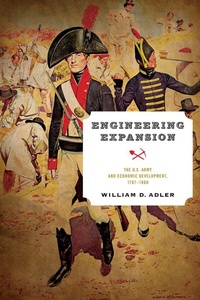
Engineering Expansion
The U.S. Army and Economic Development, 1787-1860
Published on 26. November 2021
Book
Hardback
240 pages
978-0-8122-5348-1 (ISBN)
Description
Engineering Expansion examines the U.S. Army's role in U.S. economic development from the nation's founding to the eve of the Civil War. William D. Adler starts with a simple question: if the federal government was weak in its early years, how could the economy and the nation have grown so rapidly?
Adler answers this question by focusing on the strongest part of the early American state, the U.S. Army. The Army shaped the American economy through its coercive actions in conquering territory, expanding the nation's borders, and maintaining public order and the rule of law. It built roads, bridges, and railroads while Army engineers and ordnance officers developed new technologies, constructed forts that encouraged western settlement and nurtured nascent communities, cleared rivers, and created manufacturing innovations that spread throughout the private sector. Politicians fought for control of the Army, but War Department bureaucracies also contributed to their own development by shaping the preferences of elected officials.
Engineering Expansion synthesizes a wide range of historical material and will be of interest to those interested in early America, military history, and politics in the early United States.
Adler answers this question by focusing on the strongest part of the early American state, the U.S. Army. The Army shaped the American economy through its coercive actions in conquering territory, expanding the nation's borders, and maintaining public order and the rule of law. It built roads, bridges, and railroads while Army engineers and ordnance officers developed new technologies, constructed forts that encouraged western settlement and nurtured nascent communities, cleared rivers, and created manufacturing innovations that spread throughout the private sector. Politicians fought for control of the Army, but War Department bureaucracies also contributed to their own development by shaping the preferences of elected officials.
Engineering Expansion synthesizes a wide range of historical material and will be of interest to those interested in early America, military history, and politics in the early United States.
Reviews / Votes
"With the publication of William D. Adler's excellent book, Engineering Expansion we now have a comprehensive account of the army as an institution of state power from 1787 until the Civil War....Any scholar of American Political Development, institutional development, or military history will benefit from a close reading of Engineering Expansion. Students, in particular, will find Adler's book to be an excellent guide to current scholarly debates in APD. Although many questions remain about the army's role in early America, Adler's concise volume should inspire further studies of this long neglected institution of American state building. As Adler demonstrates so persuasively in this fine book, it is time for APD to bring the military back in." (Perspectives on Politics) "William D. Adler's impressive book is a vitally important contribution to the history of nineteenth-century American political economy and the early American state. Adler convincingly argues that the United States' military was a driving force in the development of the national state, in the expansion of national boundaries, and in the dramatic growth of the national marketplace....Engineering Expansion makes a fine contribution to our understanding of American political economy, state building, and foreign relations through a detailed examinationof the Army. However much the military has been missing from the literature, Adler has successfully brought it back in." (H-DIPLO) "[I]n describing how the army contributed to the growth of the United States before the Civil War, by showing how the army was an integral part of political and economic forces driving the nation, and by demonstrating that the army was not merely a passive instrument that conformed to political will but rather-through its officers and staff bureaus-an active institution in shaping national life, Adler has done students of economics, history, and political science a worthy service. And he is entirely correct to conclude that the national economy the U.S. Army helped to build enabled the ultimate triumph of the northern states over the southern slavocracy in 1865. Students of the U.S. Army will need to account for this study in future interdisciplinary conversations." (The Journal of the Civil War Era)More details
Series
Language
English
Place of publication
Pennsylvania
United States
Target group
College/higher education
Product notice
Paper over boards
Illustrations
5 charts, 4 maps, 11 tables
Dimensions
Height: 232 mm
Width: 156 mm
Thickness: 22 mm
Weight
504 gr
ISBN-13
978-0-8122-5348-1 (9780812253481)
Copyright in bibliographic data and cover images is held by Nielsen Book Services Limited or by the publishers or by their respective licensors: all rights reserved.
Schweitzer Classification
Other editions
Additional editions
E-Book
11/2021
1st Edition
University of Pennsylvania Press
€73.49
Available for download
Person
William D. Adler is Associate Professor of Political Science at Northeastern Illinois University.
Content
Introduction 1
Chapter 1. Coercion and Economic Development
Chapter 2. Building the Nation, Building the Economy
Chapter 3. Who Commands?
Chapter 4. Political Entrepreneurs and Institutional Capacity
Conclusion. The Army and American Political Development
Notes
Bibliography
Index
Acknowledgments
Chapter 1. Coercion and Economic Development
Chapter 2. Building the Nation, Building the Economy
Chapter 3. Who Commands?
Chapter 4. Political Entrepreneurs and Institutional Capacity
Conclusion. The Army and American Political Development
Notes
Bibliography
Index
Acknowledgments