

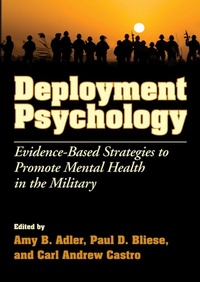
Deployment Psychology
Evidence-Based Strategies to Promote Mental Health in the Military
Will be published approx. on 15. October 2010
Book
Hardback
294 pages
978-1-4338-0881-4 (ISBN)
Description
The impact of combat on service members' mental health has received considerable attention both in the popular press and in scholarly publications. Yet few books have focused on systematic, evidence-based attempts at preventing mental health problems and enhancing service members' well-being and resilience.
This book is intended to fill that gap. The editors have gathered leading clinicians and researchers in military mental health to examine how mental health providers and military leaders can best moderate the negative impact of combat. Contributors discuss the importance of individual screening, training, peer support, leadership and organizational policies, as well as the development and implementation of large-scale mental health programs that incorporate these elements and more.
The editors promote a broad occupational health model of prevention and include the latest research on delivering mental health services in pre-deployment, in-theater settings, and VA hospitals. The psychological health of not only service members but also military families is approached as an integral aspect of deployment psychology.
The result is a ground-breaking book that emphasizes what we know-and don't know-about evidence-based interventions. It represents the first comprehensive review of mental health interventions across the deployment cycle and will help guide the field of military psychology in developing a much-needed support system for service members in the years to come.
This book is intended to fill that gap. The editors have gathered leading clinicians and researchers in military mental health to examine how mental health providers and military leaders can best moderate the negative impact of combat. Contributors discuss the importance of individual screening, training, peer support, leadership and organizational policies, as well as the development and implementation of large-scale mental health programs that incorporate these elements and more.
The editors promote a broad occupational health model of prevention and include the latest research on delivering mental health services in pre-deployment, in-theater settings, and VA hospitals. The psychological health of not only service members but also military families is approached as an integral aspect of deployment psychology.
The result is a ground-breaking book that emphasizes what we know-and don't know-about evidence-based interventions. It represents the first comprehensive review of mental health interventions across the deployment cycle and will help guide the field of military psychology in developing a much-needed support system for service members in the years to come.
More details
Language
English
Place of publication
Washington DC
United States
Target group
Professional and scholarly
Product notice
sewn/stitched
Cloth over boards
With dust jacket
Dimensions
Height: 266 mm
Width: 187 mm
Thickness: 37 mm
Weight
729 gr
ISBN-13
978-1-4338-0881-4 (9781433808814)
Copyright in bibliographic data and cover images is held by Nielsen Book Services Limited or by the publishers or by their respective licensors: all rights reserved.
Schweitzer Classification
Persons
Amy B. Adler, PhD, is a clinical research psychologist and chief of science at the U.S. Army Medical Research Unit amp ndash Europe, Walter Reed Army Institute for Research. She is the manager of the army's medical research on psychological resilience training, has led several of the army's randomized trials on psychological resilience training, and has worked on psychological health issues related to deployment for more than 5 years. Besides serving as a U.S. representative on NATO research groups, Dr. Adler has also been invited to speak and to consult with militaries in several other nations. She has published more than 4 articles and has coedited five books, including the series Military Life: The Psychology of Serving in Peace and Combat.
Paul D. Bliese, PhD, is the director of the Center for Military Psychiatry and Neuroscience at the Walter Reed Army Institute of Research (WRAIR), Silver Spring, Maryland. Dr. Bliese has served as the commander of the U.S. Army Medical Research Unit amp ndash Europe, located in Heidelberg, Germany, and as the chief of the Department of Military Psychiatry at WRAIR. In 2 5, 2 7, and 2 9, he deployed to Iraq as part of the annual Mental Health Advisory Team (in the latter 2 years as team leader). Dr. Bliese has published numerous scientific articles, has developed and maintains the multilevel library for the open-source statistical language R, and serves as an associate editor for the Journal of Applied Psychology. He is a fellow of the American Psychological Society and a colonel in the U.S. Army.
Carl Andrew Castro, PhD, is director of the Military Operational Medicine Research Program at the U.S. Army Medical Research and Material Command at Fort Detrick, Maryland, where he oversees a wide range of research programs, including Psychological Health and Resilience, Injury Prevention, Environmental Medicine, and Physiological Health and Well-Being. Most recently, Dr. Castro has served as the commander of the U.S. Army Medical Research Unit amp ndash Europe, located in Heidelberg, Germany, and as the chief of the Department of Military Psychiatry. He was the original author and developer of the Battlemind Training System, the U.S. Army's resilience training program. His operational experience includes serving tours of duty in Bosnia, Kosovo, and Iraq. In 2 3 and 2 , he deployed to Iraq as part of the annual Mental Health Advisory Team (first as senior science officer and then as team leader). Dr. Castro has published more than scientific articles and has served as coeditor of the four-volume series Military Life: The Psychology of Serving in Peace and Combat. He also leads several NATO research groups and other international activities. He is a colonel in the U.S. Army.
Paul D. Bliese, PhD, is the director of the Center for Military Psychiatry and Neuroscience at the Walter Reed Army Institute of Research (WRAIR), Silver Spring, Maryland. Dr. Bliese has served as the commander of the U.S. Army Medical Research Unit amp ndash Europe, located in Heidelberg, Germany, and as the chief of the Department of Military Psychiatry at WRAIR. In 2 5, 2 7, and 2 9, he deployed to Iraq as part of the annual Mental Health Advisory Team (in the latter 2 years as team leader). Dr. Bliese has published numerous scientific articles, has developed and maintains the multilevel library for the open-source statistical language R, and serves as an associate editor for the Journal of Applied Psychology. He is a fellow of the American Psychological Society and a colonel in the U.S. Army.
Carl Andrew Castro, PhD, is director of the Military Operational Medicine Research Program at the U.S. Army Medical Research and Material Command at Fort Detrick, Maryland, where he oversees a wide range of research programs, including Psychological Health and Resilience, Injury Prevention, Environmental Medicine, and Physiological Health and Well-Being. Most recently, Dr. Castro has served as the commander of the U.S. Army Medical Research Unit amp ndash Europe, located in Heidelberg, Germany, and as the chief of the Department of Military Psychiatry. He was the original author and developer of the Battlemind Training System, the U.S. Army's resilience training program. His operational experience includes serving tours of duty in Bosnia, Kosovo, and Iraq. In 2 3 and 2 , he deployed to Iraq as part of the annual Mental Health Advisory Team (first as senior science officer and then as team leader). Dr. Castro has published more than scientific articles and has served as coeditor of the four-volume series Military Life: The Psychology of Serving in Peace and Combat. He also leads several NATO research groups and other international activities. He is a colonel in the U.S. Army.
Content
Contributors
Acknowledgments
An Introduction to Deployment Psychology
-Amy B. Adler, Paul D. Bliese, and Carl Andrew Castro
I. Supporting Resilience in a Deployment Context
Public Health Strategies and Treatment of Service Members and Veterans With Combat-Related Mental Health Problems
-Charles W. Hoge
The CARE Framework: The Broadening of Mental Health Services in a Deployed Environment
-Christopher H. Warner, George N. Appenzeller, Jill E. Breitbach, Angela Mobbs, and Jennifer T. Lange
Optimizing Mental Health Support in the Military: The Role of Peers and Leaders
-Neil Greenberg and Norman Jones
Research-Based Preventive Mental Health Care Strategies in the Military
-Paul D. Bliese, Amy B. Adler, and Carl Andrew Castro
The Impact of Combat Deployment on Military Families
-Lyndon A. Riviere and Julie C. Merrill
II. Transitioning Home From Deployment
The Psychology of Transition: Adapting to Home After Deployment
-Amy B. Adler, Mark Zamorski, and Thomas W. Britt
Preventive Mental Health Screening in the Military
-Paul D. Bliese, Kathleen M. Wright, and Charles W. Hoge
The Psychological Recovery of Physically Wounded Service Members
-Michael J. Roy and Jennifer L. Francis
Reconceptualizing Combat-Related Posttraumatic Stress Disorder as an Occupational Hazard
-Carl Andrew Castro and Amy B. Adler
Addressing Posttraumatic Stress Disorder in Veterans: The Challenge of Supporting Mental Health Following Military Discharge
-Terence M. Keane, Barbara L. Niles, John D. Otis, and Stephen J. Quinn
Index
About the Editors
Acknowledgments
An Introduction to Deployment Psychology
-Amy B. Adler, Paul D. Bliese, and Carl Andrew Castro
I. Supporting Resilience in a Deployment Context
Public Health Strategies and Treatment of Service Members and Veterans With Combat-Related Mental Health Problems
-Charles W. Hoge
The CARE Framework: The Broadening of Mental Health Services in a Deployed Environment
-Christopher H. Warner, George N. Appenzeller, Jill E. Breitbach, Angela Mobbs, and Jennifer T. Lange
Optimizing Mental Health Support in the Military: The Role of Peers and Leaders
-Neil Greenberg and Norman Jones
Research-Based Preventive Mental Health Care Strategies in the Military
-Paul D. Bliese, Amy B. Adler, and Carl Andrew Castro
The Impact of Combat Deployment on Military Families
-Lyndon A. Riviere and Julie C. Merrill
II. Transitioning Home From Deployment
The Psychology of Transition: Adapting to Home After Deployment
-Amy B. Adler, Mark Zamorski, and Thomas W. Britt
Preventive Mental Health Screening in the Military
-Paul D. Bliese, Kathleen M. Wright, and Charles W. Hoge
The Psychological Recovery of Physically Wounded Service Members
-Michael J. Roy and Jennifer L. Francis
Reconceptualizing Combat-Related Posttraumatic Stress Disorder as an Occupational Hazard
-Carl Andrew Castro and Amy B. Adler
Addressing Posttraumatic Stress Disorder in Veterans: The Challenge of Supporting Mental Health Following Military Discharge
-Terence M. Keane, Barbara L. Niles, John D. Otis, and Stephen J. Quinn
Index
About the Editors