

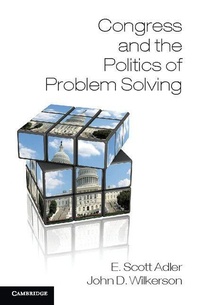
Congress and the Politics of Problem Solving
Published on 21. January 2013
Book
Hardback
259 pages
978-1-107-02318-5 (ISBN)
Description
How do issues end up on the agenda? Why do lawmakers routinely invest in program oversight and broad policy development? What considerations drive legislative policy change? For many, Congress is an institution consumed by partisan bickering and gridlock. Yet the institution's long history of addressing significant societal problems - even in recent years - seems to contradict this view. Congress and the Politics of Problem Solving argues that the willingness of many voters to hold elected officials accountable for societal conditions is central to appreciating why Congress responds to problems despite the many reasons mustered for why it cannot. The authors show that, across decades of policy making, problem-solving motivations explain why bipartisanship is a common pattern of congressional behavior and offer the best explanation for legislative issue attention and policy change.
Reviews / Votes
'In the end, I hope and expect that Adler and Wilkerson's challenging study will be widely read. A book that forces us to think hard about how we approach the study of Congress does not come along very often.' Paul J. Quirk, Congress and the PresidencyMore details
Language
English
Place of publication
Cambridge
United Kingdom
Target group
Professional and scholarly
Illustrations
38 Tables, unspecified; 20 Line drawings, unspecified
Dimensions
Height: 235 mm
Width: 157 mm
Thickness: 20 mm
Weight
581 gr
ISBN-13
978-1-107-02318-5 (9781107023185)
Copyright in bibliographic data and cover images is held by Nielsen Book Services Limited or by the publishers or by their respective licensors: all rights reserved.
Schweitzer Classification
Other editions
Additional editions
E. Scott Adler | John D. Wilkerson
Congress and the Politics of Problem Solving
E-Book
03/2013
1st Edition
Cambridge University Press
€26.49
Available for download
E. Scott Adler | John D. Wilkerson
Congress and the Politics of Problem Solving
Book
01/2013
Cambridge University Press
€39.50
Shipment within 15-20 days
E. Scott Adler
Congress and the Politics of Problem Solving
E-Book
01/2013
Cambridge University Press
€21.99
Available for download
Persons
Scott Adler is Associate Professor of Political Science at the University of Colorado, Boulder. He is a principal investigator of the Congressional Bills Project and the Congressional District Data Project. Among his publications are the books Why Congressional Reforms Fail: Reelection and the House Committee System and The Macropolitics of Congress. The former was awarded the Alan Rosenthal Prize from the Legislative Studies Section of the American Political Science Association. His research has also appeared in journals such as the American Journal of Political Science and Legislative Studies Quarterly. In 2006-7, Adler was Visiting Professor at the Center for the Study of American Politics and Department of Political Science, Yale University. He received a B.A. from the University of Michigan in 1988 and a Ph.D. from Columbia University in 1996. John Wilkerson is the Director of the Center for American Politics and Public Policy at the University of Washington. He is a principal investigator of the Congressional Bills Project, the Policy Agendas Project and the Comparative Agendas Project. His research has been published by leading scholarly journals including the American Political Science Review, the American Journal of Political Science, the Journal of Politics and Legislative Studies Quarterly. He teaches American politics and created the award-winning online congressional simulation, LegSim. He received his Ph.D. from the University of Rochester in 1991.
Content
Part I: 1. Congress and the politics of problem solving; 2. Problem-focused voters and congressional accountability; 3. Congressional approval and incumbent accountability; Part II: 4. Problem-solving constraints and legislative institutions; 5. Agenda scarcity, problem solving, and temporary legislation; Part III: 6. Rethinking committee reform; 7. Agenda setting in a problem-solving legislature; Part IV: 8. Problem solving and policy focal points; 9. Problem solving and policy change; 10. Problem solving and American politics.