

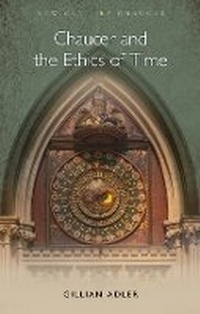
Chaucer and the Ethics of Time
Published on 15. February 2022
Book
Hardback
256 pages
978-1-78683-836-0 (ISBN)
Description
Geoffrey Chaucer wrote at a turning point in the history of timekeeping, but many of his poems demonstrate a greater interest in the moral dimension of time than in the mechanics of the medieval clock. Chaucer and the Ethics of Time examines Chaucer's sensitivity to the insecurity of human experience amid the temporal circumstances of change and time-passage, as well as strategies for ethicising historical vision in several of his major works. While wasting time was sometimes viewed as a sin in the late Middle Ages, Chaucer resists conventional moral dichotomies and explores a complex and challenging relationship between the interior sense of time and the external pressures of linearism and cyclicality. Chaucer's diverse philosophical ideas about time unfold through the reciprocity between form and discourse, thus encouraging a new look at not only the characters' ruminations on time in the tradition of St Augustine and Boethius, but also manifold narrative sequences and structures, including anachronism.
More details
Series
Language
English
Place of publication
Wales
United Kingdom
Target group
Professional and scholarly
Illustrations
No
Dimensions
Height: 216 mm
Width: 138 mm
ISBN-13
978-1-78683-836-0 (9781786838360)
Copyright in bibliographic data and cover images is held by Nielsen Book Services Limited or by the publishers or by their respective licensors: all rights reserved.
Schweitzer Classification
Person
This book is suitable for undergraduates, postgraduates, lecturers, and even general readers.
Content
List of Abbreviations
Introduction
1 Elegiac Time and the Pleasure of Forgetting in the Book of the Duchess
2 Seeing Time and the Illusion of Control in Troilus and Criseyde
3 'What may ever laste?': Narrativising Transience in the House of Fame
4 The Process of Time in the Parliament of Fowls
5 Nonlinear Time in Chaucer's Frame-Narrative and the Wife of Bath's Prologue
Conclusion
Notes
Bibliography
Introduction
1 Elegiac Time and the Pleasure of Forgetting in the Book of the Duchess
2 Seeing Time and the Illusion of Control in Troilus and Criseyde
3 'What may ever laste?': Narrativising Transience in the House of Fame
4 The Process of Time in the Parliament of Fowls
5 Nonlinear Time in Chaucer's Frame-Narrative and the Wife of Bath's Prologue
Conclusion
Notes
Bibliography