

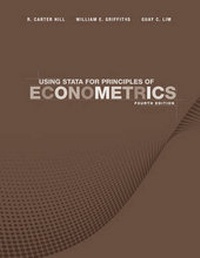
Using Stata for Principles of Econometrics
4th Edition
Will be published approx. on 6. December 2011
Book
Paperback/Softback
624 pages
978-1-118-03208-4 (ISBN)
Description
This is the Using Stata text for Principles of Econometrics, 4th Edition.
Principles of Econometrics is an introductory book for undergraduate students in economics and finance, and can be used for MBA and first-year graduate students in many fields. The 4th Edition provides students with an understanding of why econometrics is necessary and a working knowledge of basic econometric tools. This text emphasizes motivation, understanding and implementation by introducing very simple economic models and asking economic questions that students can answer.
Principles of Econometrics is an introductory book for undergraduate students in economics and finance, and can be used for MBA and first-year graduate students in many fields. The 4th Edition provides students with an understanding of why econometrics is necessary and a working knowledge of basic econometric tools. This text emphasizes motivation, understanding and implementation by introducing very simple economic models and asking economic questions that students can answer.
More details
Other editions
Previous edition

Lee C. Adkins | R. Carter Hill | William E. Griffiths
Using Stata for Principles of Econometrics
Book
02/2008
3rd Edition
Wiley
€49.51
Article exhausted; check for reprint
Persons
Lee C. Adkins and R. Carter Hill are the authors of Using Stata for Principles of Econometrics, 4th Edition, published by Wiley.
Content
1. Introducing Stata 1
2. Simple Linear Regression 53
3. Interval Estimation and Hypothesis Testing 103
4. Prediction, Goodness of Fit and Modeling Issues 123
5. Multiple Linear Regression 160
6. Further Inference in the Multiple Regression Model 181
7. Using Indicator Variables 211
8. Heteroskedasticity 247
9. Regression with Time-Series Data: Stationary Variables 269
10. Random Regressors and Moment Based Estimation 319
11. Simultaneous Equations Models 357
12. Regression with Time-Series Data: Nonstationary Variables 385
13. Vector Error Correction and Vector Autoregressive Models 407
14. Time-Varying Volatility and ARCH Models 426
15. Panel Data Models 442
16. Qualitative and Limited Dependent Variable Models 489
A. Review of Math Essentials 547
B. Review of Probability Concepts 555
C. Review of Statistical Inference 574
2. Simple Linear Regression 53
3. Interval Estimation and Hypothesis Testing 103
4. Prediction, Goodness of Fit and Modeling Issues 123
5. Multiple Linear Regression 160
6. Further Inference in the Multiple Regression Model 181
7. Using Indicator Variables 211
8. Heteroskedasticity 247
9. Regression with Time-Series Data: Stationary Variables 269
10. Random Regressors and Moment Based Estimation 319
11. Simultaneous Equations Models 357
12. Regression with Time-Series Data: Nonstationary Variables 385
13. Vector Error Correction and Vector Autoregressive Models 407
14. Time-Varying Volatility and ARCH Models 426
15. Panel Data Models 442
16. Qualitative and Limited Dependent Variable Models 489
A. Review of Math Essentials 547
B. Review of Probability Concepts 555
C. Review of Statistical Inference 574