

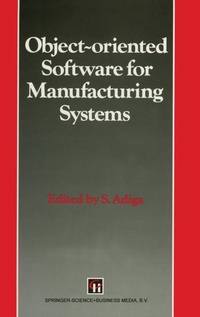
Object-oriented Software for Manufacturing Systems
1st Edition
Published on 22. July 1998
Book
Hardback
XVI, 270 pages
978-0-412-39750-9 (ISBN)
Description
This work introduces the benefits of object-oriented programming and discusses how the technology can be used to improve productivity in building software systems in the manufacturing domain. It addresses a wide range of issues from languages, design principles, research examples through to industrial applications and management issues. In essence, the main objective of the book is to interpret and apply object-oriented concepts in the context of designing manufacturing systems applications. The main audience for this book consists of professionals, engineers and managers, who deal with manufacturing systems, as well as students and educators looking for new directions in building software systems to solve problems in this area. The book should also be of special interest to engineering and computer professionals who have heard the term "object-oriented" and want to learn more about it and its importance, especially in designing software for manufacturing systems. This book should be of interest to: software and manufacturing engineers in industry; software consultants; technical managers; graduate students and researchers in computer-integrated manufacturing.
More details
Series
Edition
1., 998
Language
English
Place of publication
London
United Kingdom
Target group
College/higher education
Professional and scholarly
Research
Product notice
Paperback (trade)
sewn/stitched
Cloth over boards
Illustrations
XVI, 270 p.
Dimensions
Height: 241 mm
Width: 160 mm
Thickness: 22 mm
Weight
600 gr
ISBN-13
978-0-412-39750-9 (9780412397509)
DOI
10.1007/978-94-011-4844-3
Schweitzer Classification
Other editions
Additional editions
Book
10/2012
Springer
€53.49
Shipment within 15-20 days
Content
Part 1 Conceptual background, S. Adiga: introduction to OOS; OOS - relevance to manufacturing. Part 2 Design and implementation techniques: an architecture for OO applications in CIM environments, S. Adiga and P. Cogez; prototyping object systems and reusable object libraries, S. Adiga and M. Gadre; object-oriented databases, S. Adiga and J. Kolyer; comparing object-oriented programming languages, M. Gadre. Part 3 Manufacturing applications: flowstream - a factory floor management system, B. Lozier; OOPS in real-time control applications, D. Wilczynski and D.K. Wallace. Part 4 Management and organizational issues: management and organizational issues in adopting OO technology, A. Najmi.