

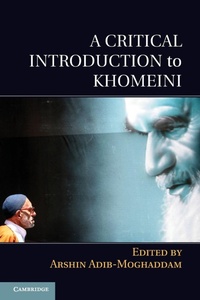
A Critical Introduction to Khomeini
Published on 10. February 2014
Book
Paperback/Softback
340 pages
978-1-107-67062-4 (ISBN)
Description
As the architect of the Iranian Revolution of 1979, Ayatollah Khomeini remains one of the most inspirational and enigmatic figures of the twentieth century. The revolution placed Iran at the forefront of Middle East politics and the Islamic revival. Twenty years after his death, Khomeini is revered as a spiritual and political figurehead in Iran and in large swathes of the Islamic world, while in the West he is remembered by many as a dictator and the instigator of Islamist confrontation. Arshin Adib-Moghaddam brings together distinguished and emerging scholars in this comprehensive volume, which covers all aspects of Khomeini's life and critically examines Khomeini the politician, the philosopher, and the spiritual leader, while considering his legacy in Iran and further afield in other parts of the Islamic world and the West. Written by scholars from varying disciplines, the book will prove invaluable to students and general readers interested in the life and times of Khomeini and the politics that he inspired.
Reviews / Votes
'This work is intended to provide advanced insight for students and researchers into the significance of Khomeini as a political innovator, religious leader, and historical figure in the establishment of the modern Islamic Republic of Iran. The essays cover topics such as Khomeini's role as a historical personality, his political philosophy and its application to the constitution and politics of Iran, his stance toward the West, and his attitudes toward issues of gender. Each contribution relates well to the theme, and the editor has done a remarkable job in integrating the work of various scholars. On the topic of Khomeini, this is one of the best works available. Summing up: highly recommended.' P. Rowe, ChoiceMore details
Language
English
Place of publication
Cambridge
United Kingdom
Target group
College/higher education
Professional and scholarly
Product notice
Paperback (trade)
Illustrations
1 Maps; 20 Halftones, unspecified; 1 Line drawings, unspecified
Dimensions
Height: 229 mm
Width: 152 mm
Thickness: 20 mm
Weight
562 gr
ISBN-13
978-1-107-67062-4 (9781107670624)
Copyright in bibliographic data and cover images is held by Nielsen Book Services Limited or by the publishers or by their respective licensors: all rights reserved.
Schweitzer Classification
Other editions
Additional editions
Arshin Adib-Moghaddam
A Critical Introduction to Khomeini
Book
02/2014
Cambridge University Press
€70.40
Shipment within 15-20 days
Arshin Adib-Moghaddam
A Critical Introduction to Khomeini
E-Book
01/2014
1st Edition
Cambridge University Press
€26.49
Available for download
Person
Dr Arshin Adib-Moghaddam is a Reader in Comparative Politics and International Relations and Chair of the Centre for Iranian Studies at the University of London's School of Oriental and African Studies. Cambridge educated, he held the first Jarvis Doctorow Fellowship at the University of Oxford.
Content
Introduction: Ayatollah Khomeini: a clerical revolutionary? Arshin Adib-Moghaddam; 1. Khomeini and the 'White Revolution' Fakhreddin Azimi; 2. The rise of Khomeinism: problematizing the politics of resistance in pre-revolutionary Iran Mojtaba Mahdavi; 3. Wilayat al-Faqih and the meaning of Islamic government Amr G. E. Sabet; 4. Ayatollah Khomeini's rule of the guardian jurist: from theory to practice Ali Rahnema; 5. Khatt-e imam: the followers of Khomeini's line L. A. Reda; 6. Khomeini and the West Mehran Kamrava; 7. Gendered Khomeini Azadeh Kian; 8. Hidden Khomeini: mysticism and poetry Lloyd Ridgeon; 9. The divine, the people, and the Faqih: on Khomeini's theory of sovereignty Behrooz Ghamari-Tabrizi; 10. Khomeini's legacy on women's rights and roles in the Islamic Republic of Iran Arzoo Osanloo; 11. To rule, or not to rule? An alternative look at the political life of Ayatollah Khomeini between 1960 and 1980 Sadegh Zibakalam; 12. Khomeini and the decolonization of the political S. Sayyid; 13. Contentious legacies of the Ayatollah Babak Rahimi.