

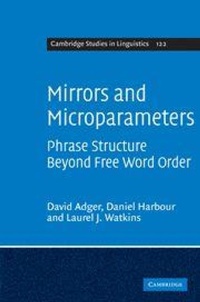
Mirrors and Microparameters
Phrase Structure beyond Free Word Order
Published on 27. October 2011
Book
Paperback/Softback
206 pages
978-1-107-40359-8 (ISBN)
Description
What is the nature of syntactic structure? Why do some languages have radically free word order ('nonconfigurationality')? Do parameters vary independently (the micro-view) or can they co-vary en masse (the macro-view)? Mirrors and Microparameters examines these questions by looking beyond the definitional criterion of nonconfigurationality - that arguments may be freely ordered, omitted, and split. Drawing on data from Kiowa, a member of the largely undescribed Kiowa-Tanoan language family, the book reveals that classically nonconfigurational languages can nonetheless exhibit robustly configurational effects. Reconciling the cooccurrence of such freedom with such rigidity has major implications for the Principles and Parameters program. This approach to nonconfigurational languages challenges widespread assumptions of linguistic theory and throws light on the syntactic structures, ordering principles, and nature of parametrization that comprise Universal Grammar.
More details
Series
Language
English
Place of publication
Cambridge
United Kingdom
Target group
Professional and scholarly
Product notice
Paperback (trade)
Illustrations
Worked examples or Exercises
Dimensions
Height: 229 mm
Width: 152 mm
Thickness: 11 mm
Weight
307 gr
ISBN-13
978-1-107-40359-8 (9781107403598)
Copyright in bibliographic data and cover images is held by Nielsen Book Services Limited or by the publishers or by their respective licensors: all rights reserved.
Schweitzer Classification
Other editions
Additional editions
David Adger | Daniel Harbour | Laurel J. Watkins
Mirrors and Microparameters
Phrase Structure beyond Free Word Order
Book
10/2009
Cambridge University Press
€79.40
Shipment within 15-20 days
Persons
Content
1. Introduction; 2. Nonconfigurationality and polysynthesis; 3. The clausal spin; 4. Making mirrors; 5. Interface properties of clausal domains; 6. Anti-quantification and the syntax-semantics interface; 7. Conclusion.