

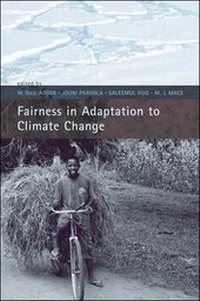
Fairness in Adaptation to Climate Change
Published on 28. April 2006
Book
Hardback
312 pages
978-0-262-01227-0 (ISBN)
Description
As a global society, we need to take action not only to prevent the potentially
catastrophic effects of climate change but also to adapt to the unavoidable effects of climate
change already imposed on the world. Fairness in Adaptation to Climate Change looks at the
challenges of ensuring that policy responses to climate change do not place undue and unfair burdens
on already vulnerable populations. All countries will be endangered by climate change risks from
flood, drought, and other extreme weather events, but developing countries are more dependent on
climate-sensitive livelihoods such as farming and fishing and hence are more vulnerable. Despite
this, the concerns of developing countries are marginalized in climate policy decisions that
exacerbate current vulnerabilities.Fairness in Adaptation to Climate Change brings together scholars
from political science, economics, law, human geography, and climate science to offer the first
assessment of the social justice issues in adaptation to climate change. The book outlines the
philosophical underpinnings of different types of justice in relation to climate change, present
inequities, and future burdens, and it applies these to real world examples of climate change
adaptation in Bangladesh, Tanzania, Botswana, Namibia, and Hungary. It argues that the key to
adapting to climate change lies in recognizing the equity and justice issues inherent in its causes
and in human responses to it.Contributors:W. Neil Adger, Paul Baer, Jon Barnett, Maria Bohn, Kirstin
Dow, Saleemul Huq, Roger E. Kasperson, Mizan R. Khan, Janica Lane, Neil A. Leary, Robin Leichenko,
Joanne Linnerooth-Bayer, M. J. Mace, Karen O'Brien, Jouni Paavola, Stephen H. Schneider, David S. G.
Thomas, Chasca Twyman, Anna Vári
catastrophic effects of climate change but also to adapt to the unavoidable effects of climate
change already imposed on the world. Fairness in Adaptation to Climate Change looks at the
challenges of ensuring that policy responses to climate change do not place undue and unfair burdens
on already vulnerable populations. All countries will be endangered by climate change risks from
flood, drought, and other extreme weather events, but developing countries are more dependent on
climate-sensitive livelihoods such as farming and fishing and hence are more vulnerable. Despite
this, the concerns of developing countries are marginalized in climate policy decisions that
exacerbate current vulnerabilities.Fairness in Adaptation to Climate Change brings together scholars
from political science, economics, law, human geography, and climate science to offer the first
assessment of the social justice issues in adaptation to climate change. The book outlines the
philosophical underpinnings of different types of justice in relation to climate change, present
inequities, and future burdens, and it applies these to real world examples of climate change
adaptation in Bangladesh, Tanzania, Botswana, Namibia, and Hungary. It argues that the key to
adapting to climate change lies in recognizing the equity and justice issues inherent in its causes
and in human responses to it.Contributors:W. Neil Adger, Paul Baer, Jon Barnett, Maria Bohn, Kirstin
Dow, Saleemul Huq, Roger E. Kasperson, Mizan R. Khan, Janica Lane, Neil A. Leary, Robin Leichenko,
Joanne Linnerooth-Bayer, M. J. Mace, Karen O'Brien, Jouni Paavola, Stephen H. Schneider, David S. G.
Thomas, Chasca Twyman, Anna Vári
More details
Language
English
Place of publication
Cambridge, Mass.
United States
Publishing group
MIT Press Ltd
Target group
Professional and scholarly
Interest Age: From 18 years
Illustrations
17 illus.
Dimensions
Height: 229 mm
Width: 152 mm
Thickness: 0 mm
Weight
454 gr
ISBN-13
978-0-262-01227-0 (9780262012270)
Copyright in bibliographic data and cover images is held by Nielsen Book Services Limited or by the publishers or by their respective licensors: all rights reserved.
Schweitzer Classification
Persons
Jouni Paavola is Senior Research Fellow at the Centre for Social and Economic Research on the Global Environment at the University of East Anglia.
Saleemul Huq is Director of the Climate Change Programme at the International Institute for Environment and Development in London.
W. Neil Adger leads the research effort on adaptation at the Tyndall Centre for Climate Change Research at the University of East Anglia.
M. J. Mace is a staff lawyer at the Foundation for International Environmental Law and Development's Climate Change and Energy Programme.
Saleemul Huq is Director of the Climate Change Programme at the International Institute for Environment and Development in London.
W. Neil Adger leads the research effort on adaptation at the Tyndall Centre for Climate Change Research at the University of East Anglia.
M. J. Mace is a staff lawyer at the Foundation for International Environmental Law and Development's Climate Change and Energy Programme.