

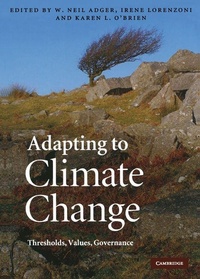
Adapting to Climate Change
Thresholds, Values, Governance
Published on 25. June 2009
Book
Hardback
532 pages
978-0-521-76485-8 (ISBN)
Description
Adapting to climate change is a critical problem facing humanity. This involves reconsidering our lifestyles, and is linked to our actions as individuals, societies and governments. This book presents top science and social science research on whether the world can adapt to climate change. Written by experts, both academics and practitioners, it examines the risks to ecosystems, demonstrating how values, culture and the constraining forces of governance act as barriers to action. As a review of science and a holistic assessment of adaptation options, it is essential reading for those concerned with responses to climate change, especially researchers, policymakers, practitioners, and graduate students. Significant features include historical, contemporary, and future insights into adaptation to climate change; coverage of adaptation issues from different perspectives: climate science, hydrology, engineering, ecology, economics, human geography, anthropology and political science; and contributions from leading researchers and practitioners from around the world.
Reviews / Votes
Review of the hardback: 'This book is a major contribution to a subject that has hitherto been far too little studied and commented on. 'Adaptation' to climate change sounds a simple idea, but turns out to be a complex and problematic one. Everyone involved in the debate about how to cope with global warming will profit by studying the diverse contributions this volume contains.' Lord Tony Giddens, London School of Economics and Political Science Review of the hardback: 'A fascinating collection of papers addressing adaptation to climate change in all its complexity, ranging geographically from the Inuit of Arctic Canada to the African Sahel via the inhabitants of Boscastle in Cornwall. On the way, it explores from the perspectives of many different writers the factors that enable and encourage communities to adapt, and the factors that hold them back. The book has a richness and depth of thinking that makes it required reading for all who seek to understand why some communities live in harmony with their climatic environment whilst others fail, and what this means for the future of society as a whole as it seeks to come to terms with climate change.' Jean Palutikof National Climate Change Adaptation Research Facility, Griffith University 'This book provokes thought ... it succeeds in bringing together a wide-ranging group of specialists and provides valuable synopses of vital aspects of climate change science and social science.' A. M. Mannion, The Biologist 'This book presents a wide range of ideas and approaches to adapting to climate change. ... The book provides a good overview of the challenges facing those studying adaptation and those seeking to adapt to climate change ... there are many thought provoking chapters covering a diverse range of subects. ... the book is a must read for anyone, researcher or policy-maker working in the area of adaptation.' The Geographical JournalMore details
Language
English
Place of publication
Cambridge
United Kingdom
Target group
Professional and scholarly
Illustrations
38 tones 28 tables
Dimensions
Height: 260 mm
Width: 183 mm
Thickness: 33 mm
Weight
1184 gr
ISBN-13
978-0-521-76485-8 (9780521764858)
Copyright in bibliographic data and cover images is held by Nielsen Book Services Limited or by the publishers or by their respective licensors: all rights reserved.
Schweitzer Classification
Other editions
Additional editions
W. Neil Adger | Irene Lorenzoni | Karen L. O'Brien
Adapting to Climate Change
Thresholds, Values, Governance
Book
11/2010
Cambridge University Press
€94.20
Shipment within 15-20 days
W. Neil Adger | Irene Lorenzoni | Karen L. O'Brien
Adapting to Climate Change
Thresholds, Values, Governance
E-Book
09/2009
1st Edition
Cambridge University Press
€64.99
Available for download
Persons
W. Neil Adger is Professor of Environmental Economics in the School of Environmental Sciences at the University of East Anglia, Norwich, UK. He has led the programme on adaptation in the Tyndall Centre for Climate Change Research at the University of East Anglia since its inception in 2000. He served as a Lead Author in the Millennium Ecosystem Assessment and as a Convening Lead Author for the Fourth Assessment Report of the Intergovernmental Panel of Climate Change. He is a co-recipient as a member of the IPCC of the Nobel Peace Prize 2007. He was awarded a Philip Leverhulme Prize from the Leverhulme Trust in 2001 for his research achievements. Irene Lorenzoni is Lecturer in Environmental Politics and Governance at the School of Environmental Sciences at the University of East Anglia, Norwich, UK. Her interest is in the understanding of, and engagement with, climate change and energy. She is deputy leader of the adaptation programme of the Tyndall Centre for Climate Change Research, and a contributing author for the Fourth Assessment Report of the IPCC on barriers to adaptation, which was co-awarded the Nobel Peace Prize in 2007. Karen L. O'Brien is a Professor in the Department of Sociology and Human Geography at the University of Oslo, Norway and Scientific Chair of the Global Environmental Change and Human Security (GECHS) project of the International Human Dimensions Programme on Global Environmental Change (IHDP). Her current research focuses on climate change adaptation as a social process, and on the role that values and worldviews play in responding to environmental change. She was a lead author on the Fourth Assessment Report of the IPCC.
Content
Introduction; 1. Adaptation now; Part I. Adapting to Thresholds in Physical and Ecological Systems: 2. Ecological limits of adaptation to climate change; 3. Adapting to the effects of climate change on water supply reliability; 4. Protecting London from tidal flooding: limits to engineering adaptation; 5. Climate prediction: a limit to adaptation?; 6. Learning to crawl: how to use seasonal climate forecasts to build adaptive capacity; 7. Norse Greenland settlement and limits to adaptation; 8. Sea ice change in Arctic Canada: are there limits to Inuit adaptation?; Part II. The Role of Value and Culture in Adaptation: 9. The past, present and some possible futures of adaptation; 10. Do values subjectively define the limits to climate change adaptation?; 11. Conceptual and practical barriers to adaptation: vulnerability and responses to heat waves in the UK; 12. Values and cost-benefit analysis: economic efficiency criteria in adaptation; 13. Hidden costs and disparate uncertainties: trade-offs in approaches to climate policy; 14. Community based adaptation and culture in theory and practice; 15. Exploring the invisibility of local knowledge in decision-making: the Boscastle harbour flood disaster; 16. Adaptation and conflict within fisheries: insights for living with climate change; 17. Exploring cultural dimensions of adaptation to climate change; 18. Adapting to an uncertain climate on the great plains: testing hypotheses on historical populations; 19. Climate change and adaptive human migration: lessons from rural North America; Part III. Governance, Knowledge and Technologies for Adaptation: 20. Are our levers long and our fulcra strong enough? Exploring the soft underbelly of adaptation decisions and actions; 21. Decentralized planning and climate adaptation: toward transparent governance; 22. Climate adaptation, local institutions and rural livelihoods; 23. Adaptive governance for a changing coastline: science, policy and publics in search of a sustainable future; 24. Climate change, international cooperation and adaptation in transboundary water management; 25. Decentralization: a window of opportunity for successful adaptation to climate change?; 26. Adapting to climate change: the nation-state as problem and solution; 27. Limits to adaptation: analysing institutional constraints; 28. Accessing diversification, networks and traditional resource management as adaptations to climate extremes; 29. Governance limits to effective global financial support for adaptation; 30. Organizational learning and governance in adaptation in urban development; 31. Conclusions: transforming the world; Index.