

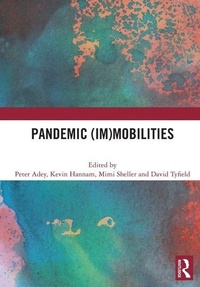
Pandemic (Im)mobilities
1st Edition
Will be published approx. on 20. July 2026
Book
Paperback/Softback
156 pages
978-1-032-86143-2 (ISBN)
Description
In this book leading social science and humanities contributors in the field of mobilities research address the multiple issues generated by the COVID-19 pandemic and its aftermaths. Contributors examine how the pandemic intensified the existing and uneven ways that we move at multiple scales, from the mobilities of viruses to global planetary movements.
As the SARS-CoV-2 coronavirus, or COVID-19 pandemic swept around the world, outpacing public health efforts to contain it, many everyday human mobilities were brought to an abrupt halt in the emergency, while others were drastically reorganized. Viral mobilities unleashed not just a disruption of human mobilities, but also a vast intensification of the existing and uneven ways that we move or don't move: such as in the contexts of tourism and international travel; in how mobilities are governed in cities, or through migration controls at and away from borders; in relation to climate change policies and transitions to net zero; in forms of transportation through which everyday life and work practices are undertaken and reproduced and, ultimately, in the way mobility is (re)valued and felt during and after a global crisis. Chapters in this book address the multiple issues generated by the pandemic and its relation to complex (im)mobilities and the ways they are governed and lived, at many scales, as well as deeper theoretical and methodological issues that arise, such as how to tell stories and visualise (im)mobilities of life under lockdown.
The book was originally published as a special issue of the Mobilities journal.
As the SARS-CoV-2 coronavirus, or COVID-19 pandemic swept around the world, outpacing public health efforts to contain it, many everyday human mobilities were brought to an abrupt halt in the emergency, while others were drastically reorganized. Viral mobilities unleashed not just a disruption of human mobilities, but also a vast intensification of the existing and uneven ways that we move or don't move: such as in the contexts of tourism and international travel; in how mobilities are governed in cities, or through migration controls at and away from borders; in relation to climate change policies and transitions to net zero; in forms of transportation through which everyday life and work practices are undertaken and reproduced and, ultimately, in the way mobility is (re)valued and felt during and after a global crisis. Chapters in this book address the multiple issues generated by the pandemic and its relation to complex (im)mobilities and the ways they are governed and lived, at many scales, as well as deeper theoretical and methodological issues that arise, such as how to tell stories and visualise (im)mobilities of life under lockdown.
The book was originally published as a special issue of the Mobilities journal.
More details
Language
English
Place of publication
London
United Kingdom
Publishing group
Taylor & Francis Ltd
Target group
College/higher education
Postgraduate, Undergraduate Advanced, and Undergraduate Core
Dimensions
Height: 246 mm
Width: 174 mm
ISBN-13
978-1-032-86143-2 (9781032861432)
Copyright in bibliographic data and cover images is held by Nielsen Book Services Limited or by the publishers or by their respective licensors: all rights reserved.
Schweitzer Classification
Other editions
Additional editions
Peter Adey | Kevin Hannam | Mimi Sheller
Pandemic (Im)mobilities
E-Book
02/2025
Routledge
€73.99
Available for download
Peter Adey | Kevin Hannam | Mimi Sheller
Pandemic (Im)mobilities
E-Book
02/2025
Routledge
€73.99
Available for download
Peter Adey | Kevin Hannam | Mimi Sheller
Pandemic (Im)mobilities
Book
02/2025
1st Edition
Routledge
€205.90
Shipment within 10-20 days
Persons
Peter Adey is Professor of Human Geography at Royal Holloway University of London.
Kevin Hannam is Professor in the Faculty of Business at City University of Macau.
Mimi Sheller is Dean of the Global School at Worcester Polytechnic Institute.
David Tyfield is Professor of Sustainable Transitions and Political Economy at Lancaster University.
Kevin Hannam is Professor in the Faculty of Business at City University of Macau.
Mimi Sheller is Dean of the Global School at Worcester Polytechnic Institute.
David Tyfield is Professor of Sustainable Transitions and Political Economy at Lancaster University.
Content
Introduction: Pandemic (Im)mobilities 1. Existential vs. essential mobilities: insights from before, during and after a crisis 2. Anxious immobilities: an ethnography of coping with contagion (Covid-19) in Macau 3. Valuing mobility in a post COVID-19 world 4. Pandemic disruption, extended bodies, and elastic situations - Reflections on COVID-19 and Mobilities 5. What is the urban without physical mobilities? COVID-19-induced immobility in the mobile risk society 6. Pathological (Im)mobilities: managing risk in a time of pandemics 7. De-confining borders: towards a politics of freedom of movement in the time of the pandemic 8. Pandemic cartographies: a conversation on mappings, imaginings and emotions