

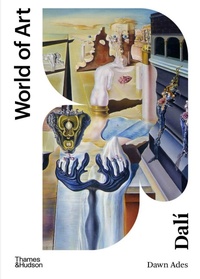
Dali
3rd Edition
Published on 7. April 2022
Book
Paperback/Softback
304 pages
978-0-500-20476-4 (ISBN)
Description
The third edition of this classic study, a thorough introduction to one of the most popular and recognizable artists of the 20th century.
Salvador Dali was, and remains, among the most universally recognizable artists of the twentieth century. What accounts for this popularity? His excellence as an artist? Or his genius as a self-publicist? In this searching text, partly based on interviews with the artist and fully revised, extended and updated for this edition, Dawn Ades considers the Dali phenomenon. From his early years, his artistic friendships and the development of his technique and style, to his relationship with the Surrealists and exploitation of Freudian ideas, and on to his post-war paintings, this essential study places Dali in social, historical and artistic context, and casts new light on the full range of his creativity.
Salvador Dali was, and remains, among the most universally recognizable artists of the twentieth century. What accounts for this popularity? His excellence as an artist? Or his genius as a self-publicist? In this searching text, partly based on interviews with the artist and fully revised, extended and updated for this edition, Dawn Ades considers the Dali phenomenon. From his early years, his artistic friendships and the development of his technique and style, to his relationship with the Surrealists and exploitation of Freudian ideas, and on to his post-war paintings, this essential study places Dali in social, historical and artistic context, and casts new light on the full range of his creativity.
Reviews / Votes
'One of our foremost historians of Surrealism ... has had access to her subject - a privilege available to few - and her book is particularly revealing' - The Spectator 'A sensitive art-historical study' - Times Literary Supplement 'Richly documented and illustrated' - Arts ReviewMore details
Series
Edition
Third edition
Language
English
Place of publication
London
United Kingdom
Edition type
Revised edition
Product notice
Paperback (trade)
Unsewn / adhesive bound
Illustrations
197 Illustrations, color
Dimensions
Height: 208 mm
Width: 149 mm
Thickness: 20 mm
Weight
636 gr
ISBN-13
978-0-500-20476-4 (9780500204764)
Copyright in bibliographic data and cover images is held by Nielsen Book Services Limited or by the publishers or by their respective licensors: all rights reserved.
Schweitzer Classification
Person
Dawn Ades is Professor Emerita of the History and Theory of Art at the University of Essex. She has written extensively on Dada, Surrealism, photography and women artists, among other things. Publications include Dada and Surrealism Reviewed, Writings on Art and Anti-Art, Marcel Duchamp (with Neil Cox and David Hopkins) and Photomontage. Among the exhibitions she has organised or co-organised are 'Art in Latin America' (1989); 'Fetishism: Visualising Power and Desire' (1995); 'Salvador Dali: The Centenary Retrospective' (2004); 'Undercover Surrealism' (2006); and 'Dali/Duchamp' (2017-18).
Content
Preface
Chronology
1. Early years: Early influences; Madrid School of Fine Arts; Cubism and Purism; first one-man exhibitions.
2. Dali and the Catalan avant-garde: The Catalan Anti-Artistic Manifesto and the L'Amic de les Arts group; Dali's early writings on painting, photography and film; Luis Bunuel and the making of Un Chien Andalou; Surrealism in Spain and its influence on Dali.
3. Dali, Surrealism and psycho-analysis: Dali's official affiliation with the Surrealist movement; the influence of Freud and psycho-analysis on his painting; collage; the legend of William Tell as obsessive theme; Dali's theoretical differences with Breton, and relationship with Surrealism on questions of taste and politics; Dali, history and tradition.
4. Painting and the paranoiac-critical method: Theory and practice of paranoia-criticism; influence of Lacan; relationship with other Surrealist methods like automatism and the dream; The Tragic Myth of Millet's Angelus as paranoiac-critical analysis.
5. Dali and the Surrealist object: Dali's 'Surrealist object functioning symbolically'; the object in relation to Surrealist theory; found or 'involuntary' and imaginary objects; furniture, spectacle, installations and exhibitions; Dali's jewels. 6. Dali's post-war painting: Modern science and mysticism; variety of visual experiment; use of photography, holography and stereoscopy.
7. Dali and the cinema: Dali and L'Age d'or; Short Critical History of the Cinema; unrealized scenarios; Hollywood collaborations and other film projects.
Select Bibliography
Chronology
1. Early years: Early influences; Madrid School of Fine Arts; Cubism and Purism; first one-man exhibitions.
2. Dali and the Catalan avant-garde: The Catalan Anti-Artistic Manifesto and the L'Amic de les Arts group; Dali's early writings on painting, photography and film; Luis Bunuel and the making of Un Chien Andalou; Surrealism in Spain and its influence on Dali.
3. Dali, Surrealism and psycho-analysis: Dali's official affiliation with the Surrealist movement; the influence of Freud and psycho-analysis on his painting; collage; the legend of William Tell as obsessive theme; Dali's theoretical differences with Breton, and relationship with Surrealism on questions of taste and politics; Dali, history and tradition.
4. Painting and the paranoiac-critical method: Theory and practice of paranoia-criticism; influence of Lacan; relationship with other Surrealist methods like automatism and the dream; The Tragic Myth of Millet's Angelus as paranoiac-critical analysis.
5. Dali and the Surrealist object: Dali's 'Surrealist object functioning symbolically'; the object in relation to Surrealist theory; found or 'involuntary' and imaginary objects; furniture, spectacle, installations and exhibitions; Dali's jewels. 6. Dali's post-war painting: Modern science and mysticism; variety of visual experiment; use of photography, holography and stereoscopy.
7. Dali and the cinema: Dali and L'Age d'or; Short Critical History of the Cinema; unrealized scenarios; Hollywood collaborations and other film projects.
Select Bibliography