

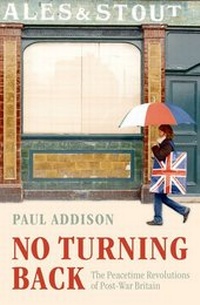
No Turning Back
The Peacetime Revolutions of Post-War Britain
Published on 24. June 2010
Book
Hardback
464 pages
978-0-19-219267-7 (ISBN)
Description
In No Turning Back, Paul Addison takes the long view, charting the vastly changing character of British society since the end of the Second World War. As he shows, in this period a series of peaceful revolutions has completely transformed the country so that, with the advantage of a longer perspective, the comparative peace and growing prosperity of the second half of the twentieth century appear as more powerful solvents of settled ways of life than the
Battle of the Somme or the Blitz.
We have come to take for granted a welfare state which would have seemed extraordinary to our forebears in the first decades of the century, based upon the achievement of a hitherto undreamed of mass prosperity. Much of the sexual morality preached if not practised for centuries has been dismantled with the creation of a 'permissive society'. The employment and career chances of women have been revolutionized. A white nation has been transformed into a multiracial one. An economy founded on
manufacturing under the watchful eye of the 'gentlemen in Whitehall' has morphed into a free market system, heavily dependent on finance, services, and housing, while a predominantly working class society has evolved into a predominantly middle class one. And the United Kingdom, which once looked as
solid as the rock of Gibraltar, now looks increasingly fragile, as Wales and especially Scotland have started to go their separate ways.
The book ends with an assessment of the gains and losses that have resulted. As this makes clear, this is not a story of progress pure and simple, it is a story of fundamental transformation in which much has been gained and much also lost, perhaps above all a sense of the ties that used to bind people together. Paul Addison brings to it the personal point of view of someone who has lived through it all and seen the Britain of his youth turn into a very different country, but who in the final
reckoning still prefers the present to the past.
Battle of the Somme or the Blitz.
We have come to take for granted a welfare state which would have seemed extraordinary to our forebears in the first decades of the century, based upon the achievement of a hitherto undreamed of mass prosperity. Much of the sexual morality preached if not practised for centuries has been dismantled with the creation of a 'permissive society'. The employment and career chances of women have been revolutionized. A white nation has been transformed into a multiracial one. An economy founded on
manufacturing under the watchful eye of the 'gentlemen in Whitehall' has morphed into a free market system, heavily dependent on finance, services, and housing, while a predominantly working class society has evolved into a predominantly middle class one. And the United Kingdom, which once looked as
solid as the rock of Gibraltar, now looks increasingly fragile, as Wales and especially Scotland have started to go their separate ways.
The book ends with an assessment of the gains and losses that have resulted. As this makes clear, this is not a story of progress pure and simple, it is a story of fundamental transformation in which much has been gained and much also lost, perhaps above all a sense of the ties that used to bind people together. Paul Addison brings to it the personal point of view of someone who has lived through it all and seen the Britain of his youth turn into a very different country, but who in the final
reckoning still prefers the present to the past.
Reviews / Votes
For any student of Britain in the modern era this is, quite simply, a must-have book. * British Scholar website * This is an outstanding and immenley readable book, light in touch, wide in breadth and with a clear case. * Robert Giddings, Tribune * Addison's book is clear enough for a general reader, but also has enough meat for an academic audience. * Joe Moran, History Today * For someone new to postwar history, this offers one of the best single-volume accounts: clear, authoritative and wide-ranging. * Joe Moran, History Today * A balanced, authoritative, deeply civilised survey. * David Kynaston, Financial Times * Few of the pages...go by without an eye-opening factoid to enlighten or a hitherto unheard anecdote to amuse. * Christopher Bray, The Independent on Sunday *More details
Language
English
Place of publication
Oxford
United Kingdom
Illustrations
20 black and white halftones
Dimensions
Height: 235 mm
Width: 159 mm
Thickness: 31 mm
Weight
842 gr
ISBN-13
978-0-19-219267-7 (9780192192677)
Copyright in bibliographic data and cover images is held by Nielsen Book Services Limited or by the publishers or by their respective licensors: all rights reserved.
Schweitzer Classification
Other editions
Additional editions
Paul Addison
No Turning Back: The Peacetime Revolutions of Post-War Britain
The Peacetime Revolutions of Post-War Britain
E-Book
06/2010
1st Edition
OUP Oxford
€43.99
Available for download
Person
Paul Addison taught history at the University of Edinburgh from 1967 to 1996 and was Director of the Centre for Second World War Studies (now the Centre for the Study of the Two World Wars) at Edinburgh from 1996 to 2005. Among his other publications are The Road to 1945: British Politics and the Second World War (1975), Now The War Is Over: A Social History of Britain from 1945 to 1951 (1985), Churchill: The Unexpected Hero (2003) and
A Companion to Contemporary Britain 1939-2000 (2005), which he edited with Harriet Jones. A former Visiting Fellow of All Souls, he is currently an Honorary Fellow at the Centre for the Study of the Two World Wars.
A Companion to Contemporary Britain 1939-2000 (2005), which he edited with Harriet Jones. A former Visiting Fellow of All Souls, he is currently an Honorary Fellow at the Centre for the Study of the Two World Wars.
Content
PART I: THE AFTERMATH 1945-1957; PART II: THE QUEST FOR MODERNITY 1957-1974; PART III: TRANSFORMATIONS 1974-1990