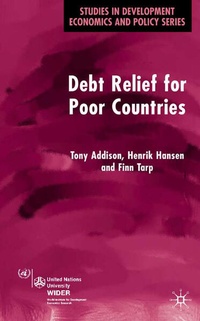
After a massive international campaign calling attention to the development impact of foreign debt, the Heavily Indebted Poor Countries (HIPC) initiative is now underway. But will the HIPC Initiative meet its high expectations? Will debt relief substantially raise growth? How do we make sure that debt relief benefits poor people? And how can we ensure that poor countries do not become highly indebted again? These are some of the key policy issues covered in this rigorous and independent analysis of debt, development, and poverty.
Reviews / Votes
'It seems that with each new book it issues, UNU-WIDER further establishes its reputation as the intellectual leader among international organisations. This volume on debt is particularly outstanding. The chapters by the editors and their co-authors are quite impressive. The book should be read both by the novice and specialist.' - John Weeks, Professor of Development Economics, SOAS, University of London, UK
'The international financial institutions agreed to debt relief for the poorest countries, under pressure from the countries themselves and a vigorous NGO campaign. This extremely useful book provides in-depth analysis of the results of the debt relief contained in HIPC: they are positive, but small. Unfortunately, as the book demonstrates, HIPC debt relief will not provide the solution to the development problems of most poor countries.' - Frances Stewart, Director, Queen Elizabeth House, University of Oxford, UK
'Can debt relief be a powerful tool for advancing human rights, helping to save literally millions of lives, and for laying the foundations for economic growth, as its proponents often claim? In this pioneering volume, a group of economists challenge some of these unquestioned assumptions. Using empirical evidence, they concluded that: it is difficult to measure accurately the effect of debt relief on economic growth and poverty reduction; that the degree to which debt relief can contribute to poverty reduction largely depends on the existence of hospitable domestic and international policy environment; and that the quality of national institutions determine the effectiveness of debt relief on the ground. These are important and timely contributions that will deepen the debate on debt relief and poverty reduction.' - Fantu Cheru, Professor, School of International Service, American University, USA
'...the papers collected in this volume represent a very welcome addition to the literature.' - Andrew Mold - Journal of International Development
Series
Edition
Language
Place of publication
Publishing group
Target group
Professional and scholarly
Product notice
sewn/stitched
Cloth over boards
With dust jacket
Illustrations
Dimensions
Height: 226 mm
Width: 139 mm
Thickness: 23 mm
Weight
ISBN-13
978-1-4039-3482-6 (9781403934826)
DOI
Schweitzer Classification
JEAN-CLAUDE BERTHÉLEMY Professor of Economics, University of Paris 1 Pantheon Sorbonne, France
ARNE BIGSTEN Professor of Development Economics, Göteborg University, Sweden
NANCY BIRDSALL Founding President, Center for Global Development, Washington, USA
ABDUR R. CHOWDHURY Director, Economic Analysis Division, United Nations Commission for Europe, Geneva, Switzerland
STIJN CLAESSENS Professor of International Finance, University of Amsterdam, The Netherlands
ERA DABLA-NORRIS International Monetary Fund, USA
ISHAC DIWAN Company Director for Ethiopia and Sudan, World Bank, USA
BENNO FERRARINI Director of Economic Research at the World Trade Institute, Switzerland
RASMUS HELTBERG World Bank, USA
JÖRGEN LEVIN Research Fellow, Örebo University, Sweden
JOHN M. MATOVU International Monetary Fund, USA
OLIVER MORRISSEY Director, Centre for Research in Economic Development and International Trade, University of Nottingham, UK
MACHIKO NISSANKE Head of Economic Department, School of Oriental and African Studies, University of London, UK
CATHERINE PATTILLO Senior Economist, International Monetary Fund, USA
HÅKAN PERSSON Associate Professor of Economics, Örebo University, Sweden
HÉLÈNE POIRSON Economist, International Monetary Fund, USA
AMINUR RAHMAN PhD candidate in economics, University College, London, UK
LUCA ANTONIO RICCI International Monetary Fund, USA
KENNTH SIMLER Research Fellow, International Food Policy Institute, Washington, USA
PAUL WADE World Bank,USA
PART I: EVALUATING DEBT RELIEF Introduction; T.Addison, H.Hansen & F.Tarp Debt Dynamics and Contingency Financing: Theoretical Reappraisal of the HIPC Initiative; M.Nissanke & B.Ferrarini Policy Selectivity Forgone: Debt and Donor Behaviour in Africa; N.Birdsall, S.Claessens & I.Diwan HIPC Debt Relief and Policy Reform Incentives; J-C.Berthélemy Resolving the HIPC Problem: Is Good Policy Enough? T.Addison & A.Rahman PART II: GROWTH EFFECTS OF DEBT RELIEF External Debt and Growth: Implications for HIPC Countries; C.Pattillo, H.Poirson & L.A.Ricci The Impact of External Aid and External Debt on Growth and Investment; H.Hansen External Debt, Growth and the HIPC Initiative: Is the Country Choice Too Narrow?; A.R.Chowdhury Debt Relief and Growth: A Study of Zambia and Tanzania; A.Bigsten, J.Levin & H.Persson PART III: POVERTY EFFECTS OF DEBT RELIEF Public Spending and Poverty in Mozambique; R.Heltberg, K.Simler & F.Tarp Debt Relief, Demand for Education, and Poverty; E.Dabla-Norris, J.M.Matovu & P.Wade Making Debt Relief Conditionality Pro-Poor; O.Morrissey