

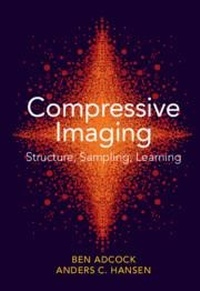
Compressive Imaging: Structure, Sampling, Learning
Published on 16. September 2021
Book
Hardback
614 pages
978-1-108-42161-4 (ISBN)
Description
Accurate, robust and fast image reconstruction is a critical task in many scientific, industrial and medical applications. Over the last decade, image reconstruction has been revolutionized by the rise of compressive imaging. It has fundamentally changed the way modern image reconstruction is performed. This in-depth treatment of the subject commences with a practical introduction to compressive imaging, supplemented with examples and downloadable code, intended for readers without extensive background in the subject. Next, it introduces core topics in compressive imaging - including compressed sensing, wavelets and optimization - in a concise yet rigorous way, before providing a detailed treatment of the mathematics of compressive imaging. The final part is devoted to recent trends in compressive imaging: deep learning and neural networks. With an eye to the next decade of imaging research, and using both empirical and mathematical insights, it examines the potential benefits and the pitfalls of these latest approaches.
More details
Language
English
Place of publication
Cambridge
United Kingdom
Target group
Professional and scholarly
Illustrations
Worked examples or Exercises
Dimensions
Height: 252 mm
Width: 178 mm
Thickness: 34 mm
Weight
1314 gr
ISBN-13
978-1-108-42161-4 (9781108421614)
Copyright in bibliographic data and cover images is held by Nielsen Book Services Limited or by the publishers or by their respective licensors: all rights reserved.
Schweitzer Classification
Other editions
Additional editions
Ben Adcock | Anders C. Hansen
Compressive Imaging: Structure, Sampling, Learning
E-Book
09/2021
Cambridge University Press
€63.49
Available for download
Persons
Ben Adcock is Associate Professor of Mathematics at Simon Fraser University. He received the CAIMS/PIMS Early Career Award (2017), an Alfred P. Sloan Research Fellowship (2015) and a Leslie Fox Prize in Numerical Analysis (2011). He has published fifteen conference proceedings, two book chapters and over fifty peer-reviewed journal articles. His work has been published in outlets such as SIAM Review and Proceedings of the National Academy of Sciences, and featured on the cover of SIAM News.
Content
1. Introduction; Part I. The Essentials of Compressive Imaging: 2. Images, transforms and sampling; 3. A short guide to compressive imaging; 4. Techniques for enhancing performance; Part II. Compressed Sensing, Optimization and Wavelets: 5. An introduction to conventional compressed sensing; 6. The LASSO and its cousins; 7. Optimization for compressed sensing; 8. Analysis of optimization algorithms; 9. Wavelets; 10. A taste of wavelet approximation theory; Part III. Compressed Sensing with Local Structure: 11. From global to local; 12. Local structure and nonuniform recovery; 13. Local structure and uniform recovery; 14. Infinite-dimensional compressed sensing; Part IV. Compressed Sensing for Imaging: 15. Sampling strategies for compressive imaging; 16. Recovery guarantees for wavelet-based compressive imaging; 17. Total variation minimization; Part V. From Compressed Sensing to Deep Learning: 18. Neural networks and deep learning; 19. Deep learning for compressive imaging; 20. Accuracy and stability of deep learning for compressive imaging; 21. Stable and accurate neural networks for compressive imaging; 22. Epilogue; Appendices: A. Linear Algebra; B. Functional analysis; C. Probability; D. Convex analysis and convex optimization; E. Fourier transforms and series; F. Properties of Walsh functions and the Walsh transform; Notation; Abbreviations; References; Index.