

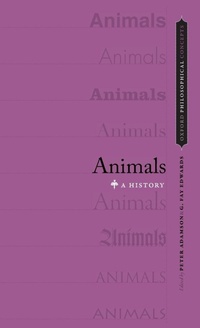
Animals
A History
Published on 28. June 2018
Book
Hardback
472 pages
978-0-19-937596-7 (ISBN)
Description
Philosophical controversy over non-human animals extends further back than many realize -- before Utilitarianism and Darwinism to the very genesis of philosophy. This volume examines the richness and complexity of that long history.
Twelve essays trace the significance of animals from Greek and Indian antiquity through the Islamic and Latin medieval traditions, to Renaissance and early modern thought, ending with contemporary notions about animals. Two main questions emerge throughout the volume: what capacities can be ascribed to animals, and how should we treat them? Notoriously ungenerous attitudes towards animals' mental lives and ethics status, found for instance in Aristotle and Descartes, are shown to have been more nuanced than often supposed, while remarkable defenses of benevolence towards animals are unearthed in late antiquity, India, the Islamic world, and Kant. Other chapters examine cannibalism and vegetarianism in Renaissance thought, and the scientific testing of animals. A series of interdisciplinary reflections sheds further light on human attitudes towards animals, looking at their depiction in visual artworks from China, Africa, and Europe, as well as the rich tradition of animal fables beginning with Aesop.
Twelve essays trace the significance of animals from Greek and Indian antiquity through the Islamic and Latin medieval traditions, to Renaissance and early modern thought, ending with contemporary notions about animals. Two main questions emerge throughout the volume: what capacities can be ascribed to animals, and how should we treat them? Notoriously ungenerous attitudes towards animals' mental lives and ethics status, found for instance in Aristotle and Descartes, are shown to have been more nuanced than often supposed, while remarkable defenses of benevolence towards animals are unearthed in late antiquity, India, the Islamic world, and Kant. Other chapters examine cannibalism and vegetarianism in Renaissance thought, and the scientific testing of animals. A series of interdisciplinary reflections sheds further light on human attitudes towards animals, looking at their depiction in visual artworks from China, Africa, and Europe, as well as the rich tradition of animal fables beginning with Aesop.
Reviews / Votes
Each of the twelve chapters of this collection presents a nuanced reading of a historical period or thinker and shows their attitudes towards non-human animals to be well-developed, explicitly argued and informed by up-to-date empirical knowledge...Overall, Animals: A History represents a genuine contribution to debates about animal cognition and animal ethics. This contribution comes not through the introduction of new figures or arguments, but rather through grounding existing figures and arguments in an impressive level of philosophical detail and historical depth. Those who read this book will no longer be satisfied with the lazy caricatures of Aristotle, Descartes, Kant and others which haunt our discourse about animals, but will see them as the worthy interlocutors and historically grounded thinkers that they are. * British Journal for the History of Philosophy * Those who have pondered ethical treatment of nonhuman animals, their behavior and cognition, and their supposed inferiority to humans will particularly appreciate this volume ... The contributors are accomplished in their fields, and their prose is accessible ... Highly recommended. * A. Wirkkala, CHOICE *More details
Series
Language
English
Place of publication
New York
United States
Target group
Professional and scholarly
Dimensions
Height: 222 mm
Width: 145 mm
Thickness: 29 mm
Weight
720 gr
ISBN-13
978-0-19-937596-7 (9780199375967)
Copyright in bibliographic data and cover images is held by Nielsen Book Services Limited or by the publishers or by their respective licensors: all rights reserved.
Schweitzer Classification
Other editions
Additional editions
Book
07/2018
Oxford University Press Inc
€57.70
Shipment within 15-20 days
E-Book
05/2018
1st Edition
OUP eBook
€27.49
Available for download
E-Book
05/2018
1st Edition
OUP eBook
€21.99
Available for download
Persons
Peter Adamson is Professor of Late Ancient and Arabic Philosophy at the LMU in Munich. He is the editor of another forthcoming volume in the Oxford Philosophical Concepts series, Health: the History of a Concept, and the author of the book series A History of Philosophy Without Any Gaps, published by Oxford University Press.
G. Fay Edwards completed her doctorate in Ancient Philosophy at King's College London in 2013, and took up a position as an Assistant Professor of Philosophy at Washington University in St. Louis until late 2015. She has published papers on Plato, Porphyry and the Stoics, and is the author of 'How to Escape Indictment for Impiety: Teaching as Punishment in the Euthyphro,' which was published in the Journal of the History of Philosophy.
G. Fay Edwards completed her doctorate in Ancient Philosophy at King's College London in 2013, and took up a position as an Assistant Professor of Philosophy at Washington University in St. Louis until late 2015. She has published papers on Plato, Porphyry and the Stoics, and is the author of 'How to Escape Indictment for Impiety: Teaching as Punishment in the Euthyphro,' which was published in the Journal of the History of Philosophy.
Content
Contributors
Introduction, Peter Adamson
Chapter 1. Aristotle on Animals Devin Henry
Chapter 2. Reincarnation, Rationality, and Temperance: Platonists on Not Eating Animals G. Fay Edwards
Reflection: Listening to Aesop's Animals Jeremy B. Lefkowitz
Chapter 3. Illuminating Thought: Animals in Classical Indian Thought Amber D. Carpenter
Reflection: The Joy of Fish and Chinese Animal Painting Hou-mei Sung
Chapter 4. Human and Animal Nature in the Philosophy of the Islamic World Peter Adamson
Reflection: Of Rainbow Snakes and Baffling Buffalos: Reflections on a Central African Mask Allen F. Roberts
Chapter 5.Marking the Boundaries: Animals in Medieval Latin Philosophy Juhana Toivanen
Reflection: Animal Intelligence: Examples of the Human-Animal Border in Medieval Literature Sabine Obermaier
Reflection: Subversive Laughter in Reynard the Fox James Simpson
Chapter 6. Animals in the Renaissance: You Eat What you Are Cecilia Muratori
Chapter 7. Animal Souls and Beast Machines: Descartes' Mechanical Biology Deborah J. Brown
Chapter 8. Kant on Animals Patrick Kain
Reflection: The Gaze of the Ape: Gabriel von Max's Affenmalerei and the "Question of All Questions" Cecilia Muratori
Chapter 9. The Emergence of the Drive Concept and the Collapse of the Animal/Human Divide Paul Katsafanas
Chapter 10. Governing Darwin's World Philip Kitcher
Chapter 11. Morgan's Canon: Animal Psychology in the Twentieth Century and Beyond Helen Steward
Chapter 12.The Contemporary Debate in Animal Ethics Robert Garner
Primary Literature
Secondary Literature
Index
Introduction, Peter Adamson
Chapter 1. Aristotle on Animals Devin Henry
Chapter 2. Reincarnation, Rationality, and Temperance: Platonists on Not Eating Animals G. Fay Edwards
Reflection: Listening to Aesop's Animals Jeremy B. Lefkowitz
Chapter 3. Illuminating Thought: Animals in Classical Indian Thought Amber D. Carpenter
Reflection: The Joy of Fish and Chinese Animal Painting Hou-mei Sung
Chapter 4. Human and Animal Nature in the Philosophy of the Islamic World Peter Adamson
Reflection: Of Rainbow Snakes and Baffling Buffalos: Reflections on a Central African Mask Allen F. Roberts
Chapter 5.Marking the Boundaries: Animals in Medieval Latin Philosophy Juhana Toivanen
Reflection: Animal Intelligence: Examples of the Human-Animal Border in Medieval Literature Sabine Obermaier
Reflection: Subversive Laughter in Reynard the Fox James Simpson
Chapter 6. Animals in the Renaissance: You Eat What you Are Cecilia Muratori
Chapter 7. Animal Souls and Beast Machines: Descartes' Mechanical Biology Deborah J. Brown
Chapter 8. Kant on Animals Patrick Kain
Reflection: The Gaze of the Ape: Gabriel von Max's Affenmalerei and the "Question of All Questions" Cecilia Muratori
Chapter 9. The Emergence of the Drive Concept and the Collapse of the Animal/Human Divide Paul Katsafanas
Chapter 10. Governing Darwin's World Philip Kitcher
Chapter 11. Morgan's Canon: Animal Psychology in the Twentieth Century and Beyond Helen Steward
Chapter 12.The Contemporary Debate in Animal Ethics Robert Garner
Primary Literature
Secondary Literature
Index