

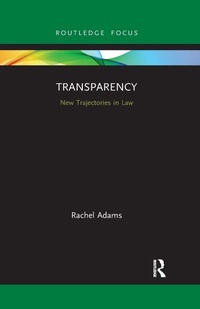
Transparency
New Trajectories in Law
1st Edition
Published on 30. September 2021
Book
Paperback/Softback
116 pages
978-1-032-17553-9 (ISBN)
Description
This book critiques the contemporary recourse to transparency in law and policy.
This is, ostensibly, the information age. At the heart of the societal shift toward digitalisation is the call for transparency and the liberalisation of information and data. Yet, with the recent rise of concerns such as 'fake news', post-truth and misinformation, where the policy responses to all these phenomena has been a petition for even greater transparency, it becomes imperative to critically reflect on what this dominant idea means, whom it serves, and what the effects are of its power. In response, this book provides the first sustained critique of the concept of transparency in law and policy. It offers a concise overview of transparency in law and policy around the world, and critiques how this concept works discursively to delimit other forms of governance, other ways of knowing and other realities. It draws on the work of Michel Foucault on discourse, archaeology and genealogy, together with later Foucaultian scholars, including Gayatri Chakravorty Spivak and Judith Butler, as a theoretical framework for challenging and thinking anew the history and understanding of what has become one of the most popular buzzwords of 21st century law and governance.
At the intersection of law and governance, this book will be of considerable interest to those working in these fields; but also to those engaged in other interdisciplinary areas, including society and technology, the digital humanities, technology laws and policy, global law and policy, as well as the surveillance society.
This is, ostensibly, the information age. At the heart of the societal shift toward digitalisation is the call for transparency and the liberalisation of information and data. Yet, with the recent rise of concerns such as 'fake news', post-truth and misinformation, where the policy responses to all these phenomena has been a petition for even greater transparency, it becomes imperative to critically reflect on what this dominant idea means, whom it serves, and what the effects are of its power. In response, this book provides the first sustained critique of the concept of transparency in law and policy. It offers a concise overview of transparency in law and policy around the world, and critiques how this concept works discursively to delimit other forms of governance, other ways of knowing and other realities. It draws on the work of Michel Foucault on discourse, archaeology and genealogy, together with later Foucaultian scholars, including Gayatri Chakravorty Spivak and Judith Butler, as a theoretical framework for challenging and thinking anew the history and understanding of what has become one of the most popular buzzwords of 21st century law and governance.
At the intersection of law and governance, this book will be of considerable interest to those working in these fields; but also to those engaged in other interdisciplinary areas, including society and technology, the digital humanities, technology laws and policy, global law and policy, as well as the surveillance society.
More details
Series
Language
English
Place of publication
London
United Kingdom
Publishing group
Taylor & Francis Ltd
Target group
College/higher education
Postgraduate and Undergraduate
Dimensions
Height: 216 mm
Width: 140 mm
Thickness: 7 mm
Weight
160 gr
ISBN-13
978-1-032-17553-9 (9781032175539)
Copyright in bibliographic data and cover images is held by Nielsen Book Services Limited or by the publishers or by their respective licensors: all rights reserved.
Schweitzer Classification
Other editions
Additional editions

Book
01/2020
1st Edition
Routledge
€76.70
Shipment within 15-20 days
E-Book
01/2020
1st Edition
Routledge
€31.49
Available for download
Person
Rachel Adams is a Senior Research Specialist at the Human Sciences Research Council, South Africa, and a Post-Doctoral Researcher with the Information Law and Policy Centre, at the Institute of Advanced Legal Studies, University of London.
Content
Table of Contents
Acknowledgements
Preface
Introduction: The Discourse of Transparency
'Beginning with the things it produced'
The Discourse of Transparency
Transparency in Scholarship
Book Outline
Approach: The Order of Discourse
Summary
Further Reading
PART I: THE DISCOURSE OF TRANSPARENCY
Chapter 1: A Brief History of Transparency's Entry in Discourse
Abstract
Introduction
Archaeology
Transparency, the Enlightenment and Human Rights
Designing Transparency
Transparency as Metaphor
Summary
Further Reading
Chapter 2: Access to Information Delimited
Abstract
Introduction
Epistemic Violence of Transparency
Law and Exclusion
Summary
Further Reading
Chapter 3: Transparency Universal
Abstract
Introduction
Transparency and Inclusivity
Proselytising Transparency
Summary
Further Reading
PART II: TOWARD THE POST-TRANSPARENT
Chapter 4: The Fallacies of Transparency: Fake News, Artificial Intelligence and the Hyperinformation Society
Abstract
Introduction
Fake News: Baudrillard and the Hyperinformation Society
The Illusion of Transparency
Summary
Further Reading
Chapter 5: Producing the Transparent Subject: The Gaze Turns Inward
Introduction
Foucault and Subjectivity
The Transparent Subject
Self-Disclosure
Legislating for the Transparent Subject
Whistleblowing Laws
Depoliticising Effects
Summary Further Reading
PART III: RESISTANCE
Chapter 6: Resisting Transparency
Abstract
Introduction
Foucault, Power and Resistance
Resistance to Transparency
Summary
Further Reading
Conclusion
Acknowledgements
Preface
Introduction: The Discourse of Transparency
'Beginning with the things it produced'
The Discourse of Transparency
Transparency in Scholarship
Book Outline
Approach: The Order of Discourse
Summary
Further Reading
PART I: THE DISCOURSE OF TRANSPARENCY
Chapter 1: A Brief History of Transparency's Entry in Discourse
Abstract
Introduction
Archaeology
Transparency, the Enlightenment and Human Rights
Designing Transparency
Transparency as Metaphor
Summary
Further Reading
Chapter 2: Access to Information Delimited
Abstract
Introduction
Epistemic Violence of Transparency
Law and Exclusion
Summary
Further Reading
Chapter 3: Transparency Universal
Abstract
Introduction
Transparency and Inclusivity
Proselytising Transparency
Summary
Further Reading
PART II: TOWARD THE POST-TRANSPARENT
Chapter 4: The Fallacies of Transparency: Fake News, Artificial Intelligence and the Hyperinformation Society
Abstract
Introduction
Fake News: Baudrillard and the Hyperinformation Society
The Illusion of Transparency
Summary
Further Reading
Chapter 5: Producing the Transparent Subject: The Gaze Turns Inward
Introduction
Foucault and Subjectivity
The Transparent Subject
Self-Disclosure
Legislating for the Transparent Subject
Whistleblowing Laws
Depoliticising Effects
Summary Further Reading
PART III: RESISTANCE
Chapter 6: Resisting Transparency
Abstract
Introduction
Foucault, Power and Resistance
Resistance to Transparency
Summary
Further Reading
Conclusion