

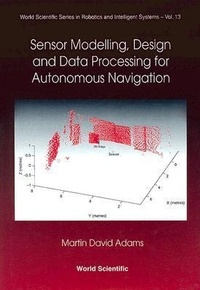
Sensor Modelling, Design And Data Processing For Autonomous Navigation
Will be published approx. on 5. February 1999
Book
Hardback
256 pages
978-981-02-3496-6 (ISBN)
Description
This invaluable book presents an unbiased framework for modelling and using sensors to aid mobile robot navigation. It addresses the problem of accurate and reliable sensing in confined environments and makes a detailed analysis of the design and construction of a low cost optical range finder. This is followed by a quantitative model for determining the sources and propagation of noise within the sensor. The physics behind the causes of erroneous data is also used to derive a model for detecting and labelling such data as false. In addition, the author's data-processing algorithms are applied to the problem of environmental feature extraction. This forms the basis of a solution to the problem of mobile robot localisation. The book develops a relationship between the kinematics of a mobile robot during the execution of successive manoeuvres, and the sensed features. Results which update a mobile vehicle's position using features from 2D and 3D scans are presented.
More details
Series
Language
English
Place of publication
Singapore
Singapore
Target group
College/higher education
Professional and scholarly
Product notice
sewn/stitched
Paper over boards
With dust jacket
Dimensions
Height: 235 mm
Width: 154 mm
Thickness: 18 mm
Weight
499 gr
ISBN-13
978-981-02-3496-6 (9789810234966)
Copyright in bibliographic data and cover images is held by Nielsen Book Services Limited or by the publishers or by their respective licensors: all rights reserved.
Schweitzer Classification
Person
Content
Sensor design and modelling - range sensing in confined environments; lidar sensor design - electronic requirements; lidar sensor design - mechanical and optical requirements; quantitative sensor modelling - noise analysis; qualitative sensor modelling - false design; mobile robot navigation oriented signal processing; environmental feature extraction; sensor driven mobile robot localization; application - mobile robot path planning; conclusions and future research directives.