

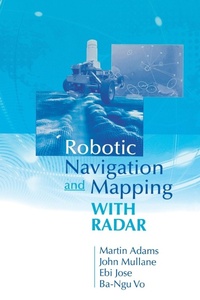
Robotic Navigation and Mapping with Radar
Published in August 2012
Book
Hardback
330 pages
978-1-60807-482-2 (ISBN)
Description
Focusing on autonomous robotic applications, this cutting-edge resource offers a practical treatment of short-range radar processing for reliable object detection at the ground level. This unique book demonstrates probabilistic radar models and detection algorithms specifically for robotic land vehicles. Engineers and researchers may find detailed coverage of Simultaneous Localization and Map Building (SLAM) - an area referred to as the "Holy Grail" of autonomous robotics research.
More details
Edition
Unabridged edition
Language
English
Place of publication
Norwood
United States
Target group
College/higher education
Professional and scholarly
Engineers and researchers whose work involves robotics and autonomous navigation, short range radar applications, sensor fusion, and cognitive systems
Edition type
Unabridged edition
Product notice
Unsewn / adhesive bound
Paper over boards
Dimensions
Height: 261 mm
Width: 182 mm
Thickness: 25 mm
Weight
805 gr
ISBN-13
978-1-60807-482-2 (9781608074822)
Copyright in bibliographic data and cover images is held by Nielsen Book Services Limited or by the publishers or by their respective licensors: all rights reserved.
Schweitzer Classification
Other editions
Additional editions
Martin Adams
Robotic Navigation and Mapping with Radar
E-Book
01/2012
1st Edition
Artech House
€131.99
Available for download
Persons
Martin Adams is professor in the Department of Electrical Engineering, Advanced Mining Technology Centre (AMTC) at the University of Chile. He received his D.Phil. in robotics research at the University of Oxford. Ebi Jose is a senior research and development engineer at Singapore Technologies Electronics. He holds a Ph.D. in robotics from Nanyang Technological University.
Content
Introduction.; Part I: Detection and Mapping with Radar - Mapping with Radar. Case Study: Short Range FMCW Radar. Detection Based on target Presence Probability. Robot Mapping Using Measurement Likelihoods.; Part II: Radar Based Simultaneous Localization and Map Building - Exploiting Radar's Multiple Line of Sight Capabilities.; Part III: Map Representations for Radar - Random Finite Set Based Mapping and Navigation. Coastal Feature Extraction with X-Band Marine Radar. Conclusions and Future Directions.