

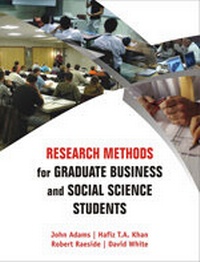
Research Methods for Graduate Business and Social Science Students
1st Edition
Published on 18. September 2007
Book
Paperback/Softback
272 pages
978-0-7619-3589-6 (ISBN)
Description
Research Methods for Graduate Business and Social Science Students is a fundamental and easy guide to studying research methods. In addition to the general concepts relating to research methods, broad research issues and theoretical concepts critical to research are discussed. The book is written in a highly reader-friendly manner and contains plenty of examples and helpful practical exercises at the end of each chapter to reinforce and enjoy learning. Divided into 16 chapters, the authors aim to clearly and concisely explain the basics of quantitative and qualitative analysis and research to students, including:
- Research ethics
- Formulation and process of research
- Literature analysis and critical reading
- How to plan and implement a research project
- Data collection, survey research and data management
- Practical research techniques
- Elementary and advanced statistical analyses
- Assessment, reliability and validity of research work
- Guidelines on research writing and structures of dissertation
- Research ethics
- Formulation and process of research
- Literature analysis and critical reading
- How to plan and implement a research project
- Data collection, survey research and data management
- Practical research techniques
- Elementary and advanced statistical analyses
- Assessment, reliability and validity of research work
- Guidelines on research writing and structures of dissertation
More details
Edition
First Edition
Language
English
Place of publication
Thousand Oaks
United States
Target group
College/higher education
Professional and scholarly
Dimensions
Height: 241 mm
Width: 184 mm
Weight
464 gr
ISBN-13
978-0-7619-3589-6 (9780761935896)
Copyright in bibliographic data and cover images is held by Nielsen Book Services Limited or by the publishers or by their respective licensors: all rights reserved.
Schweitzer Classification
Other editions
New editions
John Adams | Hafiz T. A. Khan | Robert Raeside
Research Methods for Business and Social Science Students
Book
03/2014
2nd Edition
SAGE Publications India Pvt Ltd
€47.22
Article not available for order
Persons
John Adams is the Head of Department of Economics at the British University in Egypt and was previously Director of the China-EU Research Centre based in Edinburgh. He has published widely in the field of economics in both national and international academic journals, is the co-author of several textbooks and has worked as external examiner at the Universities of Dundee, Sussex and Hong Kong. Professor Adams has also undertaken consultancy assignments for a wide range of public and private sector organisations in the United Kingdom and overseas. He is currently a visiting Professor at three universities in China. His research is mainly focused on economic development and on the process of development. Professor Adams also provides training to Investment Promotion Agencies in several countries on attracting, managing and evaluating FDI.
Hafiz T. A. Khan is Professor of Public Health at the University of West London. He is also an Associate Research Fellow in Demography at the Oxford Institute of Population Ageing, The University of Oxford, UK. Professor Khan trained as a statistician at the University of Chittagong and later as a statistical demographer at several institutions: Edinburgh Napier University in the UK, the International Institute for Applied Systems Analysis (IIASA) in Austria, the National University of Singapore, the University of Oxford, Middlesex University London, and lastly at Birmingham City University in the UK. His principal research interests lie in the broader areas of population and development including population ageing and its consequences, poverty and vulnerability, micro-finance; development issues, reproductive health and family planning in developing countries. He has written extensively in population-related issues and has over 100 academic publications including books, book chapters and journals.
Robert Raeside is currently Professor of Applied Statistics and Director of the Employment Research Institute (ERI) at Edinburgh Napier University, UK. He is also a Chartered Statistician of the Royal Statistical Society (CStat), London, Member of the Operational Research Society, Birmingham, and a Fellow of the Higher Education Academy (FHEA), York. He received his BSc Hons from Napier College under the auspices of the Council for Academic Awards (CNAA), his MSc from the University of Strathclyde, Glasgow, and PhD in demographic forecasting from the CNAA in collaboration with the University of Oxford. He serves on two British Standards Committees and is part of the editorial teams for the Journal of Applied Probability and Statistics and the Journal of Revenue and Pricing Management. He was appointed a visiting Professor in Demography to the University of Dhaka, Bangladesh, 2009. Professor Raeside's research has been on the application of statistics to areas of demographic change, public health, employment and business improvement. He is particularly interested in the use of social network analysis to investigate complex processes. He has acted in an advisory capacity to business, local authorities and to the national government.
Hafiz T. A. Khan is Professor of Public Health at the University of West London. He is also an Associate Research Fellow in Demography at the Oxford Institute of Population Ageing, The University of Oxford, UK. Professor Khan trained as a statistician at the University of Chittagong and later as a statistical demographer at several institutions: Edinburgh Napier University in the UK, the International Institute for Applied Systems Analysis (IIASA) in Austria, the National University of Singapore, the University of Oxford, Middlesex University London, and lastly at Birmingham City University in the UK. His principal research interests lie in the broader areas of population and development including population ageing and its consequences, poverty and vulnerability, micro-finance; development issues, reproductive health and family planning in developing countries. He has written extensively in population-related issues and has over 100 academic publications including books, book chapters and journals.
Robert Raeside is currently Professor of Applied Statistics and Director of the Employment Research Institute (ERI) at Edinburgh Napier University, UK. He is also a Chartered Statistician of the Royal Statistical Society (CStat), London, Member of the Operational Research Society, Birmingham, and a Fellow of the Higher Education Academy (FHEA), York. He received his BSc Hons from Napier College under the auspices of the Council for Academic Awards (CNAA), his MSc from the University of Strathclyde, Glasgow, and PhD in demographic forecasting from the CNAA in collaboration with the University of Oxford. He serves on two British Standards Committees and is part of the editorial teams for the Journal of Applied Probability and Statistics and the Journal of Revenue and Pricing Management. He was appointed a visiting Professor in Demography to the University of Dhaka, Bangladesh, 2009. Professor Raeside's research has been on the application of statistics to areas of demographic change, public health, employment and business improvement. He is particularly interested in the use of social network analysis to investigate complex processes. He has acted in an advisory capacity to business, local authorities and to the national government.
Content
SECTION - I: GENERAL INTRODUCTION
Chapter 1: Introduction to Research
1.1 What is Research?
1.2 Why is Research Conducted?
1.3 Who Does Research?
1.4 How is Research Conducted?
1.5 Business and Social Research Methods
SECTION - II: RESEARCH METHODOLOGY
Chapter 2: Research Methodology
2.1 Introduction
2.2 Research Method versus Research Methodology
2.3 Approaches to Business and Social Research
2.4 Justifying the Scientific Method
2.5 Research Ethics
2.6 Exercises
2.7 References
SECTION - III: FORMULATION
Chapter 3: The Research Cycle
3.1 Introduction
3.2 The Research Cycle
3.3 Problems with the Research Process
3.4 Exercises
3.5 References
Chapter 4: Literature Review and Critical Reading
4.1 Introduction
4.2. The Importance of a Literature Review
4.3 What Should the Literature Review Do?
4.4 Types of Literature Review
4.5 Some General Points in Literature Reviewing
4.6 Obtaining Literature Sources
4.7 Searching the Literature
4.8 Assessing the Quality of Literature
4.9 An Example of a Literature Review
4.10 Critical Evaluation
4.11 Critical Analysis
4.12 Critical Reading
4.13 Critical Thinking
4.14 Critical Questions
4.15 Critical Reviews
4.16 Exercises
4.17 References
SECTION - IV: RESEARCH DESIGN
Chapter 5: Sampling
5.1 Introduction
5.2 Classification of Research Designs
5.3 Sources of Data
5.4 Types of Data and Measurement
5.5 Methods of Data Collection
5.6 Sampling Techniques
5.7 Representative Sampling Plans
5.8 Sample Size Determination
5.9 Test of Significance for Population Mean
5.10 Test of Significance for Population Proportion
5.11 Key Statistical Concepts
5.12 Some Problems with Random Sample Surveys
5.13 The Normal Distribution
5.14 Exercises
5.15 References
SECTION - V: DATA COLLECTION
Chapter 6: Primary Data Collection
6.1 Introduction
6.2 Observation
6.3 Experimentation
6.4 Surveys
6.5 Interviews
6.6 Diary Methods
6.7 Case Studies
6.8 Data Storage
6.9 Triangulation
6.10 Exercises
6.11 References
Chapter 7: Secondary Data Collection
7.1 Introduction
7.2 Web Search Skills
7.3 Exercises
7.4 References
Chapter 8: Surveys
8.1 Introduction
8.2 Design
8.3 Questions
8.4 Administering the Survey
8.5 Ensuring a High Response Rate
8.6 Missing Information
8.7 Coding and Data Input
8.8 Guidelines
8.9 References
Chapter 9: Interviews
9.1 Introduction
9.2 Why do Interviews?
9.3 General Guidelines for Interviewing
9.4 Bias and Errors
9.5 Telephone Interviews
9.6 Group/Focus Group Interviews
9.7 References
SECTION - VI: ANALYSIS
Chapter 10: Qualitative Data Analysis
10.1 Introduction
10.2 Preparation
10.3 Content Analysis
10.4 Summarising
10.5 Grounded Theory
10.6 References
Chapter 11: Descriptive Quantitative Analysis
11.1 Introduction
11.2 Descriptive Statistics
11.3 Are There Significant Differences?
11.4 Comparing Two Groups
11.5 Comparing More Than Two Groups
11.6 The Association Between Categorical Variables
11.7 Summary of Test Procedures
11.8 Exercises
11.9 Appendix: Exploratory Data Analysis
11.10 References
Chapter 12: Correlation and Regression
12.1 Introduction
12.2 Correlation
12.3 Regression
12.4 Diagnostics
12.5 Multiple Regression
12.6 Exercises
12.7 References
Chapter 13: Advanced Statistical Analysis
SECTION - VII: QUALITY AND VERIFICATION - 1 Introduction 2 Factor Analysis 3 Logistic Regression 4 Exercises 5 References
Chapter 14: Test of Measurement and Quality
14.1 Introduction
14.1 Reliability
14.2 Validity
14.3 Generalisability
14.5 Exercises
14.6 References
SECTION - VIII: INVOLVEMENT DURING RESEARCH
Chapter 15: Conducting Your Research
15.1 Introduction
15.2 Selecting your Topic
15.3 Guidelines for Supervision
15.4 Undertaking your Research
15.5 References
Chapter 16: Writing and Presenting the Dissertation
16.1 Introduction
16.2 The Dissertation
16.3 Dissertation Objectives
16.4 What Should a Dissertation Look Like?
16.5 Presenting the Dissertation
16.6 References
Chapter 1: Introduction to Research
1.1 What is Research?
1.2 Why is Research Conducted?
1.3 Who Does Research?
1.4 How is Research Conducted?
1.5 Business and Social Research Methods
SECTION - II: RESEARCH METHODOLOGY
Chapter 2: Research Methodology
2.1 Introduction
2.2 Research Method versus Research Methodology
2.3 Approaches to Business and Social Research
2.4 Justifying the Scientific Method
2.5 Research Ethics
2.6 Exercises
2.7 References
SECTION - III: FORMULATION
Chapter 3: The Research Cycle
3.1 Introduction
3.2 The Research Cycle
3.3 Problems with the Research Process
3.4 Exercises
3.5 References
Chapter 4: Literature Review and Critical Reading
4.1 Introduction
4.2. The Importance of a Literature Review
4.3 What Should the Literature Review Do?
4.4 Types of Literature Review
4.5 Some General Points in Literature Reviewing
4.6 Obtaining Literature Sources
4.7 Searching the Literature
4.8 Assessing the Quality of Literature
4.9 An Example of a Literature Review
4.10 Critical Evaluation
4.11 Critical Analysis
4.12 Critical Reading
4.13 Critical Thinking
4.14 Critical Questions
4.15 Critical Reviews
4.16 Exercises
4.17 References
SECTION - IV: RESEARCH DESIGN
Chapter 5: Sampling
5.1 Introduction
5.2 Classification of Research Designs
5.3 Sources of Data
5.4 Types of Data and Measurement
5.5 Methods of Data Collection
5.6 Sampling Techniques
5.7 Representative Sampling Plans
5.8 Sample Size Determination
5.9 Test of Significance for Population Mean
5.10 Test of Significance for Population Proportion
5.11 Key Statistical Concepts
5.12 Some Problems with Random Sample Surveys
5.13 The Normal Distribution
5.14 Exercises
5.15 References
SECTION - V: DATA COLLECTION
Chapter 6: Primary Data Collection
6.1 Introduction
6.2 Observation
6.3 Experimentation
6.4 Surveys
6.5 Interviews
6.6 Diary Methods
6.7 Case Studies
6.8 Data Storage
6.9 Triangulation
6.10 Exercises
6.11 References
Chapter 7: Secondary Data Collection
7.1 Introduction
7.2 Web Search Skills
7.3 Exercises
7.4 References
Chapter 8: Surveys
8.1 Introduction
8.2 Design
8.3 Questions
8.4 Administering the Survey
8.5 Ensuring a High Response Rate
8.6 Missing Information
8.7 Coding and Data Input
8.8 Guidelines
8.9 References
Chapter 9: Interviews
9.1 Introduction
9.2 Why do Interviews?
9.3 General Guidelines for Interviewing
9.4 Bias and Errors
9.5 Telephone Interviews
9.6 Group/Focus Group Interviews
9.7 References
SECTION - VI: ANALYSIS
Chapter 10: Qualitative Data Analysis
10.1 Introduction
10.2 Preparation
10.3 Content Analysis
10.4 Summarising
10.5 Grounded Theory
10.6 References
Chapter 11: Descriptive Quantitative Analysis
11.1 Introduction
11.2 Descriptive Statistics
11.3 Are There Significant Differences?
11.4 Comparing Two Groups
11.5 Comparing More Than Two Groups
11.6 The Association Between Categorical Variables
11.7 Summary of Test Procedures
11.8 Exercises
11.9 Appendix: Exploratory Data Analysis
11.10 References
Chapter 12: Correlation and Regression
12.1 Introduction
12.2 Correlation
12.3 Regression
12.4 Diagnostics
12.5 Multiple Regression
12.6 Exercises
12.7 References
Chapter 13: Advanced Statistical Analysis
SECTION - VII: QUALITY AND VERIFICATION - 1 Introduction 2 Factor Analysis 3 Logistic Regression 4 Exercises 5 References
Chapter 14: Test of Measurement and Quality
14.1 Introduction
14.1 Reliability
14.2 Validity
14.3 Generalisability
14.5 Exercises
14.6 References
SECTION - VIII: INVOLVEMENT DURING RESEARCH
Chapter 15: Conducting Your Research
15.1 Introduction
15.2 Selecting your Topic
15.3 Guidelines for Supervision
15.4 Undertaking your Research
15.5 References
Chapter 16: Writing and Presenting the Dissertation
16.1 Introduction
16.2 The Dissertation
16.3 Dissertation Objectives
16.4 What Should a Dissertation Look Like?
16.5 Presenting the Dissertation
16.6 References