

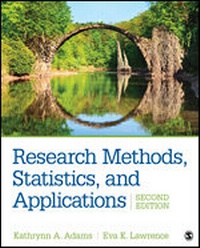
Research Methods, Statistics, and Applications
2nd Edition
Published on 26. April 2018
Book
Paperback/Softback
672 pages
978-1-5063-5045-5 (ISBN)
Description
One of the greatest strengths of this text is the consistent integration of research methods and statistics so that students can better understand how the research process requires the combination of these elements. The end goal is to spark students' interest in conducting research and to increase their ability to critically analyze it.
In the new second edition of the text, Katherine Adams and Eva Lawrence have integrated additional information on online data collection and research methods, additional coverage of regression and ANOVA, and new examples to engage students.
In the new second edition of the text, Katherine Adams and Eva Lawrence have integrated additional information on online data collection and research methods, additional coverage of regression and ANOVA, and new examples to engage students.
Reviews / Votes
"The authors have constructed a manuscript that utilizes real life research questions and takes the reader through a detailed process of how a researcher would construct a study to answer the question, select the appropriate statistics to answer the question, and disseminate the results in how to write up the results/discussion." -- Charles Fountaine "It outlines the bare necessities of research. It's not full of definitions, it more so teaches students about the application of materials. The book comes across as task-oriented." -- Derrick Bryan "In our sections of research methods & statistics, students are asked to buy two books (methods + stats). I appreciate that this textbook is able to unite the two domains in such a clear way. This book really stands out as a detailed "field manual" for psychological research, and it's the kind of book that students might be more likely to hang on to for future reference. The integration of SPSS & APA style conventions throughout was nice to see. Also nice to see effect sizes and power analysis show up so students don't have a simple view of null hypothesis statistical tests." -- Ben Denkinger "I like the combination of the methods and stats. I believe that this book would be beneficial for an advanced research methods/stats class at the undergraduate level. I like that the book provides adequate coverage to case studies and single case research design." -- Erin Fekete "Some good thorough discussion of aspects of each kind of research and statistical approach. Workbook pretty thorough." -- Kevin E. Lawson "The simplicity and relevance of the supplemental materials built in to illustrate the concepts are the key strengths of this text." -- Malaika BrownMore details
Edition
2nd Revised edition
Language
English
Place of publication
Thousand Oaks
United States
Target group
College/higher education
Edition type
Revised edition
Dimensions
Height: 232 mm
Width: 187 mm
Weight
1110 gr
ISBN-13
978-1-5063-5045-5 (9781506350455)
Copyright in bibliographic data and cover images is held by Nielsen Book Services Limited or by the publishers or by their respective licensors: all rights reserved.
Schweitzer Classification
Other editions
New editions
Kathrynn A. Adams | Eva Kung McGuire (aka: Lawrence)
Research Methods, Statistics, and Applications
Book
03/2022
3rd Edition
SAGE Publications Inc
€218.38
Shipment within 15-20 days
Previous edition
Kathrynn A. Adams | Eva Kung McGuire (aka: Lawrence)
Research Methods, Statistics, and Applications
Book
04/2014
1st Edition
SAGE Publications Inc
€115.32
Article exhausted; check for reprint
Persons
Kathrynn (Kathy) A. Adams earned her PhD in general experimental psychology from the University of Alabama in 1977. She was a Charles A. Dana Professor of Psychology at Guilford College when she retired in 2017 after 37 years of teaching. Her professional interests include gender issues, relationships, and teaching pedagogy. She worked with the Preparing Future Faculty Program for 20 years and helped establish the Early College at Guilford, a nationally ranked high school. In her spare time, she spends as much time as possible outdoors, practices yoga, and bakes chocolate desserts.
Eva K. McGuire earned her PhD in clinical psychology from Virginia Commonwealth University in 2002. She is a Charles A. Dana Professor of Psychology at Guilford College, where she has taught since 2003. Her research interests include environmental psychology and computer-mediated communication. Eva enjoys walking, yoga, and bike riding, and she loves to listen to live music.
Eva K. McGuire earned her PhD in clinical psychology from Virginia Commonwealth University in 2002. She is a Charles A. Dana Professor of Psychology at Guilford College, where she has taught since 2003. Her research interests include environmental psychology and computer-mediated communication. Eva enjoys walking, yoga, and bike riding, and she loves to listen to live music.
Content
Preface
About The Authors
Chapter 1: Thinking Like A Researcher
Critical Thinking
Thinking Critically About Ethics
The Scientific Approach
Overview of the Research Process (a.k.a. the Scientific Method)
The Big Picture: Proof and Progress in Science
Chapter 2: Build a Solid Foundation for Your Study Based On Past Research
Types of Sources
Types of Scholarly Works
Strategies to Identify and Find Past Research
Reading and Evaluating Primary Research Articles
Develop Study Ideas Based on Past Research
APA Format for References
The Big Picture: Use the Past to Inform the Present
Chapter 3: The Cornerstones of Good Research: Reliability and Validity
Using Data Analysis Programs: Measurement Reliability
Reliability and Validity Broadly Defined
Reliability and Validity of Measurement
Constructs and Operational Definitions
Types of Measures
Assessing Reliability of Measures
Assessing Validity of Measures
Reliability and Validity at the Study Level
The Big Picture: Consistency and Accuracy
Chapter 4: Basics of Research Design: Description, Measurement, and Sampling
When Is a Descriptive Study Appropriate?
Validity in Descriptive Studies
Measurement Methods
Defining the Population and Obtaining a Sample
The Big Picture: Beyond Description
Chapter 5: Describing Your Sample
Ethical Issues in Describing Your Sample
Practical Issues in Describing Your Sample
Descriptive Statistics
Choosing the Appropriate Descriptive Statistics
Using Data Analysis Programs: Descriptive Statistics
Comparing Interval/Ratio Scores with z Scores and Percentiles
The Big Picture: Know Your Data and Your Sample
Chapter 6: Beyond Descriptives: Making Inferences Based on Your Sample
Inferential Statistics
Hypothesis Testing
Errors in Hypothesis Testing
Effect Size, Confidence Intervals, and Practical Significance
Determining the Effect Size, Confidence Interval, and Practical Significance in a Study
The Big Picture: Making Sense of Results
Chapter 7: Comparing Your Sample to a Known or Expected Score
Choosing the Appropriate Test
One-Sample t Tests
Formulas and Calculations: One-Sample t Test
Using Data Analysis Programs: One-Sample t Test
Results
Discussion
The Big Picture: Examining One Variable at a Time
Chapter 8: Examining Relationships among Your Variables: Correlational Design
Correlational Design
Basic Statistics to Evaluate Correlational Research
Using Data Analysis Programs: Pearson's r and Point-Biserial r
Regression
Formulas and Calculations: Simple Linear Regression
Using Data Analysis Programs: Regression
The Big Picture: Correlational Designs Versus Correlational Analyses
Chapter 9: Examining Causality
Testing Cause and Effect
Threats to Internal Validity
Basic Issues in Designing an Experiment
Other Threats to Internal Validity
Balancing Internal and External Validity
The Big Picture: Benefits and Limits of Experimental Design
Chapter 10: Independent-Groups Designs
Designs with Independent Groups
Designing a Simple Experiment
Independent-Samples t Tests
Formulas and calculations: independent-samples t test
Using data analysis programs: independent-samples t test
Designs With More Than Two Independent Groups
Formulas and calculations: one-way independent-samples anova
Using data analysis programs: one-way independent-samples anova
The big picture: identifying and analyzing independent-groups designs
Chapter 11: Dependent-Groups Designs
Designs with dependent groups
Formulas and Calculations: Dependent-Samples t Test
Using data analysis programs: dependent-samples t test
Designs with more than two dependent groups
Formulas and calculations: within-subjects ANOVA
Using data analysis programs: within-subjects ANOVA
The big picture: selecting analyses and interpreting results for dependent-groups designs
Chapter 12: Factorial Designs
Basic Concepts in Factorial Design
Rationale for Factorial Designs
2 x 2 Designs
Analyzing Factorial Designs
Analyzing Independent-Groups Factorial Designs
Formulas and Calculations: Two-Way Between-Subjects ANOVA
Using Data Analysis Programs: Two-Way Between-Subjects ANOVA
Reporting and Interpreting Results of a Two-Way ANOVA
Dependent-Groups Factorial Designs
Mixed Designs
The Big Picture: Embracing Complexity
Chapter 13: Nonparametric Statistics
Parametric Versus Nonparametric Statistics
Nonparametric Tests for Nominal Data
Formulas and Calculations: Chi-Square Goodness of Fit
Using Data Analysis Programs: Chi-Square Goodness of Fit
Formulas and calculations: chi-square test for independence
Using data analysis programs: chi-square test for independence
Nonparametric statistics for ordinal (ranked) data
Formulas and calculations: spearman's rho
Using data analysis programs: spearman's rho
The big picture: selecting parametric versus nonparametric tests
Chapter 14: Focusing on the Individual Case Studies and Single N Designs
Samples Versus Individuals
The Case Study
Single N Designs
The Big Picture: Choosing Between a Sample, Case Study, or Single N Design
Chapter 15: How to Decide? Choosing a Research Design and Selecting the Correct Analysis
First and Throughout: Base Your Study on Past Research
Choosing a Research Design
Selecting Your Statistical Analyses
The Big Picture: Beyond This Class
Appendix A: Answers to Practice Questions
Appendix B: APA Style and Format Guidelines
Appendix C: Statistical Tables
Appendix D: Statistical Formulas
Glossary
References
Author index
Subject index
About The Authors
Chapter 1: Thinking Like A Researcher
Critical Thinking
Thinking Critically About Ethics
The Scientific Approach
Overview of the Research Process (a.k.a. the Scientific Method)
The Big Picture: Proof and Progress in Science
Chapter 2: Build a Solid Foundation for Your Study Based On Past Research
Types of Sources
Types of Scholarly Works
Strategies to Identify and Find Past Research
Reading and Evaluating Primary Research Articles
Develop Study Ideas Based on Past Research
APA Format for References
The Big Picture: Use the Past to Inform the Present
Chapter 3: The Cornerstones of Good Research: Reliability and Validity
Using Data Analysis Programs: Measurement Reliability
Reliability and Validity Broadly Defined
Reliability and Validity of Measurement
Constructs and Operational Definitions
Types of Measures
Assessing Reliability of Measures
Assessing Validity of Measures
Reliability and Validity at the Study Level
The Big Picture: Consistency and Accuracy
Chapter 4: Basics of Research Design: Description, Measurement, and Sampling
When Is a Descriptive Study Appropriate?
Validity in Descriptive Studies
Measurement Methods
Defining the Population and Obtaining a Sample
The Big Picture: Beyond Description
Chapter 5: Describing Your Sample
Ethical Issues in Describing Your Sample
Practical Issues in Describing Your Sample
Descriptive Statistics
Choosing the Appropriate Descriptive Statistics
Using Data Analysis Programs: Descriptive Statistics
Comparing Interval/Ratio Scores with z Scores and Percentiles
The Big Picture: Know Your Data and Your Sample
Chapter 6: Beyond Descriptives: Making Inferences Based on Your Sample
Inferential Statistics
Hypothesis Testing
Errors in Hypothesis Testing
Effect Size, Confidence Intervals, and Practical Significance
Determining the Effect Size, Confidence Interval, and Practical Significance in a Study
The Big Picture: Making Sense of Results
Chapter 7: Comparing Your Sample to a Known or Expected Score
Choosing the Appropriate Test
One-Sample t Tests
Formulas and Calculations: One-Sample t Test
Using Data Analysis Programs: One-Sample t Test
Results
Discussion
The Big Picture: Examining One Variable at a Time
Chapter 8: Examining Relationships among Your Variables: Correlational Design
Correlational Design
Basic Statistics to Evaluate Correlational Research
Using Data Analysis Programs: Pearson's r and Point-Biserial r
Regression
Formulas and Calculations: Simple Linear Regression
Using Data Analysis Programs: Regression
The Big Picture: Correlational Designs Versus Correlational Analyses
Chapter 9: Examining Causality
Testing Cause and Effect
Threats to Internal Validity
Basic Issues in Designing an Experiment
Other Threats to Internal Validity
Balancing Internal and External Validity
The Big Picture: Benefits and Limits of Experimental Design
Chapter 10: Independent-Groups Designs
Designs with Independent Groups
Designing a Simple Experiment
Independent-Samples t Tests
Formulas and calculations: independent-samples t test
Using data analysis programs: independent-samples t test
Designs With More Than Two Independent Groups
Formulas and calculations: one-way independent-samples anova
Using data analysis programs: one-way independent-samples anova
The big picture: identifying and analyzing independent-groups designs
Chapter 11: Dependent-Groups Designs
Designs with dependent groups
Formulas and Calculations: Dependent-Samples t Test
Using data analysis programs: dependent-samples t test
Designs with more than two dependent groups
Formulas and calculations: within-subjects ANOVA
Using data analysis programs: within-subjects ANOVA
The big picture: selecting analyses and interpreting results for dependent-groups designs
Chapter 12: Factorial Designs
Basic Concepts in Factorial Design
Rationale for Factorial Designs
2 x 2 Designs
Analyzing Factorial Designs
Analyzing Independent-Groups Factorial Designs
Formulas and Calculations: Two-Way Between-Subjects ANOVA
Using Data Analysis Programs: Two-Way Between-Subjects ANOVA
Reporting and Interpreting Results of a Two-Way ANOVA
Dependent-Groups Factorial Designs
Mixed Designs
The Big Picture: Embracing Complexity
Chapter 13: Nonparametric Statistics
Parametric Versus Nonparametric Statistics
Nonparametric Tests for Nominal Data
Formulas and Calculations: Chi-Square Goodness of Fit
Using Data Analysis Programs: Chi-Square Goodness of Fit
Formulas and calculations: chi-square test for independence
Using data analysis programs: chi-square test for independence
Nonparametric statistics for ordinal (ranked) data
Formulas and calculations: spearman's rho
Using data analysis programs: spearman's rho
The big picture: selecting parametric versus nonparametric tests
Chapter 14: Focusing on the Individual Case Studies and Single N Designs
Samples Versus Individuals
The Case Study
Single N Designs
The Big Picture: Choosing Between a Sample, Case Study, or Single N Design
Chapter 15: How to Decide? Choosing a Research Design and Selecting the Correct Analysis
First and Throughout: Base Your Study on Past Research
Choosing a Research Design
Selecting Your Statistical Analyses
The Big Picture: Beyond This Class
Appendix A: Answers to Practice Questions
Appendix B: APA Style and Format Guidelines
Appendix C: Statistical Tables
Appendix D: Statistical Formulas
Glossary
References
Author index
Subject index