

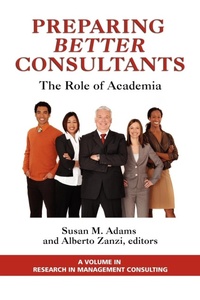
Preparing Better Consultants
The Role of Academia
Will be published approx. on 16. November 2011
Book
Paperback/Softback
290 pages
978-1-61735-614-8 (ISBN)
Description
This volume focuses on a relatively neglected area of management consulting, the education of consultants. In today's business world, we find training programs provided by consultancies, certification programs provided by professional organizations, on-the-job training of consultants with formal or informal supervision, self-taught professionals, and some academic programs and courses. Is that enough? No, better consultants are needed to handle the complexity and changing nature of business. Academe is in the best position to provide the critical thinking preparation necessary. Yet, academic institutions have been slow in embracing this challenge. The role of academia needs to grow in magnitude and in certain directions that educate consultants beyond industry training practices. Chapter authors provide examples of innovative programs, topical approaches for courses, and thoughtful reflections on the role academia can play in preparing better consultants. There are lessons for business schools, consultancies, and aspiring and practicing consultants.
More details
Series
Language
English
Place of publication
Charlotte
United States
Publishing group
Emerald Publishing Inc
Target group
Professional and scholarly
Dimensions
Height: 234 mm
Width: 156 mm
Thickness: 16 mm
Weight
445 gr
ISBN-13
978-1-61735-614-8 (9781617356148)
Copyright in bibliographic data and cover images is held by Nielsen Book Services Limited or by the publishers or by their respective licensors: all rights reserved.
Schweitzer Classification
Other editions
Additional editions
E-Book
01/2011
1st Edition
Information Age Publishing
from
€62.33
Available for download
Content
Preface; Anthony F. Buono.
Introduction; Susan M. Adams and Alberto Zanzi.
Part I. Program Innovations.
Chapter 1. Upgrading Problem-Based Learning by Involving Consulting Professionals; G. M. (Bud) Smith, Jr. and Deborah Good.
Chapter 2. Bridging the Divide: Enhancing the Real-World Experience in a Management Consulting Course; Tom Cooper and Dennis Hanlon.
Chapter 3. A Springboard for Further Learning: Teaching Seasoned Practitioners by Harnessing Their Experience; Hans Vermaak.
Chapter 4. The IFF-M/O/T Master Program in Organization Development; Ralph Grossmann, Klaus Scala, and Kurt Mayer.
Chapter 5. Preparing and Training Better Consultants Through the Socioeconomic Approach to Management Curricula; Henri Savall, Veronique Zardet, Marc Bonnet, and Michel Peron.
Chapter 6. Want Higher Impact Consulting? Use Yourself as an Instrument of Change; Miriam Y. Lacey.
Part II. Topical Approaches.
Chapter 7. Intervening and Interventions: An Overview; Leon de Caluwe.
Chapter 8. Consultants and Persuasive Argumentation; Onno Bouwmeester.
Chapter 9. Academic Storytelling Consultancy Supporting a Local Arts Scene: An Agential Realist and Socioeconomic Approach to Management Perspective; David M. Boje and Joe Gladstone.
Chapter 10. Virtual Project Consultants: A Time-Driven Decision-Making Model; Velvet Weems-Landingham.
Part III. Reflections On The Role Of Academia In Preparing Better Consultants.
Chapter 11. Experiential International Consulting Education: Lessons Learned From Success and Adversity; Thomas C. Head, Alan G. Krabbenhoft, D. Michael Brown, and Ralph Haug.
Chapter 12. Locals and Cosmopolitans: The Challenges of the Business Consulting Course; Moshe Banai and Philip Tulimieri.
Chapter 13. Realizing Consultant Domain and Client Agenda; Jean E. Neumann.
About the Authors.
Introduction; Susan M. Adams and Alberto Zanzi.
Part I. Program Innovations.
Chapter 1. Upgrading Problem-Based Learning by Involving Consulting Professionals; G. M. (Bud) Smith, Jr. and Deborah Good.
Chapter 2. Bridging the Divide: Enhancing the Real-World Experience in a Management Consulting Course; Tom Cooper and Dennis Hanlon.
Chapter 3. A Springboard for Further Learning: Teaching Seasoned Practitioners by Harnessing Their Experience; Hans Vermaak.
Chapter 4. The IFF-M/O/T Master Program in Organization Development; Ralph Grossmann, Klaus Scala, and Kurt Mayer.
Chapter 5. Preparing and Training Better Consultants Through the Socioeconomic Approach to Management Curricula; Henri Savall, Veronique Zardet, Marc Bonnet, and Michel Peron.
Chapter 6. Want Higher Impact Consulting? Use Yourself as an Instrument of Change; Miriam Y. Lacey.
Part II. Topical Approaches.
Chapter 7. Intervening and Interventions: An Overview; Leon de Caluwe.
Chapter 8. Consultants and Persuasive Argumentation; Onno Bouwmeester.
Chapter 9. Academic Storytelling Consultancy Supporting a Local Arts Scene: An Agential Realist and Socioeconomic Approach to Management Perspective; David M. Boje and Joe Gladstone.
Chapter 10. Virtual Project Consultants: A Time-Driven Decision-Making Model; Velvet Weems-Landingham.
Part III. Reflections On The Role Of Academia In Preparing Better Consultants.
Chapter 11. Experiential International Consulting Education: Lessons Learned From Success and Adversity; Thomas C. Head, Alan G. Krabbenhoft, D. Michael Brown, and Ralph Haug.
Chapter 12. Locals and Cosmopolitans: The Challenges of the Business Consulting Course; Moshe Banai and Philip Tulimieri.
Chapter 13. Realizing Consultant Domain and Client Agenda; Jean E. Neumann.
About the Authors.