

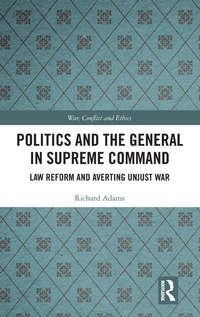
Politics and the General in Supreme Command
Law Reform and Averting Unjust War
1st Edition
Published on 25. November 2024
Book
Hardback
164 pages
978-1-032-86509-6 (ISBN)
Description
This book argues for reform of the convention that, when politicians decide on a course of action, the general in supreme command obeys without question.
The entire spread-out chain of command is unified in the general, who offers the only connection between the military and politics. Offering the sole connection between the military and politics, only the general can turn political directions into military command and capacitate war. Thus, the general has unique opportunity to resist unconscionable direction to launch an unjust war or to conduct or expand war unjustly. This book argues for reform, so the general has the right in law to refuse direction which is lawful, but awful. The legal capacity to refuse would mean the general would be expected to act responsibly, not merely as the unresisting pawn of politics. Such reform, creating legal opportunity for the supreme command to refuse lawful but unconscionable directives, might avert unjust war.
This book will be of much interest to students of the ethics of war, civil-military relations, and international relations.
The entire spread-out chain of command is unified in the general, who offers the only connection between the military and politics. Offering the sole connection between the military and politics, only the general can turn political directions into military command and capacitate war. Thus, the general has unique opportunity to resist unconscionable direction to launch an unjust war or to conduct or expand war unjustly. This book argues for reform, so the general has the right in law to refuse direction which is lawful, but awful. The legal capacity to refuse would mean the general would be expected to act responsibly, not merely as the unresisting pawn of politics. Such reform, creating legal opportunity for the supreme command to refuse lawful but unconscionable directives, might avert unjust war.
This book will be of much interest to students of the ethics of war, civil-military relations, and international relations.
Reviews / Votes
'Sometimes problems are disagreeable, and it is impossible to do as one would wish. But law should offer an opportunity to decide, to act responsibly with the best intention. Speaking of the supreme command, Adams makes this case clearly.'Vice Admiral Tim Barrett, AO, CSC, Royal Australian Navy (ret'd) Chief of Navy 2014-2018
More details
Series
Language
English
Place of publication
London
United Kingdom
Publishing group
Taylor & Francis Ltd
Target group
College/higher education
Professional and scholarly
Postgraduate, Professional Reference, and Undergraduate Advanced
Dimensions
Height: 240 mm
Width: 161 mm
Thickness: 14 mm
Weight
435 gr
ISBN-13
978-1-032-86509-6 (9781032865096)
Copyright in bibliographic data and cover images is held by Nielsen Book Services Limited or by the publishers or by their respective licensors: all rights reserved.
Schweitzer Classification
Other editions
Additional editions
Book
05/2026
1st Edition
Routledge
€57.00
Shipment within 10-20 days
E-Book
11/2024
1st Edition
Routledge
€60.49
Available for download
E-Book
11/2024
1st Edition
Routledge
€60.49
Available for download
Person
Richard Adams is a commander in the Royal Australian Navy. He has doctorates from the University of Western Australia and the University of New South Wales. He was an Australian Fulbright scholar to Yale University and a visiting research fellow to the Changing Character of War programme at the University of Oxford.
Content
1 Introduction
2 What's Been Said - Scholarship has Paid Insufficient Attention to the General
3 Law and War - Law Cannot Capture War's Moral Complexity
4 Liberalism and Law - The Risk in Law's Overstatement
5 Conscience - Some Things will be Morally Impossible
6 For All of Us, As One of Us - The General is Equal as a Citizen
7 More Than a Postman - The General's Singular Burden
8 Let the General Say No - Moral Space in the Shadow of Law
9 Conclusion
2 What's Been Said - Scholarship has Paid Insufficient Attention to the General
3 Law and War - Law Cannot Capture War's Moral Complexity
4 Liberalism and Law - The Risk in Law's Overstatement
5 Conscience - Some Things will be Morally Impossible
6 For All of Us, As One of Us - The General is Equal as a Citizen
7 More Than a Postman - The General's Singular Burden
8 Let the General Say No - Moral Space in the Shadow of Law
9 Conclusion