

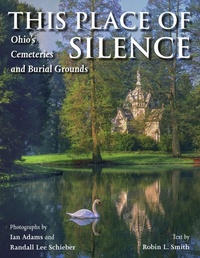
This Place of Silence
Ohio's Cemeteries and Burial Grounds
Will be published approx. on 31. July 2024
Book
Paperback/Softback
264 pages
978-0-8040-1252-2 (ISBN)
Description
This Place of Silence is a photographic portrait of Ohio's cemeteries and burial grounds by Ohio photographers Ian Adams and Randall Lee Schieber. The text and photo captions by Robin L. Smith provide an overview of the history of burial grounds, from prehistoric mounds through modern "green" cemeteries-and many fascinating details about gravestones, mausoleums, statuary, and cemetery landscapes.
The introduction provides an overview of the historical place of burial grounds in our society and of their value today not only as rich sources of history but also as repositories of art, architecture, and nature. Cemeteries record the history of their communities in their names and dates, but they also tell us how a community wanted its history recorded: How did this community see itself? What was important to that community? Who were the prominent people, and what did they accomplish? Graveyards, especially older ones, are also full of quirky names and mysteries. Who would name a child Nimrod, and where did that name come from? Why would two families build identical side-by-side mausoleums? Who would want a grave marker that looks like a pile of stones?
Chapters cover prehistoric mounds and early European American burial grounds; the evolution from rural cemeteries in the nineteenth century to modern green burials; art, architecture, and symbolism in cemeteries; cemeteries and nature; military and institutional burial grounds; and distinctive ethnic cemeteries.
The authors highlight and showcase these often beautiful but sometimes neglected pieces of history. Cemeteries are not dark, morbid places to be avoided, but historic landscapes that are full of beauty, hope, and honor for those Ohioans who came before us.
The introduction provides an overview of the historical place of burial grounds in our society and of their value today not only as rich sources of history but also as repositories of art, architecture, and nature. Cemeteries record the history of their communities in their names and dates, but they also tell us how a community wanted its history recorded: How did this community see itself? What was important to that community? Who were the prominent people, and what did they accomplish? Graveyards, especially older ones, are also full of quirky names and mysteries. Who would name a child Nimrod, and where did that name come from? Why would two families build identical side-by-side mausoleums? Who would want a grave marker that looks like a pile of stones?
Chapters cover prehistoric mounds and early European American burial grounds; the evolution from rural cemeteries in the nineteenth century to modern green burials; art, architecture, and symbolism in cemeteries; cemeteries and nature; military and institutional burial grounds; and distinctive ethnic cemeteries.
The authors highlight and showcase these often beautiful but sometimes neglected pieces of history. Cemeteries are not dark, morbid places to be avoided, but historic landscapes that are full of beauty, hope, and honor for those Ohioans who came before us.
Reviews / Votes
A fantastic addition to the existing literature on cemetery landscapes. The photographs are absolutely beautiful. - Timothy G. Anderson, Ohio University This Place of Silence uses Ohio's rich collection of cemeteries to leave these burial places anything but silent. Its collection of images, people, and places in their historical and design contexts gives readers more than a book about cemeteries-it is about the American experience itself. - Jeffrey E. Smith, Lindenwood University The beauty of Ohio's cemeteries and burial grounds is forever immortalized in This Place of Silence. Adams, Schieber, and Smith should be commended for their impressive dedication to highlight and illustrate these sacred areas that are so often overlooked.(Echoes Magazine)
More details
Language
English
Place of publication
Ohio
United States
Publishing group
Ohio University Press
Product notice
Paperback (trade)
Illustrations
240 color photographs
Dimensions
Height: 229 mm
Width: 150 mm
Thickness: 15 mm
Weight
259 gr
ISBN-13
978-0-8040-1252-2 (9780804012522)
Copyright in bibliographic data and cover images is held by Nielsen Book Services Limited or by the publishers or by their respective licensors: all rights reserved.
Schweitzer Classification
Persons
Ian Adams has twenty-one photography books and more than sixty-five Ohio calendars to his credit. He conducts nature and garden photography seminars, workshops, and slide programs throughout North America and taught digital photography at Ohio State University's Agricultural Technical Institute in Wooster from 2010 to 2019.
Randall Lee Schieber is a professional photographer based in Columbus, Ohio. He specializes in editorial, architectural, location, and travel photography and has published eight books and fifteen calendars. His work has appeared in a variety of local and national publications.
Robin L. Smith is the research director at Columbus Business First newspaper. She is the coauthor (with Randall Lee Schieber) of Columbus: A Photographic Portrait and Ohio: Then and Now, and the author of Columbus Ghosts: Historical Haunts of Ohio's Capital and Columbus Ghosts II: More Central Ohio Haunts.
Randall Lee Schieber is a professional photographer based in Columbus, Ohio. He specializes in editorial, architectural, location, and travel photography and has published eight books and fifteen calendars. His work has appeared in a variety of local and national publications.
Robin L. Smith is the research director at Columbus Business First newspaper. She is the coauthor (with Randall Lee Schieber) of Columbus: A Photographic Portrait and Ohio: Then and Now, and the author of Columbus Ghosts: Historical Haunts of Ohio's Capital and Columbus Ghosts II: More Central Ohio Haunts.
Content
PREFACE
INTRODUCTION
CHAPTER 1: NATIVE AMERICAN AND EARLY BURIAL GROUNDS
CHAPTER 2: THE EVOLUTION OF CEMETERIES
CHAPTER 3: ARCHITECTURE, STATUARY, AND SYMBOLISM
CHAPTER 4: THE NATURAL ENVIRONMENT
CHAPTER 5: MILITARY AND INSTITUTIONAL CEMETERIES
CHAPTER 6: DISTINCTIVE TRADITIONS, DISTINCTIVE PLACES
A GUIDE TO THE CEMETERIES
SUGGESTED READINGS
INDEX
INTRODUCTION
CHAPTER 1: NATIVE AMERICAN AND EARLY BURIAL GROUNDS
CHAPTER 2: THE EVOLUTION OF CEMETERIES
CHAPTER 3: ARCHITECTURE, STATUARY, AND SYMBOLISM
CHAPTER 4: THE NATURAL ENVIRONMENT
CHAPTER 5: MILITARY AND INSTITUTIONAL CEMETERIES
CHAPTER 6: DISTINCTIVE TRADITIONS, DISTINCTIVE PLACES
A GUIDE TO THE CEMETERIES
SUGGESTED READINGS
INDEX