

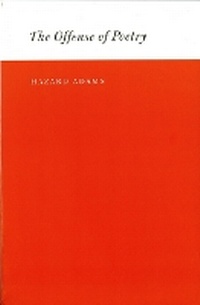
The Offense of Poetry
Will be published approx. on 4. October 2007
Book
Hardback
284 pages
978-0-295-98742-2 (ISBN)
Description
There is something offensive and scandalous about poetry, judging by the number of attacks on it and defenses of it written over the centuries. Poetry, Hazard Adams argues, exists to offend - not through its subject matter but through the challenges it presents to the prevailing view of what language is for. Poetry's main cultural value is its offensiveness; it should be defended as offensive.
Adams specifies four poetic offenses - gesture, drama, fiction, and trope - and devotes a chapter to each, ranging across the landscape of traditional literary criticism and exploring the various attitudes toward poetry, including both attacks and defenses, offered by writers from Plato and Aristotle to Sidney, Vico, Blake, Yeats, and Seamus Heaney, among others. "Criticism," Adams writes, "needs renewal in every age to free poetry from the prejudices of that age and the unintended prejudices of even the best critics of the past, to free poetry to perform its provocative, antithetical cultural role."
Poetry achieves its cultural value by opposing the binary oppositions - form and content, fact and fiction, reason and emotion - that structure and polarize most understandings of literature and of life. Adams takes a position antithetical to the extremes of both abstract formalism and the politicization of literary content. He concludes with an appreciation of what he calls the double offense of "great bad poetry," poetry so exceptionally bad that it transcends its shortcomings and leads to gaiety. He reminds us that Blake, in The Marriage of Heaven and Hell, identified angels with the settled and coercive and assigned the qualities of energy and creativity to his devils. According to Adams, poetry, in its broad and traditional sense of all imaginative writing, may be identified with Blake's devils.
Adams specifies four poetic offenses - gesture, drama, fiction, and trope - and devotes a chapter to each, ranging across the landscape of traditional literary criticism and exploring the various attitudes toward poetry, including both attacks and defenses, offered by writers from Plato and Aristotle to Sidney, Vico, Blake, Yeats, and Seamus Heaney, among others. "Criticism," Adams writes, "needs renewal in every age to free poetry from the prejudices of that age and the unintended prejudices of even the best critics of the past, to free poetry to perform its provocative, antithetical cultural role."
Poetry achieves its cultural value by opposing the binary oppositions - form and content, fact and fiction, reason and emotion - that structure and polarize most understandings of literature and of life. Adams takes a position antithetical to the extremes of both abstract formalism and the politicization of literary content. He concludes with an appreciation of what he calls the double offense of "great bad poetry," poetry so exceptionally bad that it transcends its shortcomings and leads to gaiety. He reminds us that Blake, in The Marriage of Heaven and Hell, identified angels with the settled and coercive and assigned the qualities of energy and creativity to his devils. According to Adams, poetry, in its broad and traditional sense of all imaginative writing, may be identified with Blake's devils.
Reviews / Votes
"Adams continues to transmit the explosiveness and idiosyncrasy of the literary and philosophical works he loves most. With undeniable passion and intellectual range, he situates these works historically and imagines them surging forth . . . to help us tolerate a culture of bottom lines and effective communication." -- Benjamine Lee * Modern Philology *More details
Language
English
Place of publication
Seattle
United States
Target group
College/higher education
US School Grade: College Graduate Student
Dimensions
Height: 229 mm
Width: 152 mm
Weight
544 gr
ISBN-13
978-0-295-98742-2 (9780295987422)
Copyright in bibliographic data and cover images is held by Nielsen Book Services Limited or by the publishers or by their respective licensors: all rights reserved.
Schweitzer Classification
Other editions
Additional editions
Hazard Adams
The Offense of Poetry
E-Book
07/2011
1st Edition
University of Washington Press
€29.49
Available for download
Person
Hazard Adams is professor emeritus of comparative literature, University of Washington, and founder and honorary senior fellow of the School of Criticism and Theory. His Critical Theory since Plato has served as a standard text in the field for more than three decades.
Content
Preface
1. Introduction: Scandal and Offense
Part I. Historical: Attack and Defense
2. Attack
3. Defense
Part II. Theoretical: Four Offenses
4. Gesture
5. Drama
6. Fiction
7. Trope
Part III. Critical: Studies in Antithetical Offense
8. Vico and Blake: Poetic Logic as Offense
9. Blake and Joyce: Friends in Offense
10. Joyce Cary's Antitheticality and His Politics of Experience
11. Seamus Heaney's Criticism and the Antithetical
12. The Double Offense of Great Bad Poetry; or, McGonagal Apotheosized
Epilogue: Reminders Not Quite Gentle
Index
1. Introduction: Scandal and Offense
Part I. Historical: Attack and Defense
2. Attack
3. Defense
Part II. Theoretical: Four Offenses
4. Gesture
5. Drama
6. Fiction
7. Trope
Part III. Critical: Studies in Antithetical Offense
8. Vico and Blake: Poetic Logic as Offense
9. Blake and Joyce: Friends in Offense
10. Joyce Cary's Antitheticality and His Politics of Experience
11. Seamus Heaney's Criticism and the Antithetical
12. The Double Offense of Great Bad Poetry; or, McGonagal Apotheosized
Epilogue: Reminders Not Quite Gentle
Index