

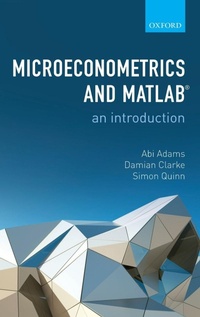
Microeconometrics and MATLAB: An Introduction
An Introduction
Published on 14. January 2016
Book
Hardback
214 pages
978-0-19-875449-7 (ISBN)
Description
This book is a practical guide for theory-based empirical analysis in economics that guides the reader through the first steps when moving between economic theory and applied research. The book provides a hands-on introduction to some of the techniques that economists use for econometric estimation and shows how to convert a selection of standard and advanced estimators into MATLAB code.
The book first provides a brief introduction to MATLAB and its syntax, before moving into microeconometric applications studied in undergraduate and graduate econometrics courses. Along with standard estimation methods such as, for example, Method of Moments, Maximum Likelihood, and constrained optimisation, the book also includes a series of chapters examining more advanced research methods. These include discrete choice, discrete games, dynamic models on a finite and infinite horizon, and semi- and nonparametric methods. In closing, it discusses more advanced features that can be used to optimise use of MATLAB, including parallel computing.
Each chapter is structured around a number of worked examples, designed for the reader to tackle as they move through the book. Each chapter ends with a series of readings, questions, and extensions, designed to help the reader on their way to adapting the examples in the book to fit their own research questions.
The book first provides a brief introduction to MATLAB and its syntax, before moving into microeconometric applications studied in undergraduate and graduate econometrics courses. Along with standard estimation methods such as, for example, Method of Moments, Maximum Likelihood, and constrained optimisation, the book also includes a series of chapters examining more advanced research methods. These include discrete choice, discrete games, dynamic models on a finite and infinite horizon, and semi- and nonparametric methods. In closing, it discusses more advanced features that can be used to optimise use of MATLAB, including parallel computing.
Each chapter is structured around a number of worked examples, designed for the reader to tackle as they move through the book. Each chapter ends with a series of readings, questions, and extensions, designed to help the reader on their way to adapting the examples in the book to fit their own research questions.
More details
Other editions
Additional editions
Abi Adams | Damian Clarke | Simon Quinn
Microeconometrics and MATLAB: An Introduction
E-Book
01/2016
1st Edition
OUP eBook
€64.49
Available for download
Abi Adams | Damian Clarke | Simon Quinn
Microeconometrics and MATLAB: An Introduction
E-Book
01/2016
1st Edition
OUP eBook
€64.49
Available for download
Persons
Abi Adams is an Associate Professor of Economics at the University of Oxford, a Research Fellow at the Institute of Fiscal Studies and a Cowles Foundation Postdoctoral Fellow. Her research focuses on consumer choice, with a particular interest in nonparametric methods and revealed preference theory.
Damian Clarke is a DPhil (PhD) student in economics at the University of Oxford, with research focusing on maternal and child health and education, fertility and family size, and applied microeconometrics. Damian has worked for a range of international organisations and government bodies in Latin America and in West Africa.
Simon Quinn is an Associate Professor of Economics and a Deputy Director of the Centre for the Study of African Economies at the University of Oxford. Simon's research interests lie primarily in the study of firms and development.
Damian Clarke is a DPhil (PhD) student in economics at the University of Oxford, with research focusing on maternal and child health and education, fertility and family size, and applied microeconometrics. Damian has worked for a range of international organisations and government bodies in Latin America and in West Africa.
Simon Quinn is an Associate Professor of Economics and a Deputy Director of the Centre for the Study of African Economies at the University of Oxford. Simon's research interests lie primarily in the study of firms and development.
Content
I: FOUNDATIONS; II: DISCRETE CHOICE; III: DYNAMICS; IV: NON-PARAMETRIC METHODS; V: SPEED