

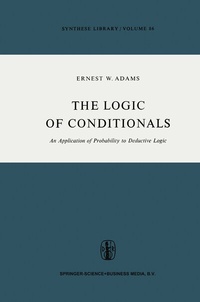
The Logic of Conditionals
An Application of Probability to Deductive Logic
Published on 25. December 2010
Book
Paperback/Softback
XIII, 161 pages
978-90-481-8343-2 (ISBN)
Description
Of the four chapters in this book, the first two discuss (albeit in consider ably modified form) matters previously discussed in my papers 'On the Logic of Conditionals' [1] and 'Probability and the Logic of Conditionals' [2], while the last two present essentially new material. Chapter I is relatively informal and roughly parallels the first of the above papers in discussing the basic ideas of a probabilistic approach to the logic of the indicative conditional, according to which these constructions do not have truth values, but they do have probabilities (equal to conditional probabilities), and the appropriate criterion of soundness for inferences involving them is that it should not be possible for all premises of the inference to be probable while the conclusion is improbable. Applying this criterion is shown to have radically different consequences from the orthodox 'material conditional' theory, not only in application to the standard 'fallacies' of the material conditional, but to many forms (e. g. , Contraposition) which have hitherto been regarded as above suspi cion. Many more applications are considered in Chapter I, as well as certain related theoretical matters. The chief of these, which is the most important new topic treated in Chapter I (i. e.
More details
Series
Edition
Softcover reprint of hardcover 1st ed. 1975
Language
English
Place of publication
Dordrecht
Netherlands
Target group
Professional and scholarly
Research
Illustrations
XIII, 161 p.
Dimensions
Height: 229 mm
Width: 152 mm
Thickness: 11 mm
Weight
270 gr
ISBN-13
978-90-481-8343-2 (9789048183432)
DOI
10.1007/978-94-015-7622-2
Schweitzer Classification
Other editions
Additional editions
Book
10/1975
Kluwer Academic Publishers
€53.49
Shipment within 15-20 days
Content
I. The Indicative Conditional.- II. Mathematical Theory of Probabilistic Consistency and Universal Probabilistic Soundness.- III. Motives for Wanting to Assure the Soundness of Reasoning: Truth and Probability as Desirable Attributes of Conclusions Reached in Reasoning.- IV. A Hypothesis Concerning Counterfactuals; Probability Change Aspects of Inference.- Index of Names.- Index of Subjects.